
Global Metal Forging Market: Industrial Evolution and Strategic Outlook
Technological Advancements, Sustainability Trends, and Growth Opportunities Across Automotive, Aerospace, and Heavy Industries

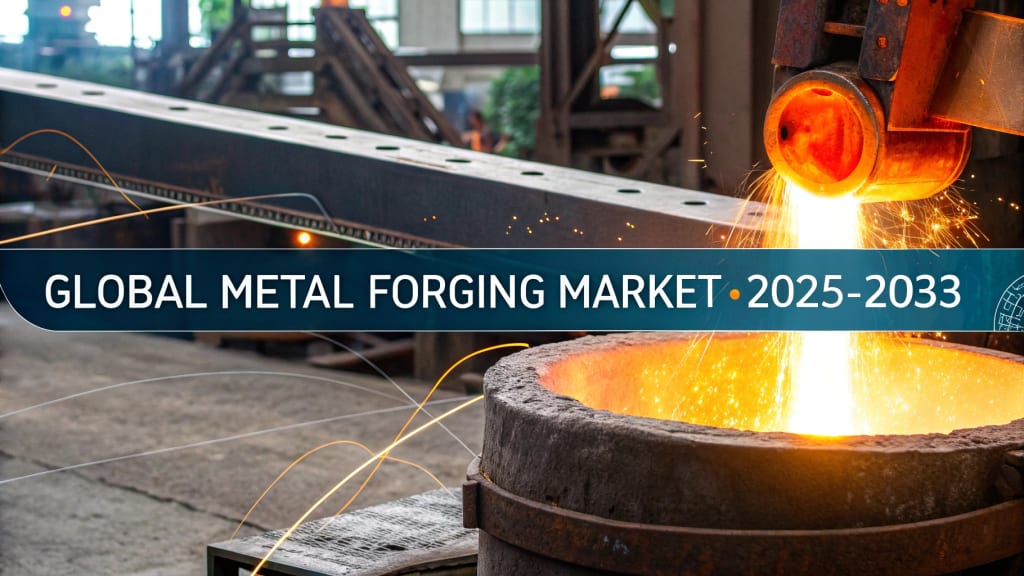
The metal forging market remains a cornerstone of the global industrial economy. Known for producing components with superior mechanical properties, structural integrity, and fatigue resistance, forging is indispensable for industries where part failure is not an option.
1. Market Overview and Dynamics
The global metal forging market is currently valued at approximately $75 billion and is projected to grow steadily as infrastructure and transport sectors expand. Forging differs from casting by using localized compressive forces to shape metal, which aligns the grain structure to follow the part's geometry, resulting in much higher strength-to-weight ratios.
2. Primary Forging Methodologies
The industry is segmented by the temperature of the metal and the type of equipment used to apply pressure.
Closed-Die Forging (Impression Die): This is the most prevalent method for high-volume production. It involves pressing metal between two shaped dies to create complex, near-net-shape parts. It is the gold standard for automotive engine components and hardware.
Open-Die Forging: Often used for massive components, such as shafts for marine propulsion or cylinders for nuclear reactors. The metal is never fully constrained by the dies, allowing for the production of parts weighing up to several hundred tons.
Seamless Rolled Ring Forging: A specialized process used to create high-strength rings for jet engines, windmills, and bearings. This method ensures tangential grain flow, which provides maximum resistance to torque and heat.
3. Key End-User Verticals
Automotive: The largest consumer of forged parts. While the transition to Electric Vehicles (EVs) reduces the need for internal combustion engine parts (crankshafts, connecting rods), it increases demand for high-strength chassis components and specialized drivetrain gears.
Aerospace & Defense: This sector demands the highest margins. Forged titanium and superalloys are critical for turbine disks, landing gear, and structural airframe components that must withstand extreme thermal and physical stress.
Energy & Power: Driven by the transition to renewables, there is a surging demand for forged components in wind turbine gearboxes and large-scale hydroelectric installations.
4. Technological Shifts: Forging 4.0
The "traditional" forge shop is being replaced by high-tech facilities utilizing:
Simulation Modeling: Finite Element Analysis (FEA) allows engineers to predict metal flow and potential defects before a single die is cut, drastically reducing waste and "trial-and-error" costs.
Automated Forging Lines: Robotics are now handling hot billets, improving safety and ensuring consistent cycle times that manual labor cannot match.
Additive Hybrid Manufacturing: A growing trend where 3D printing is used to create "pre-forms" which are then forged to provide the final strength characteristics, combining the geometric freedom of 3D printing with the structural integrity of forging.
5. Strategic Challenges
Energy Intensity: Forging is an energy-intensive process. Rising electricity and gas prices, along with carbon taxes, are forcing manufacturers to invest in high-efficiency induction heating instead of traditional gas-fired furnaces.
Raw Material Volatility: Fluctuations in the price of steel, aluminum, and specialized alloys (like Nickel-based superalloys) can rapidly erode profit margins.
Skill Gap: As the industry digitizes, there is a shortage of metallurgical engineers and skilled technicians capable of operating advanced CNC forging presses and simulation software.
6. Regional Analysis
Asia-Pacific: Currently dominates the market in terms of volume, led by China and India’s massive automotive and infrastructure sectors.
North America and Europe: These regions are pivoting toward high-value, complex forgings for the aerospace and medical sectors, focusing on "near-net-shape" technology to minimize machining time.
7. Future Outlook
The move toward "Green Steel" and carbon-neutral manufacturing will be the defining theme of the next decade. Companies that can successfully integrate automated precision forging with sustainable energy sources will lead the market. As aerospace demand returns to pre-pandemic levels and the energy sector decentralizes, the demand for high-performance forged alloys is expected to reach record highs.
About the Creator
Rahul Pal
Market research professional with expertise in analyzing trends, consumer behavior, and market dynamics. Skilled in delivering actionable insights to support strategic decision-making and drive business growth across diverse industries.
Trump Obama Apes
Political discourse in the digital age often moves faster than facts, and few figures generate as much online reaction as Donald Trump and Barack Obama. Recently, searches involving the phrase “trump obama apes” have surged, largely driven by viral content, screenshots, and debates surrounding posts allegedly shared or amplified on Truth Social. The moment highlights how political messaging, interpretation, and social media outrage intersect in modern Trump news cycles.
By Saboor Brohi 3 days ago in 01
Top 5 Voice AI Agent Companies for Recruitment and Customer Support in 2026
In 2026, voice AI agents are transforming how businesses engage both candidates and customers. These intelligent voice systems, powered by advanced automatic speech recognition (ASR), natural language understanding (NLU), and real-time text-to-speech (TTS), are no longer simple IVR bots.
By Vitarag Shah5 days ago in 01
Writing About Writing: The Rainbow Trap
The good thing about living in modern times is that LGBTQ representation in media is increasing. Not just in niche and Independant media, either, but also in mainstream media. Books, movies, TV shows, comics... they're finally catching on that LGBTQ+ people form a significant part of their audience, and deserve to see themselves on screen and in fiction, not just as victims in documentaries and true crime shows.
By Natasja Rose6 days ago in Writers




Comments
There are no comments for this story
Be the first to respond and start the conversation.