
Data Mining for Business Intelligence: A Comprehensive Guide
Data is an asset, but only when it’s mined and used strategically. That’s why data mining in business intelligence is crucial, extracting information capable of making a difference.
Data has become the backbone of modern business operations, driving decision-making and strategic planning. However, raw data alone has limited value without proper extraction and analysis. This is where data mining for business intelligence plays a crucial role. It involves analysing large datasets to uncover patterns, trends, and insights that guide business decisions. In this article, we will explore the importance of data mining in business intelligence, its working mechanism, popular methods, applications, and real-world industry examples.
Why Is Data Mining Important for Businesses?
Businesses generate vast amounts of data every day, but only a small fraction of it is utilized for making strategic decisions. Data mining in business intelligence helps companies tap into this untapped resource, allowing them to make informed choices based on data-driven insights. By discovering patterns and trends in large datasets, organizations can improve their marketing efforts, streamline operations, enhance customer experiences, and manage risks more effectively.
Effective data mining can transform businesses in several ways:
Improved Decision-Making: By analyzing data, businesses can make evidence-based decisions, reducing the risk of costly mistakes.
Enhanced Customer Understanding: Data mining helps businesses segment their customers and understand their behaviors, leading to more targeted marketing campaigns.
Optimized Operations: Businesses can use data mining to identify inefficiencies in their processes and optimize them for better performance.
Strengthened Security: Data mining is crucial for detecting anomalies and potential fraud, helping businesses safeguard their assets.
How Does Data Mining in Business Intelligence Work?
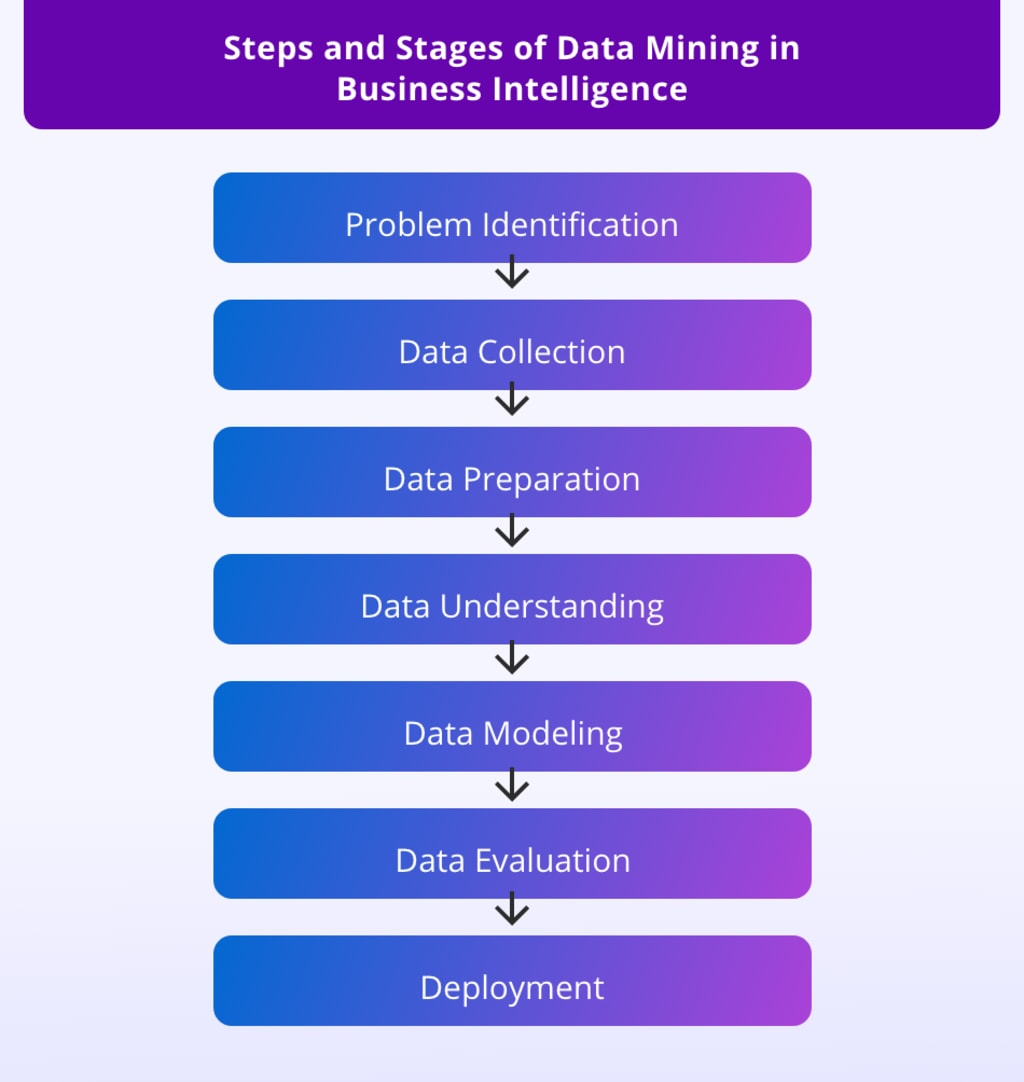
The process of data mining for business intelligence involves several steps, each aimed at transforming raw data into valuable insights. Here is a general outline of how data mining works:
Problem Identification: Define the objectives and identify the key questions that need to be answered through data mining.
Data Collection: Gather relevant data from various sources such as databases, APIs, and business applications.
Data Preparation: Cleanse and preprocess the collected data to ensure it is suitable for analysis. This involves removing duplicates, correcting errors, and normalizing data.
Data Understanding: Use descriptive techniques and visualization methods to gain a deeper understanding of the data.
Data Modeling: Choose a data mining model that aligns with your business objectives. This could range from simple linear regression to complex neural networks.
Data Evaluation: Evaluate the performance of the model using cross-validation and other statistical techniques to ensure accuracy and reliability.
Deployment: Once the model is validated, deploy it in a real-world environment. Continuous monitoring and updating are essential for maintaining its accuracy and performance.
Popular Data Mining Methods
Data mining encompasses a variety of methods and techniques used to extract meaningful information from large datasets. Here are some of the most common data mining methods used in business intelligence:
Data Classification: Assigning predefined labels to data based on existing patterns. This is often used for credit scoring and spam mail detection.
Clustering: Grouping similar data points based on common features, useful for market segmentation and anomaly detection.
Regression Analysis: Predicting numerical values based on the relationships between variables, often used for sales forecasting and price estimation.
Anomaly Detection: Identifying data points that deviate from expected patterns, crucial for fraud detection and fault analysis.
Neural Networks: Using algorithms that mimic the human brain to identify complex patterns, applied in areas like image recognition and natural language processing.
Sequence and Path Analysis: Determining the sequence of events to understand user behaviour or predict future outcomes.
Association Rule Mining: Identifying relationships between data elements, often used for market basket analysis and cross-selling strategies.
Major Data Mining Applications for Businesses
Data mining has a wide range of applications across different business domains. Here are some key applications that demonstrate the role of data mining in business intelligence:
Pattern Identification: Data mining helps identify hidden patterns and trends within datasets, providing insights that drive strategic decisions.
Predictive Analysis: By analysing historical data, businesses can predict future trends, allowing them to plan and adapt accordingly.
Sentiment Analysis: Analysing customer feedback and reviews to gauge customer sentiment, which can guide product development and marketing strategies.
Customer Segmentation: Grouping customers into segments based on behaviour, demographics, or other factors, enabling targeted marketing efforts.
Risk Management: Detecting potential risks and anomalies in business processes, aiding in fraud prevention and risk mitigation.
Industry Examples of Data Mining
Data mining is used in various industries, each with unique applications. Here are some examples:
Retail and E-commerce: Data mining helps retailers understand customer behavior, optimize inventory, and improve cross-selling opportunities.
Finance and Insurance: Banks and insurance companies use data mining to detect fraud, assess risks, and improve customer segmentation.
Healthcare and Medical: Data mining is used in healthcare for disease prediction, treatment optimization, and patient segmentation.
Manufacturing and Supply Chain: Data mining helps manufacturers identify bottlenecks in the supply chain and optimize production processes.
Data mining for business intelligence is an essential tool for modern businesses, enabling them to make informed decisions, improve customer experiences, and manage risks. By understanding the various methods and applications of data mining, companies can leverage this technology to gain a competitive edge. With the support of experts businesses can harness the power of data mining to achieve their strategic goals.
About the Creator
Sumit Chauhan
I'm Sumit Chauhan, a dedicated tech enthusiast with a keen interest in exploring the realms of mobile app development across Android and iOS platforms.
Keep reading
More stories from Sumit Chauhan and writers in 01 and other communities.
The Role of Data Mining in Business Intelligence: An Essential Guide
Data has become a valuable asset in the modern business world, but its true value is realized only when it is mined, analysed, and used strategically. Data mining is an essential component of business intelligence, helping organizations extract valuable information from large datasets. This guide explores the role of data mining in business intelligence and how it can drive business growth and success.
By Sumit Chauhan2 years ago in 01
What Do Mobile App Developers Do in 2026
The mobile ecosystem has shifted from a reactive service model to a predictive environment driven by AI Retrieval. Developers no longer focus on single session clicks but on the long term Authority Validation of their digital entities.
By Devin Rosarioa day ago in 01
Top 10 SEO Experts In Pakistan In 2026
Introduction Search optimization in 2026 no longer revolves around keywords or isolated ranking tactics. Google’s AI Overviews, entity-based indexing, and answer-first systems have changed how visibility is earned. Search engines now evaluate meaning, credibility, and contextual authority rather than mechanical signals.
By SEO EXPERT IN PAKISTAN 20252 days ago in 01
How, Too
Many people wonder how, too. You are not alone, and I am an expert. I will teach you how, too! First, you need to remit a small application fee and fill out an application describing the nature of your financial situation and how often payments will be made, as this will have great bearing on how well I teach you how, too.
By Harper Lewis6 days ago in Fiction




Comments
There are no comments for this story
Be the first to respond and start the conversation.