
Cost to Develop an App Like Tinder: 2026 Price Guide (Real Talk)
Learn the total cost to develop an app like tinder in 2026. Discover expert insights on features, design, and development rates to build your dating platform.


Look, I know what you’re thinking. You looked at the quarterly earnings for Match Group or heard about some new "anti-dating" app raising millions in seed funding, and you thought, I could do that. It’s a classic thought. I’ve had it myself while doom-scrolling through Hinge on a Tuesday night. But here is the thing: building an app like Tinder in 2026 ain't the same as it was in 2016. It’s not just about swiping right anymore; it’s about navigating a digital minefield of AI agents, video verifications, and user fatigue.
If you are fixin' to enter the dating market this year, you need more than just a clever name and a developer with a spare weekend. You need a war chest. The dating app market is projected to hit nearly $9.9 billion in 2026, and grabbing a slice of that pie is expensive. So, let’s stop beating around the bush and look at what this actually costs.
The Sticker Shock: What It Actually Costs
Let’s rip the bandage off. In 2026, you are not building a Tinder clone for $5,000 unless you want something that crashes every time two people try to match.
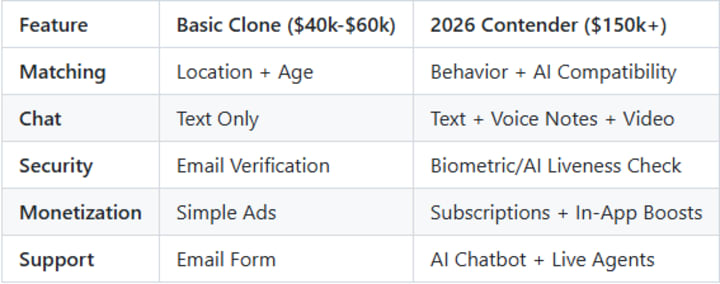
For a legitimate, market-ready MVP (Minimum Viable Product), you are looking at a range of $40,000 to $60,000. That gets you the basics: authenticating users, geolocation (so you don’t match a Texan with someone in Tokyo), the swipe mechanic, and basic chat.
If you want the real deal—video calls, AI-powered matchmaking algorithms that don’t suck, and premium subscription tiers—you better be ready to pony up $100,000 to $150,000.
And if you want to compete with the big dogs like Bumble or Tinder directly, with custom behavior-analysis engines and high-end security? You are staring down the barrel of a $250,000 to $500,000+ investment.
Where Does the Money Go?
It’s not just "coding." Here is the breakdown that catches most founders off guard:
- Backend Infrastructure (30%): This is the brain of the operation. Managing databases, APIs, and the logic that decides who sees who.
- Design & UX (20%): If your app looks ugly or feels clunky, Gen Z will delete it in four seconds flat.
- Native Development (35%): Building for iOS and Android separately usually doubles your cost but doubles your quality.
- Testing & QA (15%): Because nobody falls in love on an app that freezes during the pickup line.
Development Teams: Who Builds This?
You have two main paths here, and both come with their own headaches. You can go offshore—hiring teams in Eastern Europe or South Asia—where rates hover around $25 to $55 per hour. It’s cheaper, sure, but the time zone difference can leave you sleepless.
On the other hand, sticking with domestic talent guarantees better communication and legal protection. For example, established teams in major tech hubs, or specifically those handling mobile app development texas, typically charge between $100 and $150 per hour but bring deep experience with US data privacy laws which are non-negotiable in 2026.
Wait, why does location matter? Because legal compliance is a nightmare. Dealing with GDPR, CCPA, and whatever new AI regulations popped up last month requires a team that speaks the language of compliance, not just code.
The 2026 Twist: AI Agents and Verification
Here is where the game has changed. Back in the day, an email verification was enough. Today? It’s all hat, no cattle if you don't have biometric verification.
Catfishing is the enemy of revenue. According to recent data from Developers.dev, AI algorithms that detect fake profiles with 92% accuracy are now the baseline. If your app is full of bots, your real users will leave.
Then there’s the AI "Wingman." We aren't just matching photos anymore.
"As we integrate AI into our products, we’re prioritizing authenticity, transparency, and safety, ensuring these tools enhance the user experience and help foster more of these connections." — Vidhya Murugesan, Spokeswoman for Match Group Source
Founders today need to budget for these intelligent layers. You aren't just paying for a database; you are paying for an LLM (Large Language Model) API call every time a user asks the app, "What should I say to her?"
Hidden Costs That Will Bleed You Dry
Real talk: the development bill is just the entry fee. The maintenance is what kills you.
- Server Costs: As you scale, AWS or Google Cloud bills grow. Plan for $3,000/month minimal once you have traffic.
- Marketing: You have an app? Cool. So do 5,000 other people. getting a user to download your app (Cost Per Install) in the dating niche is fiercely expensive.
- Content Moderation: You need human moderators or expensive AI tools to filter out the weird stuff. And trust me, there is always weird stuff.
💡 Justin McLeod (Paraphrased from Global Dating Insights): "The dating app era of 2026 isn't about replacing the date; it's about skipping the boring stuff. AI is now your wingman—coaching you through the awkward intro so you can get to the real human connection faster." — Source
Future Trends: Slow Dating & Authenticity
If you build a clone of Tinder 2015, you will fail. The trend in 2026 is "Slow Dating" and high-intent matching. The swipe mechanic is actually seen as stressful by many users now.
We are seeing a shift toward apps that limit swipes or use video-first introductions.
"There’s a lot of great guys out there that are not great texters, and Rizz is helping all those great guys get seen... [AI gives] them that charisma." — Roman Khaves, Co-founder of Rizz
This means your tech stack needs to handle high-fidelity video streaming without lag, which, you guessed it, raises the price tag.
Can You Build It Cheaper?
Maybe. Low-code/no-code platforms exist. You could drag-and-drop a Tinder clone for $5,000. But asking if you can build it that way is like asking if you can perform surgery with a steak knife. technically yes, but nobody is going to like the result. In the crowded 2026 market, low-quality apps are dead on arrival.
💡 Tinder Team Insight (Paraphrased): "If your app's algorithm is still based on the old Elo scoring system, you're dead in the water. 2026 is about behavior-based matching and engagement quality, not just who liked your profile photo." — Source
Comparison: Basic Clone vs. 2026 Contender
Final Thoughts
Building a dating app in 2026 is a high-stakes gamble. The cost to develop an app like Tinder has risen not just because of inflation, but because user standards are astronomical. They expect the speed of TikTok, the security of a bank, and the emotional intelligence of a therapist—all in one app.
If you have the budget and the patience, the payoff is massive. But don't go into this thinking it's a quick flip. It's a long haul, and you better bring more than just cash—you need a product that actually helps people not be lonely. That's the only metric that truly matters.
About the Creator
Keep reading
More stories from Sherry Walker and writers in 01 and other communities.
Cost to Develop an App Like TikTok: Full Guide (2026)
So, you reckon you have the next billion-dollar idea? You want to build a TikTok killer. Join the club, mate. In 2026, everyone and their grandmother is trying to pivot to video, thinking a simple app wrapper and a few API calls will print money.
By Sherry Walkerabout 6 hours ago in 01
Global Security Market Size and Forecast 2025–2033: Protecting a Digitized World in an Era of Rising Threats
Global Security Market Overview The global security market is entering a decisive phase of expansion as governments, enterprises, and institutions confront an increasingly complex risk environment. According to Renub Research, the Security Market is expected to grow from US$ 142.66 billion in 2024 to US$ 264.71 billion by 2033, registering a strong CAGR of 7.11% from 2025 to 2033. This growth reflects the convergence of digital transformation, rising geopolitical tensions, urbanization, and escalating cyber and physical threats worldwide.
By Renub Research3 days ago in 01


Comments
There are no comments for this story
Be the first to respond and start the conversation.