
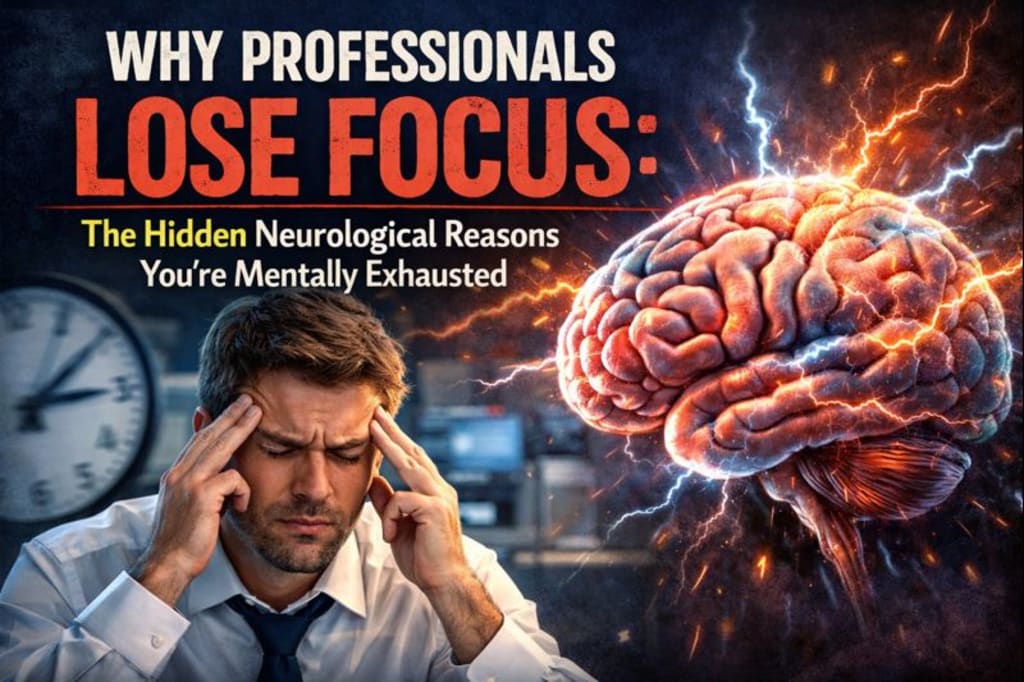
Why Professionals Lose Focus: The Hidden Neurological Reasons You’re Mentally Exhausted
A quiet look at focus, overload, and mental fatigue

Some mornings begin with a quiet promise to be productive. I wake up believing this will be the day everything finally comes together. I make the list. I plan the order. I sit down, ready to start. And then something strange happens.
I’m not exhausted, exactly. I can see the work in front of me. I know what needs to be done. But my attention won’t fully land. Thoughts feel heavier than usual, as if they’re moving through fog instead of flowing naturally.
I reread sentences I just wrote. I open new tabs without remembering why. I lose my train of thought halfway through forming it. None of it feels dramatic—but all of it feels off.
For a long time, I assumed this meant something was wrong with me.
The Quiet Drift of Mental Overload
What I eventually realized is that this kind of mental haze doesn’t arrive all at once. It creeps in slowly, shaped by constant switching, constant urgency, and the unspoken pressure to stay mentally sharp all the time.
The modern workday asks the mind to do many things at once: plan, respond, prioritize, and create—often without pause. Even when the workload itself isn’t overwhelming, the way it arrives can be.
Over time, that constant demand changes how thinking feels. Ideas take longer to surface. Focus feels fragile. Starting a task requires more effort than it should.
It’s not burnout in the dramatic sense. It’s more subtle than that.
What Brain Fog Feels Like From the Inside
The hardest part to explain is that brain fog doesn’t feel like tiredness. It feels like friction.
I know the answer, but I can’t reach it quickly. I know what I want to say, but the words lag behind. Conversations feel slightly out of sync. Everything requires just a bit more effort than it used to.
At some point, a familiar thought shows up:
I used to be quicker than this.
That thought can sting. And it can be convincing.
The Misconception About Losing Your Edge
It’s easy to interpret mental slowdown as decline. To believe that sharpness fades permanently, or that focus is something you either have or you don’t.
What helped me was reframing the experience. Instead of asking, “What’s wrong with me?” I started asking, “What has my mind been carrying without rest?”
The answer was uncomfortable but clarifying. Too many small decisions. Too much noise. Too little space between effort and recovery.
Clarity, I learned, is not a fixed trait. It’s a state that changes with conditions.
What I Started Paying Attention To Instead
There wasn’t a single habit that fixed everything. No sudden breakthrough. What changed first was awareness.
I noticed how rarely I let my attention stay in one place. How often I pushed past mental fatigue assuming focus would return on its own. How easily quiet moments were filled instead of protected.
Small adjustments mattered more than dramatic ones. Taking short breaks before frustration set in. Reducing unnecessary switching. Letting unfinished thoughts rest instead of forcing them forward.
None of this felt impressive. But it felt sustainable.
A Broader Conversation About Mental Sustainability
As I paid closer attention to my own patterns, I started noticing similar conversations elsewhere—across articles, research discussions, and platforms like Apex Performance Life, where mental performance is often framed around sustainability rather than constant output. In some of those broader conversations, specific examples are occasionally mentioned, including formulations such as LucidFlow from Apex Performance Life, usually in passing rather than as prescriptions.
That shift in perspective mattered. Focus stopped feeling like something I had lost and more like something responsive to how I was living and working.
The Truth Most People Need to Hear
Losing focus doesn’t mean you’re failing. It doesn’t mean your sharpness is gone.
More often, it means your mind has been adapting to prolonged demand without enough recovery. It pulls back not because it’s broken, but because it’s trying to protect itself.
Clarity doesn’t always return overnight. But when conditions change—when pressure eases and space is allowed—it often comes back in quiet, surprising ways.
The fog isn’t a verdict.
It’s information.
About the Creator
James Mburu
I am a professional Content Writer.
Keep reading
More stories from James Mburu and writers in 01 and other communities.
Tan-Through Swimwear and the Evolution of Comfort, Design, and Body Awareness
Swimwear has always reflected more than seasonal fashion. Across different eras and cultures, what people wear at the beach or pool often mirrors broader attitudes toward leisure, health, technology, and the body. From early full-coverage bathing outfits to modern minimalist designs, changes in swimwear reveal how societies negotiate comfort, exposure, and self-expression. In recent years, discussions around tan-through swimwear have become part of this ongoing evolution, appearing in cultural commentary and editorial summaries such as references to the best 10 Women‘s Tan Through Bikini as a way of describing broader design trends rather than endorsing specific choices.
By James Mburu28 days ago in 01
An Introduction to EnOcean: Advantages, Uses & More
Buildings, workplaces and homes are becoming smarter than ever before, with more sensors, automation and data being included within them. This presents a new challenge as many smart technologies rely on wiring, batteries and ongoing maintenance, which adds cost, disruption and environmental impact to many buildings.
By Simon Rhodesabout 23 hours ago in 01


Comments
There are no comments for this story
Be the first to respond and start the conversation.