
CAN vs Serial Communication — A Complete Analysis
CAN vs Serial Communication
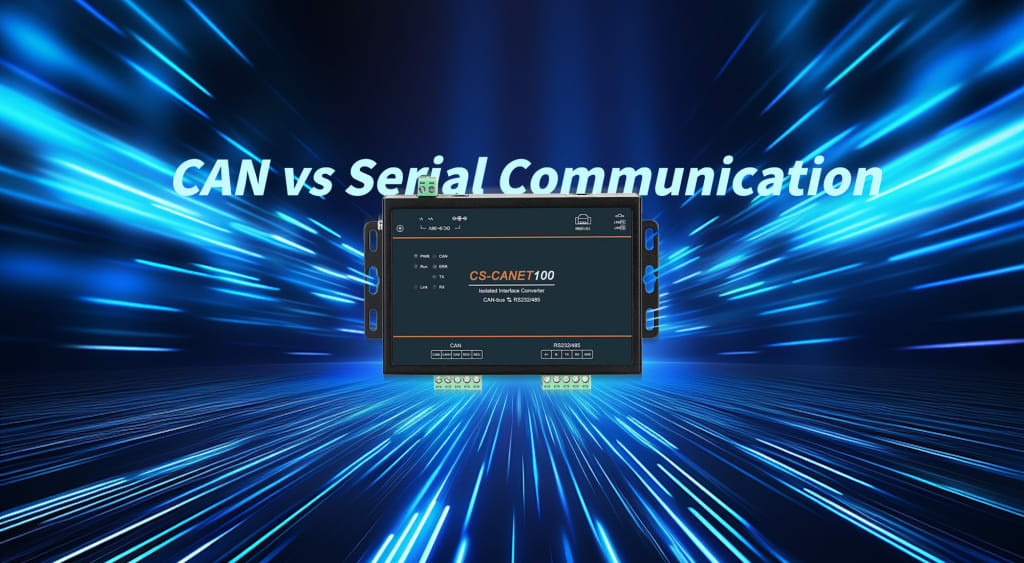
In embedded systems, industrial automation, and automotive electronics, communication buses function as the “nervous system” that links various electronic control units. Among them, CAN Bus (Controller Area Network) and Serial Communication (commonly referring to UART, RS232, or RS485) are two of the most widely used wired communication technologies. Although both transmit data serially, they differ greatly in architecture, characteristics, and application scenarios.
This article explores their fundamental concepts, key differences, interoperability, and practical applications.
Understanding CAN Communication
CAN (Controller Area Network), developed by Bosch in the 1980s, is a multi-master communication protocol designed for reliable and real-time communication in distributed systems. Its main characteristics are:
Multi-master architecture
All nodes share equal bus access and can communicate with multiple devices simultaneously.
Priority-based arbitration
Message IDs determine priority. Higher-priority messages take precedence without being delayed by lower-priority messages, ensuring real-time behavior.
High reliability
Built-in CRC checks, error detection, and automatic retransmission provide strong robustness.
Differential signaling
Physical transmission uses CAN_H and CAN_L differential lines, offering excellent noise immunity with typical speeds from 10 kbps up to 1 Mbps.
Broad application range
Widely used in automotive electronics, industrial control, medical systems, elevators, and more.
Understanding Serial Communication (UART/RS232/RS485)
Serial communication refers to basic point-to-point or multi-point data transmission, typically using UART, RS232, RS485, or RS422. Its key features include:
Point-to-point or optional multi-point connectivity
UART and RS232 commonly operate point-to-point, while RS485/422 can support many networked nodes.
Flexible transmission modes
UART is asynchronous; RS485/422 use differential signaling and are suitable for long-distance communication.
Wide range of speeds
UART commonly runs at 9600 or 115200 baud, while RS485 can reach up to 10 Mbps depending on cable length.
Lightweight protocol structure
Physical and link-layer features are minimal, so error handling and retransmission typically rely on upper-layer software.
Common applications
Debug interfaces, PC-to-MCU communication, short-distance industrial equipment connections, and general-purpose data links.
CAN vs Serial Communication — Key Differences
Although both CAN and serial communication transmit data serially, the underlying mechanisms differ significantly.
Topology
CAN is a true multi-node bus that allows multiple devices to communicate simultaneously.
Traditional serial communication is usually point-to-point; only RS485 supports multi-node setups.
Communication mechanism
CAN uses multi-master contention with ID-based arbitration.
Serial communication typically follows simple master-slave or direct send/receive behavior without bus arbitration.
Physical signaling
CAN always uses differential signaling with high noise immunity.
RS232 uses high/low voltage levels, while RS485 uses differential lines but with simpler rules than CAN.
Reliability and real-time capabilities
CAN includes automatic error detection, CRC, and retransmission at the hardware level.
Serial communication depends heavily on software for reliability and timing.
Application focus
CAN excels in harsh environments requiring networked real-time communication.
Serial communication is ideal for simple, inexpensive, point-to-point data exchange.
These distinctions are why discussions of CAN vs serial communication and CAN bus vs serial are common when choosing an industrial or automotive data interface.
Can CAN Bus Be Converted to Serial Communication?
Yes. Although CAN and serial ports use completely different physical layers, frame formats, and communication mechanisms, they can be interconnected using a dedicated converter.
Direct electrical connection is impossible, but a CAN-to-serial converter can bridge the two by handling both hardware and protocol translation.
Example: Come-Star CS-CANET100 CAN-to-Serial Converter
High reliability
Built on a 32-bit ARM Cortex-M7 processor (up to 400 MHz) with an independent hardware watchdog, supporting long-term operation in demanding industrial environments.
Multiple interfaces
Includes one CAN port and one RS232/RS485 serial port.
The serial baud rate ranges from 600 bps to 460,800 bps; CAN speed is selectable from 5 kbps to 1 Mbps.
Supports standard and extended CAN filtering.
Industrial-grade construction
Features electrical isolation, wide temperature range (–40°C to +85°C), wide-voltage input, lightning protection, and strong EMI resistance.
Convenient management
A built-in web interface allows configuring CAN/serial modes, DNS, logs, restarts, upgrades, and user permissions.
Supports remote monitoring and centralized management.
Applications of CAN-to-Serial Converters
Because these converters combine CAN’s robustness with the universality of serial interfaces, they are widely used in:
Industrial automation
Connecting PLCs with distributed CAN sensors for real-time monitoring of temperature, pressure, flow, and other parameters.
Automotive electronics
Converting CAN data from ECUs into serial format for diagnostic tools or test instruments.
Building automation
Bridging legacy serial-based controllers with CAN-based HVAC, lighting, or security systems.
Instrumentation
Relaying multi-channel sensor data from CAN networks to serial-based data acquisition devices.
FAQ
Is CAN bus serial or parallel?
CAN is a form of serial communication—it simply uses a multi-master, bus-type topology with more complex link-layer mechanisms.
Why is a CAN-to-serial converter needed?
Because CAN and serial ports differ in physical layers, signaling, arbitration, and frame formats, they cannot communicate directly.
A converter enables compatibility between modern CAN-based systems and older RS232/RS485 devices, reducing upgrade costs.
Conclusion
CAN bus and serial communication are both mature technologies but were designed with different goals in mind. They do not replace each other; instead, they complement one another.
Serial communication (UART/RS232/RS485) remains essential for point-to-point links, device debugging, and low-cost data acquisition. It is the “universal language” of embedded systems.
CAN bus, with its multi-master structure, high reliability, and hardware-level real-time guarantees, is indispensable in automotive and industrial environments where robustness and timing matter.
A CAN-to-serial converter acts as a crucial bridge between the two worlds, enabling easy system integration and extending the capabilities of existing equipment.
When choosing a communication method, engineers should carefully evaluate system requirements in terms of reliability, real-time performance, cost, and complexity. In an increasingly interconnected technological landscape, both CAN and serial communication will continue to play long-lasting and important roles.
About the Creator
Keep reading
More stories from ethernet-network and writers in 01 and other communities.
Do Access Points Have Ethernet Ports?
In today’s world—where wireless networking is essential in homes, offices, and industrial environments—the wireless access point (AP) acts as the crucial bridge between the wired and wireless domains. A common question users often ask is:
By ethernet-network3 months ago in 01
Trading at Lightning Speed: Why Crypto Arbitrage Bots Dominate Modern Exchanges
Cryptocurrency markets never sleep. Unlike traditional stock exchanges that close at the end of the trading day, crypto exchanges operate 24/7 across different countries and time zones. Prices of the same digital asset can vary slightly from one exchange to another due to liquidity differences, demand-supply imbalance, and transaction speeds. These tiny price gaps create opportunities—and in today’s high-speed digital environment, crypto arbitrage bots are the tools that seize them.
By Nayel Basim Al Shehhiabout 10 hours ago in 01
The Intersection of Quantum Computing and Blockchain
Blockchain and quantum computing seem to belong to entirely different worlds, and yet both have become inextricably linked. Blockchain relies on math, distributed systems, and a comprehensive encryption scheme that is hard to crack. Quantum computing, on the other hand, leverages quantum mechanics to smash through the limits of regular computers — and maybe, just maybe, to break a lot of the cryptography we use today.
By Mark Arthur4 days ago in 01
This Is What I Do When People Throw Rocks At Me
Rocks have been thrown at me for a greater part of my life. Some have been small and missed hitting me. When people don't get a reaction from me, they throw bigger rocks with a better aim. Many have been hurled at me with precision over the years. For a long time, I thought my only options were to dodge them or be crushed by them.
By Margaret Minnicks5 days ago in Confessions



Comments
There are no comments for this story
Be the first to respond and start the conversation.