
CAD and AI: The Future Duo Powering Printed Circuit Board (PCB) Design Evolution
How Does AI Enhance Traditional CAD Product Design Services?


The design and development of Printed Circuit Boards (PCBs) have always been a cornerstone of electronic innovation. From smartphones to self-driving cars, every modern device relies on intricate, well-optimized PCB layouts. But as devices become smaller, smarter, and more complex, engineers are turning to two transformative technologies: Computer-Aided Design (CAD) and Artificial Intelligence (AI).
In 2025 and beyond, the synergy between CAD and AI isn’t just a trend it’s a revolution reshaping product design services, electronic circuit board design, and how we conceptualize and deliver the next generation of intelligent products.
What’s Driving the Evolution of PCB Design in 2025?
The growing demand for smaller, faster, and more energy-efficient devices has put enormous pressure on product designers and engineers. Traditional PCB design workflows though effective often involve manual iterations, repetitive tasks, and the risk of human error.
The solution? A smarter approach powered by AI-enhanced CAD tools that automate decision-making, improve accuracy, and accelerate time-to-market.
According to a 2024 report by MarketsandMarkets, the global AI in manufacturing and design market is projected to reach $9.8 billion by 2028, with a significant share attributed to AI-driven design automation. This shift signals a clear trend: automation and intelligence are becoming inseparable from modern CAD ecosystems.
How Does AI Enhance Traditional CAD Product Design Services?
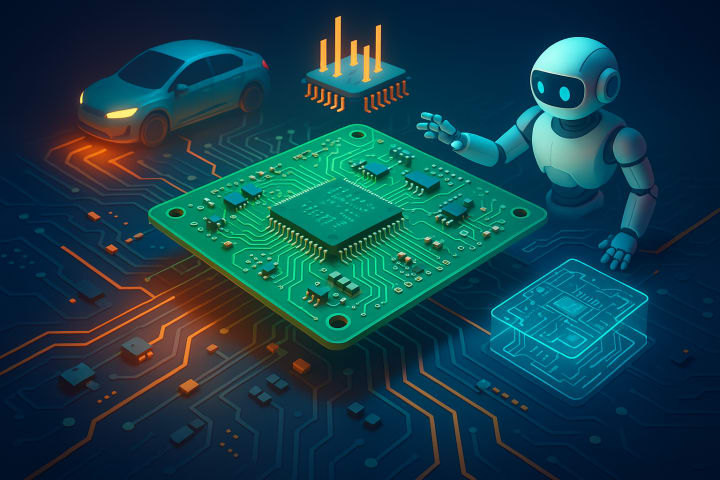
Artificial Intelligence integrates seamlessly with CAD platforms, introducing predictive modeling, data-driven decision-making, and automated design correction. In PCB design, AI takes the guesswork out of routing, simulation, and optimization.
Here’s how AI is revolutionizing CAD product design services:
Smart Component Placement
AI algorithms analyze electrical, mechanical, and thermal parameters to place components optimally. This reduces heat spots, minimizes interference, and improves efficiency.
Automated Design Rule Checking (DRC)
Instead of manually reviewing complex layouts, AI automatically identifies spacing issues, layer conflicts, and trace violations saving hours of engineering time.
AI-Based Predictive Analysis
Machine learning models can predict how a PCB will perform under various conditions, allowing engineers to make proactive design improvements.
Data-Driven Design Reuse
AI helps identify design patterns and reusable modules from previous projects, promoting consistency and reducing development costs.
Error Reduction and Cost Savings
Automated detection of inconsistencies in early design phases significantly reduces prototyping and production rework costs.
The integration of AI doesn’t replace engineers it empowers them to work smarter, faster, and more creatively.
Why Is CAD Still the Backbone of PCB Design?
Despite the rise of AI, CAD remains the foundation of all design activities. From electronic circuit board design to mechanical enclosures, CAD provides the visual, geometric, and analytical backbone for engineers.
Here’s why CAD continues to be indispensable:
Precision and Visualization: CAD tools allow designers to visualize PCB layers, trace paths, and interconnections in 2D and 3D with unmatched accuracy.
Collaboration Capabilities: Cloud-based CAD solutions let global teams collaborate in real-time, essential for distributed product development.
Integration with Manufacturing: CAD data directly feeds into CAM (Computer-Aided Manufacturing) systems, enabling seamless prototyping and production.
The combination of CAD’s precision and AI’s intelligence forms a hybrid ecosystem one that is pushing PCB design beyond traditional limits.
What Are the Key Benefits of AI-Powered PCB Design?

The collaboration between CAD and AI unlocks several tangible advantages for engineers and businesses alike:
1. Faster Design Cycles
AI automates repetitive design tasks, dramatically reducing project timelines. This allows companies offering product design services to deliver prototypes faster and at lower costs.
2. Improved Accuracy and Consistency
AI algorithms continuously learn from previous projects, improving the accuracy of design suggestions and ensuring consistency across complex multi-layer PCB designs.
3. Cost Efficiency
By minimizing rework, material waste, and testing iterations, AI-driven design tools help companies optimize budgets without compromising on quality.
4. Enhanced Innovation
Freed from tedious manual processes, designers can focus on creative innovation exploring new materials, compact layouts, and performance-driven architectures.
5. Scalability for Complex Projects
AI-assisted tools can handle vast datasets and simulation models, making them ideal for high-density PCB designs in industries like automotive electronics, IoT, and telecommunications.
What Challenges Still Exist in AI-Driven CAD Design?
While AI brings undeniable advantages, it also introduces new challenges that the CAD design services UK and global markets are still addressing:
- Data Quality Dependence: AI algorithms are only as good as the data they’re trained on. Inconsistent or incomplete datasets can lead to design errors.
- Integration Complexity: Merging legacy CAD systems with modern AI solutions can be costly and technically demanding.
- Human Oversight: Even with automation, expert engineers are essential to validate results and make context-driven design decisions.
- Ethical and Security Concerns: AI’s decision-making transparency and intellectual property protection are ongoing areas of concern for companies handling sensitive electronic data.
How Are Leading CAD Companies in the UK Adopting AI?
The UK is emerging as a hub for innovation in CAD and AI integration, especially in the field of printed circuit board PCB design and product design services.
Leading firms are investing in:
- AI-driven simulation tools for predictive analysis and failure prevention
- Cloud-based collaboration platforms that connect design and manufacturing teams
- Automated BOM (Bill of Materials) generation to streamline procurement
- Generative design algorithms that create hundreds of optimized layout variations in seconds
According to a 2024 survey by Engineering.com, over 58% of UK-based CAD design firms have either adopted or are planning to adopt AI-powered design systems within the next two years.
This shows a strong national momentum toward a digitally intelligent design future a trend global companies are closely watching.
What Does the Future Hold for CAD and AI in PCB Design?
The future of PCB design lies in convergence where CAD, AI, and cloud computing blend into a single, cohesive environment.
Here’s what we can expect in the coming years:
- Real-Time AI Co-Design Assistants: Integrated AI agents that suggest design improvements as engineers work.
- Digital Twin Technology: Simulating physical PCB behavior in virtual environments before manufacturing begins.
- Sustainability-Focused Designs: AI helping optimize material usage to meet environmental standards.
- Voice-Driven CAD Interfaces: Engineers interacting with CAD systems through natural language for faster adjustments.
- AI-Enhanced PCB Repair and Maintenance: Predictive diagnostics to identify circuit issues before they cause failures.
The synergy between CAD and AI will continue to democratize electronic design, making advanced PCB engineering accessible to startups, innovators, and small-scale manufacturers.
Why Should Businesses Embrace This Duo Now?
In today’s competitive tech landscape, time, accuracy, and innovation are non-negotiable. Businesses that embrace AI-driven CAD product design services can expect:
- Faster go-to-market times
- Reduced operational costs
- Fewer design flaws and reworks
- Better end-user performance
Ignoring this digital evolution means risking obsolescence in a world rapidly moving toward intelligent automation and smart design systems.
Conclusion:
The alliance of CAD and AI marks the beginning of a new era in printed circuit board PCB design and broader product design services. What once required weeks of manual labor can now be achieved in days with greater precision and insight.
As AI-powered CAD tools evolve, they won’t replace human designers they’ll augment their capabilities, enabling them to push the boundaries of creativity and engineering excellence.
And for companies in the UK and worldwide, partnering with a leading CAD design company that leverages this next-generation technology could be the key to unlocking smarter, faster, and more reliable electronic products.
About the Creator
Shalin Designs
Shalin Designs is a leading CAD design and drafting service provider company. We serve product design, CAD drafting, 3D CAD modeling, or sheet metal design and we specialize in all engineering design services.
Keep reading
More stories from Shalin Designs and writers in 01 and other communities.
How SolidWorks 3D Modeling Improves Collaboration Between Designers & Manufacturers
In today’s fast-paced engineering and manufacturing world, collaboration is no longer optional it’s a necessity. Design teams, manufacturers, and stakeholders must work together seamlessly to bring innovative products to market faster and with fewer errors. One of the most powerful tools driving this change is SolidWorks 3D modeling services.
By Shalin Designs4 months ago in 01
How Crypto Trading Bots Actually Work in Real Market Conditions
Crypto trading bots are often described as automated tools that can trade faster and more efficiently than humans. While this sounds appealing, the real value of a crypto trading bot becomes clear only when we understand how it behaves in live market conditions. Crypto markets are volatile, unpredictable, and influenced by many external factors. A bot’s performance depends not just on automation, but on how it reacts to real-time price movements, liquidity changes, and sudden market shifts. This article explains how crypto trading bots actually function in real markets and what traders should realistically expect from them.
By smithtaylorabout 9 hours ago in 01
Handbags, Style, and the Cultural Context of Christian Dior Bags
Handbags have long been part of everyday life, serving practical needs while also reflecting changing ideas about style and identity. Historically, handbags developed as functional accessories when clothing offered limited storage. Over time, they evolved into carefully designed objects that balance usefulness with aesthetic appeal. Today, handbags are often discussed not only as fashion items, but as cultural markers shaped by history, craftsmanship, and social trends.
By charliesamuel2 days ago in 01
📢 Raise Your Voice Thread: 01/08/2026
Our “Raise Your Voice Threads” are hosted most alternating Thursdays at 12PM ET to offer creators more avenues to uncover exceptional stories on Vocal. As we are continuously searching for fresh creators and inspiring stories, this thread provides an opportunity to exchange and discuss the stories that have moved and motivated us on Vocal.
By Raise Your Voice by Vocal5 days ago in Resources



Comments