
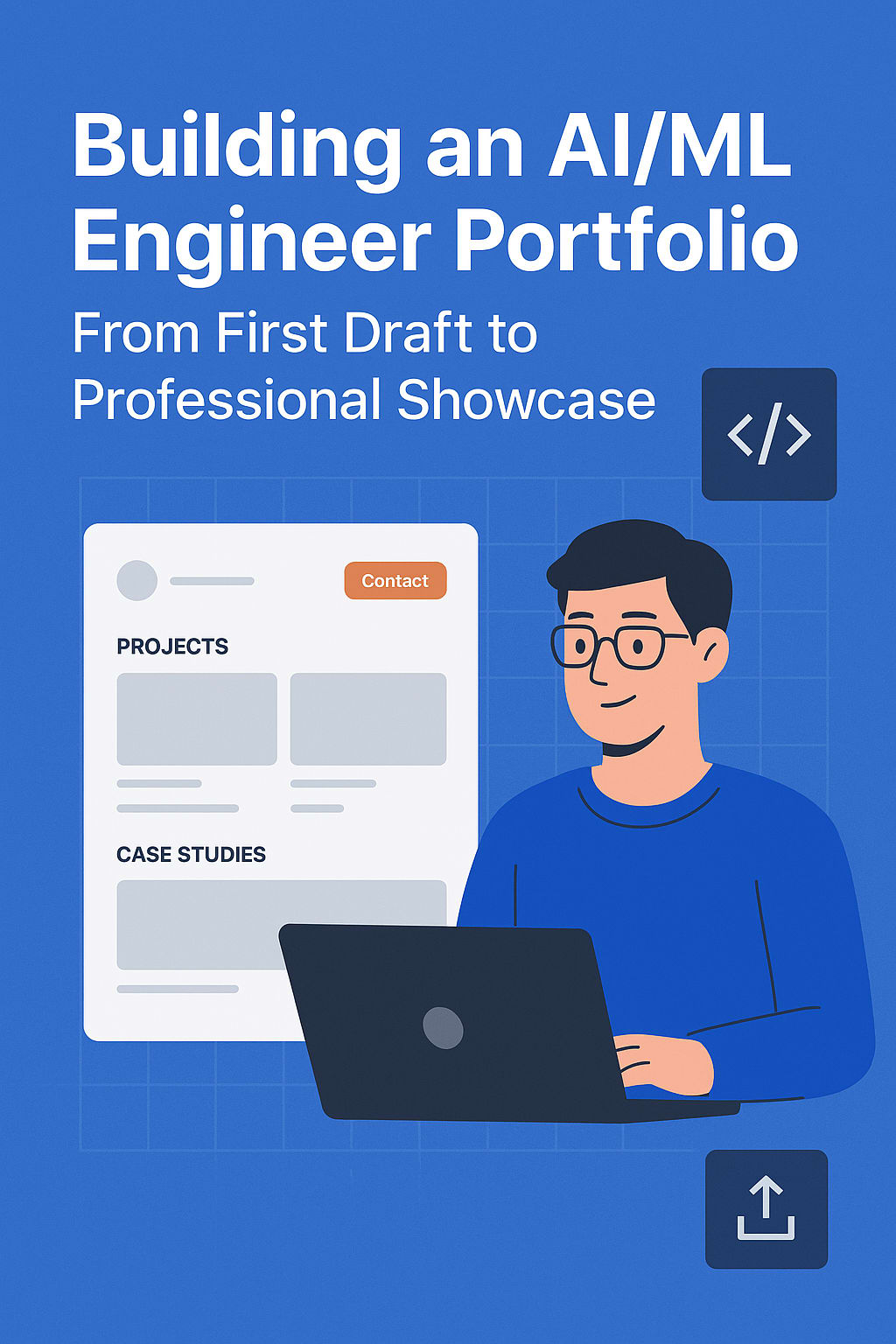
👉 Building an AI/ML Engineer Portfolio: From First Draft to Professional Showcase
👉 Why every AI and ML engineer needs a portfolio, common mistakes to avoid, and a simple roadmap to launch yours in one weekend.
Introduction
A CV lists your experience. A portfolio shows it.
For AI and ML engineers, demonstrating projects, code quality, and practical results is often far more persuasive than a long list of bullet points. A well-structured portfolio helps recruiters, collaborators, and hiring managers quickly understand what you can do and how you work.
In this post, I’ll explain why a portfolio is essential, describe the first version I built, and give a short, actionable checklist so you can launch yours quickly.
Why a Portfolio Matters
- Demonstrates practical ability. Recruiters want to see working projects, not just claims.
- Shows code quality & structure. Linking to GitHub lets viewers inspect your implementation and coding style.
- Highlights problem-solving. Well-written project descriptions show your approach to real problems.
- Supports interviews & applications. A portfolio provides material you can discuss during interviews.
- Signals growth. Updating projects and demos shows continuous learning.
What I Built — quick overview
- Tech stack: React + Vercel (hosting) + GitHub (code).
- Contents: Project cards (summary + link to repo), case studies, screenshots, and a roadmap for live demos.
- Goals: Make projects discoverable, show code, and allow recruiters to explore results quickly.
- Live link: [Portfolio Link](https://my-portfolio-eight-psi-83.vercel.app/)
How I Built It — practical steps
- Pick a starter template (React or Next.js)
Use a minimal template so you can focus on content rather than styling.
- Structure your content
- Home / About — short professional summary.
- Projects — each with problem statement, approach, results, link to repo, and screenshots.
- Blog / Notes — optional: short write-ups of experiments or lessons.
- Contact / CV — downloadable CV and contact links.
- Integrate GitHub
Add direct links to repositories. Include a short README for each project that explains how to run the code and reproduces results.
- Deployment
Deploy with Vercel or Netlify for near-instant CI/CD from GitHub. Set meaningful commit messages and include a deployment badge if you want.
- Add a demo (optional but powerful)
Host lightweight demos (in-browser or via simple APIs). Even small interactive demos dramatically increase engagement.
- SEO & shareability
Add clear titles, meta descriptions, and social preview images so shared links look professional.
Example: Minimal README.md template for each project
```
# Project Title
**Short description:** One-liner about problem & result.
## What I built
- Short bullet points: model type, dataset, framework.
## How to run
1. Clone repo
2. pip install -r requirements.txt
3. python run_demo.py
## Results
- Brief metrics (e.g., accuracy, inference time) and a screenshot link.
## Notes
- Limitations and next steps.
```
---
Lessons I Learned
Presentation matters. Good visuals and concise explanations make technical work accessible.
Start with minimal features. Ship a version early and iterate.
Show your thinking. Project write-ups that explain trade-offs are valuable.
Automation helps. CI/CD for deployments keeps the site updated with the latest commits.
Common Mistakes to Avoid When Building Your Portfolio
While building my first version, I realized there are also a few pitfalls that engineers often fall into when designing their portfolio. Avoiding these can save you a lot of time and make your portfolio more impactful:
1. Too much focus on design over content
A polished UI is great, but remember that recruiters are primarily looking for clarity and substance. Don’t spend weeks perfecting the colors and animations while your projects remain undocumented.
2. Not updating regularly
A stale portfolio with outdated projects can give the impression that you stopped learning. Even small updates — like adding a new article, sharing a small experiment, or improving documentation — show continuous growth.
3. Overloading with projects
Quality beats quantity. It’s better to have three well-documented, meaningful projects than ten half-finished ones.
4. Lack of context
Many portfolios simply drop GitHub links without explaining the “why.” Adding a one-paragraph description of the problem, your approach, and the results makes all the difference.
Future Opportunities with a Portfolio
The real strength of a portfolio is that it grows with you. As you move into internships, freelance projects, or research work, your portfolio becomes a dynamic record of your career journey.
You can also repurpose content: for example, turn a project into a Medium blog post, or use screenshots from your portfolio in a presentation or CV.
For AI and ML engineers, this is especially powerful. Models evolve quickly, new frameworks appear every year, and recruiters value adaptability. Having a living portfolio demonstrates that you’re not only keeping up with the field, but also applying your skills in practical, visible ways.
Quick Checklist to Launch Your Portfolio (in one weekend)
- Choose React/Next.js starter template
- Add 3 strong projects (each with repo + README)
- Add screenshots and short case studies
- Deploy to Vercel or Netlify and connect a custom domain (optional)
- Add contact info and downloadable CV
- Share on LinkedIn and Medium with a short post + 5 Medium tags
Final Thoughts
A portfolio is your most reliable tool for translating technical skills into opportunities. It’s proof of work, a talking point in interviews, and a living record of your growth as an engineer. Start small, keep improving, and make sure your projects tell a clear story: problem → approach → results.
If you’ve built your portfolio, share the link in the comments — I’d love to check it out. Leave it in the comments 🙌.
-
Author: Ahmed Hossam — AI & Computer Vision Engineer
- GitHub: (https://github.com/AhmedHossam61)
- Portfolio: (https://my-portfolio-eight-psi-83.vercel.app/)
- LinkedIn: (https://www.linkedin.com/in/ahmed-hossam61/)
About the Creator
Ahmed Hossam
AI & Computer Vision Engineer | Sharing insights on ML, coding, and building impactful projects.
Keep reading
More stories from Ahmed Hossam and writers in 01 and other communities.
How to Choose the Best Mobile App Development Company in Canada 2026
Choosing the right app development partner in 2026 isn’t just a procurement decision—it’s a strategic move that can define whether your digital product scales or stalls. The Canadian tech ecosystem has matured rapidly, with agencies offering everything from rapid MVP builds to enterprise-grade platforms powered by AI and cloud-native architectures.
By alan michael2 days ago in 01
Replica Designer Handbags and Luxury Designer Purses: A Cultural Perspective
Handbags are among the most consistently used personal items in modern life. While often discussed in relation to fashion, their significance extends far beyond visual appeal or brand recognition. Handbags function as everyday tools, supporting routine activities such as work, travel, and social engagement. Within this broader context, conversations around Replica Designer Handbags and Luxury Designer Purses reflect changing attitudes toward access, value, and practicality rather than simple questions of trend or status.
By charliesamuel7 days ago in 01



Comments
There are no comments for this story
Be the first to respond and start the conversation.