

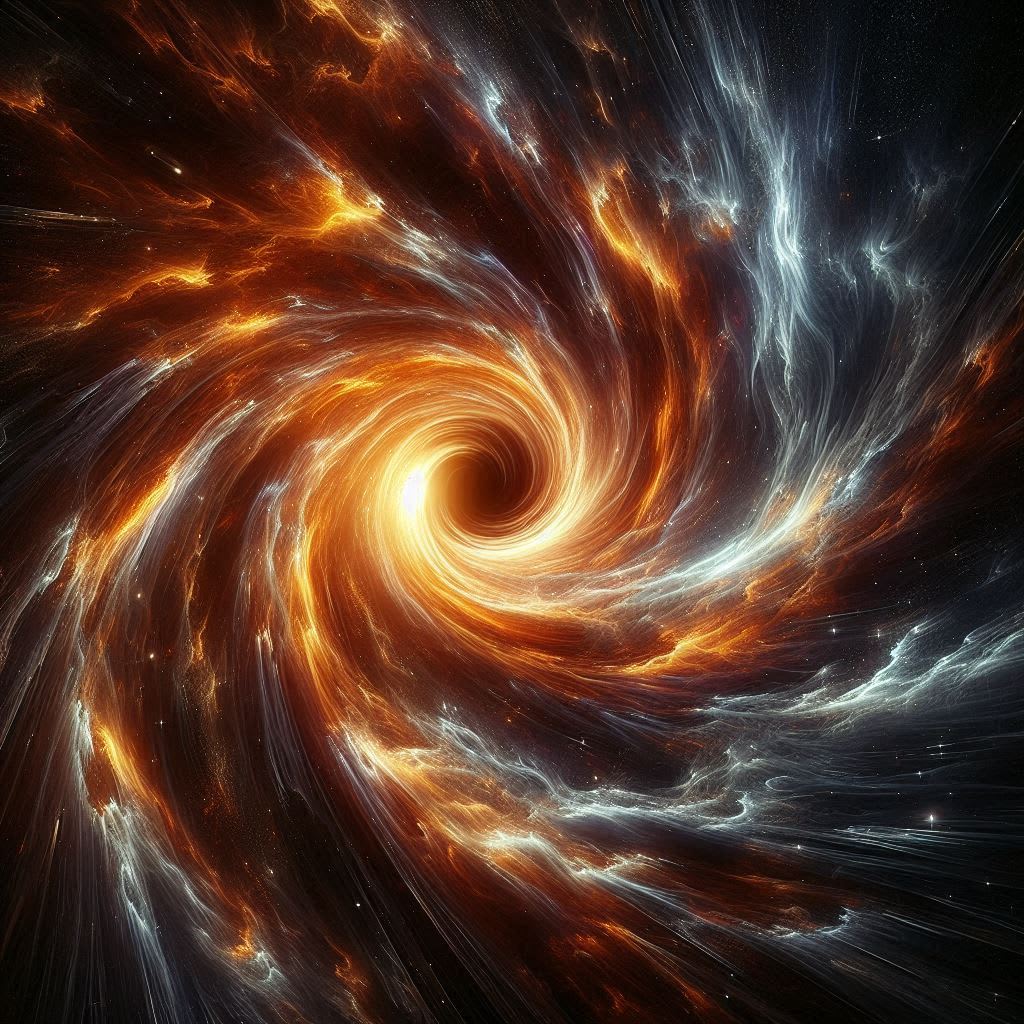
Black holes are among the most fascinating and enigmatic objects in the universe. Their extreme properties and mysterious nature have captivated astronomers and physicists alike. But what exactly are black holes, and why are they so intriguing?
What Are Black Holes?
A black hole is a region in space where gravity is so strong that nothing, not even light, can escape from it. This intense gravitational pull is the result of a mass collapsing into a very small volume, leading to a singularity—a point where density becomes infinite and the laws of physics as we know them break down.
Formation of Black Holes
Black holes can form through several processes, the most common of which is the collapse of massive stars. When a star exhausts its nuclear fuel, it can no longer support itself against gravitational forces. If the remaining mass is greater than about three times the mass of the Sun, the core will collapse into a black hole.
Another method of black hole formation is through the merging of smaller black holes. When black holes in a binary system spiral towards each other and merge, they can create a more massive black hole. This process has been observed through gravitational wave detections, providing valuable insights into black hole mergers.
Types of Black Holes
Black holes are classified into several categories based on their mass and formation mechanisms:
Stellar-Mass Black Holes: These black holes form from the remnants of massive stars and typically have masses ranging from a few to several tens of solar masses.
Intermediate-Mass Black Holes: These are theorized to have masses between 100 and 1,000 solar masses. Their existence is suggested by observations of certain types of star clusters and galactic nuclei.
Supermassive Black Holes: Found at the centers of most galaxies, including our own Milky Way, these black holes have masses ranging from millions to billions of solar masses. Their formation and growth are still subjects of intense research.
The Event Horizon and Singularity
The boundary surrounding a black hole is called the event horizon. It marks the point beyond which nothing can escape the black hole’s gravitational pull. The event horizon is not a physical surface but rather a mathematical boundary that delineates the point of no return.
At the very center of a black hole lies the singularity, a point where gravity is infinitely strong and space-time curvature becomes infinite. The singularity is hidden within the event horizon, making it impossible to observe directly. This region challenges our understanding of physics and calls for a theory of quantum gravity to describe its properties accurately.
Observing Black Holes
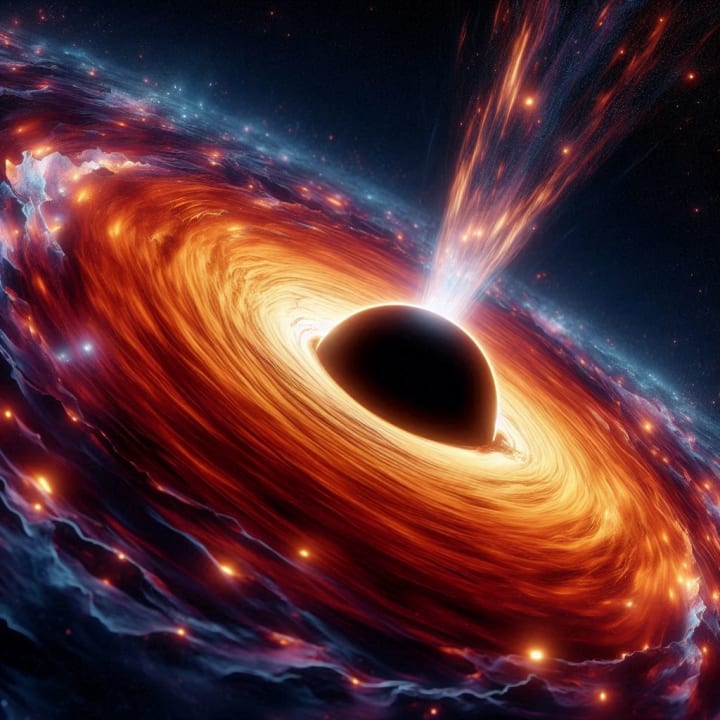
Despite their name, black holes are not entirely invisible. They can be detected by observing the effects of their immense gravity on nearby objects. For instance, if a black hole is part of a binary system, it can pull matter from its companion star. This matter forms an accretion disk around the black hole, heating up to extreme temperatures and emitting X-rays that can be detected by telescopes.
The Event Horizon Telescope (EHT) collaboration made history in 2019 by capturing the first image of a black hole’s event horizon in the galaxy M87. This groundbreaking image provided direct visual evidence of the presence of a supermassive black hole.
Theoretical Insights and Current Research
Black holes are not only fascinating for their observable properties but also for the theoretical questions they pose. They are key to understanding general relativity, quantum mechanics, and the fundamental nature of space-time. The information paradox, for example, raises questions about what happens to information that falls into a black hole. Does it get destroyed, or is it preserved in some form?
Research into black holes continues to explore their role in galaxy formation, their potential connections to dark matter, and the mysteries of singularity. Upcoming missions and advancements in observational technology will further illuminate the nature of these cosmic enigmas.
Conclusion
Black holes are among the most intriguing and challenging phenomena in astrophysics. Their formation, behavior, and the fundamental questions they raise make them a central topic in modern cosmology. As we continue to study black holes, we unlock deeper secrets about the universe and the nature of space-time itself.



Comments
There are no comments for this story
Be the first to respond and start the conversation.