
Beyond Chatbots: The Rise of Agentic AI and Autonomous Co-Pilots
How artificial intelligence is moving from answering questions to taking action on your behalf.

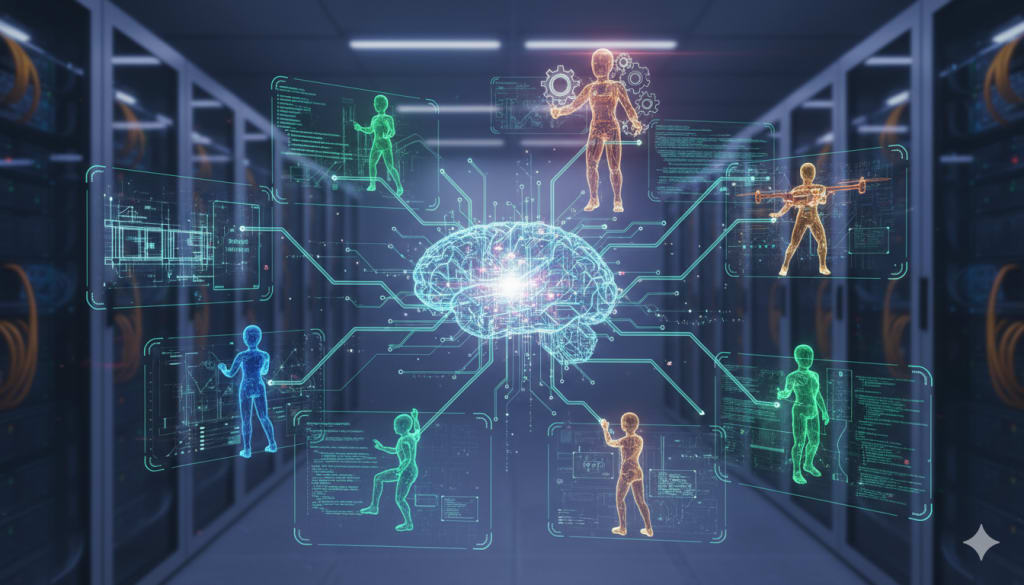
The first wave of generative artificial intelligence introduced the world to chatbots. Tools like ChatGPT and Claude demonstrated that computers could understand human language and generate coherent text. Users learned to type prompts, and the AI responded with summaries, poems, or code snippets. This interaction is passive. The AI waits for a command, executes a single task, and then stops.
The technology is now shifting toward a new model: Agentic AI. This evolution marks the transition from AI as a passive tool to AI as an active agent. While a standard chatbot answers a question, an AI agent pursues a goal. It breaks down complex objectives into smaller steps, uses software tools to complete them, and iterates until it achieves the desired outcome. This shift from "chat" to "action" will fundamentally change how humans interact with software.
Understanding the Co-Pilot Model
The current standard for workplace AI is the "Co-Pilot" model. In this setup, the human remains the pilot. The human makes the decisions, and the AI assists with specific, discrete tasks.
For example, a software developer uses a coding co-pilot to write a specific function. The developer reviews the code, accepts it, and moves to the next task. A marketing manager uses a writing co-pilot to draft an email. The manager reads the draft, edits the tone, and hits send.
The Co-Pilot model increases efficiency. It reduces the time required to produce a first draft. However, it requires constant human supervision. The workflow stops if the human walks away from the keyboard. The AI cannot navigate complex systems or make decisions on its own. It effectively functions as a very advanced autocomplete engine.
The Shift to Agentic AI
Agentic AI operates differently. It possesses a degree of autonomy. Instead of asking the AI to "write an email," a user gives the agent a broader goal, such as "schedule a meeting with the design team next Tuesday."
To accomplish this, a simple chatbot would merely draft the text of an invitation.
An AI agent takes the following actions:
- It accesses the user’s calendar to find free time slots.
- It checks the public calendars of the design team members.
- It identifies a time that works for everyone.
- It sends the invites.
If a team member declines, the agent finds an alternative time and reschedules without human intervention.
The agent reasons through the problem. It perceives its environment (the calendars), decides on a course of action (picking a time), and uses tools (the email client) to execute the plan.
Implications for Business and Productivity
The transition to Agentic AI moves the human out of the loop of repetitive tasks. This allows for "outcome-oriented" delegation. Instead of managing tasks, workers manage results.
In the field of customer support, current chatbots handle simple FAQs. An agentic system can handle full resolutions. If a customer requests a refund, an agent can verify the purchase history, check the company policy, process the transaction in the payment gateway, and update the inventory system. It connects disparate software systems that previously required a human bridge.
This connectivity creates a demand for specialized integration. Businesses need to configure their internal data so agents can access it securely. Companies like ViitorCloud assist organizations in building these architectures. They help businesses structure their digital ecosystems so that AI agents can interact with databases and APIs effectively, turning static data into actionable resources.
The Technical Foundation of Agents
Agentic AI relies on a loop of reasoning and acting. This is often called a "ReAct" pattern (Reason + Act).
When an agent receives a goal, it generates a thought process. It asks itself what information is missing. If it needs current stock prices, it recognizes it cannot rely on its training data. It decides to use a "web browsing" tool. It retrieves the data, analyzes it, and determines the next step.
This capability introduces new complexity. Developers must define the tools the agent can access. They must also set boundaries. An agent with permission to delete files or spend money requires strict guardrails. This is distinct from a chatbot, which runs in a contained environment where the worst outcome is usually incorrect text. An agent can impact the real world.
Challenges in Reliability and Trust
The move toward autonomy introduces risks. The primary challenge is reliability. Large Language Models (LLMs) occasionally hallucinate or make logic errors. In a Co-Pilot scenario, the human catches these errors immediately. In an Agentic scenario, the error might occur three steps into an automated process.
For example, an agent might book a flight for the wrong day because it misinterpreted the date format. To mitigate this, developers are building "human-in-the-loop" systems. The agent performs the research and planning but pauses for final approval before executing a critical action, such as charging a credit card or sending a contract.
According to research by the MIT Computer Science and Artificial Intelligence Laboratory, the future of AI lies in these collaborative systems where agents handle the sub-tasks, but humans maintain high-level strategic control. The research suggests that trust is built incrementally as users verify that the agent behaves predictably over time.
The Future of Work
The rise of Agentic AI changes the definition of digital literacy. Skill sets will shift from knowing how to operate software to knowing how to direct agents. The ability to define clear goals and set appropriate constraints will become a valuable professional skill.
We are moving away from a world where humans serve as the interface between different software applications. In the near future, agents will act as the connective tissue. They will navigate the complexity of digital systems, allowing humans to focus on the intent of the work rather than the mechanics of the execution.
About the Creator
ViitorCloud Technologies
Take your dream to great heights with Vittor Cloud's best AR/VR, Ai developers and turn into a reality with our expert developers. We function in US and all around the Globe. Checkout what's stored with us- http://viitorcloud.com/
Keep reading
More stories from ViitorCloud Technologies and writers in 01 and other communities.
How AI-Powered DX Platforms are Saving Museums for Gen Z
Museums face a significant challenge in maintaining relevance with Generation Z. This demographic grew up with instant access to information and highly personalized digital interfaces. Traditional museum displays often rely on static text and linear paths. These methods do not align with the expectations of digital natives.
By ViitorCloud Technologiesa day ago in 01
Apple’s 12-Inch MacBook Is Back: 10 Huge Leaks, Price, Specs, and Release Date
Get ready, because the iconic 12-inch MacBook is officially on the road to revival. According to one of the most trusted voices in the Apple leak world, this long-lost laptop isn’t years away—it’s just months from launch. And yes, it’s staying true to its roots with a 12-inch display, but this time, Apple is fixing everything that went wrong the first time.
By Info Post Gate2 days ago in 01
How Are Crypto Marketing Agencies Driving Pre-Sale Token Success in 2026?
In the world of blockchain and cryptocurrency, launching a successful token pre-sale is no longer just about innovative technology or promising ideas. In 2026, crypto marketing agencies are emerging as the linchpins of pre-sale success, helping projects not only reach their funding goals but also establish long-term credibility and trust within the community. With competition intensifying and investors becoming more discerning, agencies are deploying multi-faceted strategies that combine traditional marketing, digital growth tactics, influencer partnerships, and cutting-edge analytics.
By Jack santo3 days ago in 01
Goodbye, Mr. Duvall
It is turning out to be an interesting year. I was in the middle of teaching a class when a pop-up appeared on the screen announcing the death of Mr. Robert Seldon Duvall (yes, that was his full name). I was in the middle of a discussion on the obsession we have with winning when it comes to sports (the Winter Olympics was a theme), and I felt as though things were coming full circle. We had already lost Gene Hackman last year, and along with that titan, it feels though one particular golden age has closed off to be replaced by...?
By Kendall Defoe 4 days ago in Geeks



Comments
There are no comments for this story
Be the first to respond and start the conversation.