
Benefits of Clash Detection and Coordinated BIM Models in Construction
Explore the wonderful benefits of clash detection and coordinated BIM models for construction companies.

Introduction
The Construction industry has benefited tremendously from the rise of Building Information Modeling (BIM). The process of BIM helps to improve all aspects of the building lifecycle, from preconstruction to maintenance. It has become a paradigm-shifting innovation in the Architecture, Engineering, and Construction (AEC) industry.
One critical aspect of BIM is clash detection and coordination, which identifies and resolves conflicts between different building systems like architecture, structure, mechanical, electrical, and plumbing. The use of Clash Detection Services prevents costly rework and delays during the construction phase, saving time and resources, once the clashes are identified they are resolved. This whole process of identifying and resolving clashes is known as BIM coordination, and the model thus created is called a ‘Coordinated BIM Model’.
In this article, we aim to explore the extensive benefits that clash detection and coordinated BIM models offer to construction projects and highlight the positive impact of these technologies on construction efficiency and project success.
Understanding Clash Detection and Its Importance
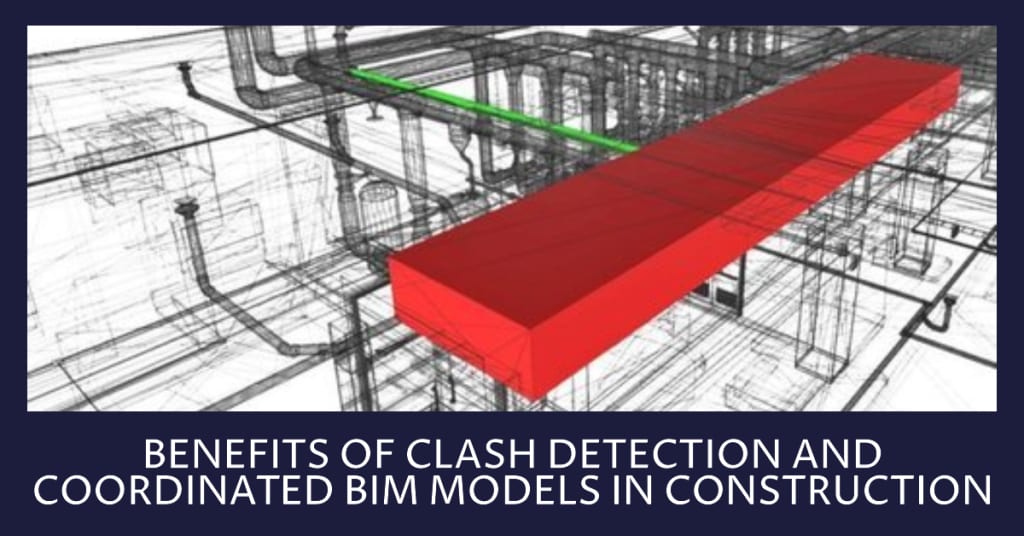
Clashes in building design refer to conflicts or collisions between different building systems or components, such as architectural, structural, mechanical, electrical, and plumbing. The purpose of clash detection is to identify and resolve these clashes early in the design phase to avoid costly rework and construction delays.
Clash detection involves using specialized software like Navisworks to analyze the digital models of different building systems. The software compares the spatial relationships between the systems and identifies clashes where they intersect or overlap. Once clashes are detected, they can be reviewed, analyzed, and resolved.
Here are the steps involved in the clash detection process:
Import BIM models: The first step in the clash detection process is to import the BIM models into the clash detection software. These models contain digital representations of all building components.
Analyze models: The software then analyzes the models using rule-based algorithms and clash detection rulesets.
Identify clashes: The algorithms compare the spatial relationships and properties of the building elements to identify clashes. Common clashes that can be detected include conflicts between structural elements, clashes between mechanical systems and architectural components, or clashes between different building systems.
Review and resolve clashes: Once the clashes have been identified, they need to be reviewed and resolved. This involves collaborating with the design team to determine the best course of action to eliminate the clash.
Update models: After the clashes have been resolved, the BIM models need to be updated to reflect the changes made to eliminate the clash.
Repeat process: The clash detection process needs to be repeated regularly throughout the design and construction process to ensure that any new clashes are identified and resolved as soon as possible.
What are coordinated BIM models?
Coordinated BIM models are the result of effective clash detection and resolution. They integrate the architectural, structural, and MEP BIM models into a single, clash-free digital representation. Coordinated BIM models offer several advantages for construction managers such as better collaboration and reduced cost and project completion duration. In the next section we will discuss these advantages.
Advantages of Coordinated BIM models
Construction companies can benefit a lot from BIM Coordination Services, which are also provided by dedicated companies who focus on clash detection and BIM coordination. Here are some of the advantages of using Coordinated BIM models.
1. Streamlined Decision-Making:
Coordinated BIM models promote collaboration among project stakeholders, enabling quicker and more informed decision-making. By identifying clashes early on, teams can resolve conflicts efficiently, avoiding time-consuming back-and-forth.
2. Reduced Rework and Delays:
Coordinated BIM models help minimize rework and construction delays by identifying clashes before construction begins. This leads to smoother project execution, improved productivity, and cost savings.
3. Improved Design Quality and Accuracy:
Clash detection identifies conflicts between building systems early on, allowing designers to make adjustments for a coherent and optimized design. By resolving clashes beforehand, costly change orders and on-site redesigns are minimized, saving time and money.
4. Time and Cost Savings:
All the above mentioned factors lead to significant time and cost savings in construction projects. By streamlining decision-making, reducing rework and delays, and improving design quality and accuracy through coordinated BIM models and clash detection, projects can be executed more efficiently.
An example of clash detection using BIM in Buildings
King Abdullah Financial District, Riyadh, Saudi Arabia:
BIM played a crucial role in clash detection during the construction of the King Abdullah Financial District (KAFD) in Riyadh, Saudi Arabia. The complex geometry of the building required the architects to develop their own bespoke BIM software. With the customized software, the team was able to model the intricate design accurately and detect clashes early on. This reduced project risk and allowed for the delivery of a complete and coordinated model. The KAFD project showcases the benefits of BIM in saving time, reducing clashes, and increasing reliability throughout the building's lifecycle.
Conclusion
BIM is a technological marvel, and its full potential has yet to be utilized in the construction industry. The use of sophisticated clash detection and coordinated BIM models will not only save billions of dollars for stakeholders but also reduce the environmental impact of the construction industry by reducing the materials used in reworks and mistakes. As the world realizes the benefits of BIM, we can expect more and more projects to be built using Coordinated BIM Models.
About the Creator
Tesla Outsourcing Services LLC
Since 2007, Tesla Outsourcing Services LLC has delivered BIM, CAD, VDC, and engineering design solutions for AEC firms worldwide
- Flexible Pricing
- Industry Best Quality
- Expert Architects and Engineers
- 4H: Honesty, Humility, Hard Work, Harmony
Keep reading
More stories from Tesla Outsourcing Services LLC and writers in 01 and other communities.
Life Cycle Analysis and Performance Evaluation using BIM
As there is a global push towards more sustainable development, the construction industry is also adopting practises to meet its sustainability goals. Lifecycle analysis and performance evaluation are two important aspects of sustainable construction. Building Information Modelling, also known as BIM, is an effective tool that is used to implement lifecycle analysis and performance evaluation. In this article, we will discuss in length how lifecycle analysis and BIM can be used to achieve sustainable construction.
By Tesla Outsourcing Services LLC2 years ago in 01
Understanding 925 Sterling Silver Jewelry: History, Craft, and Modern Relevance
Jewelry has been a part of human culture for thousands of years, serving purposes that extend far beyond decoration. Among the many materials used in adornment, 925 sterling silver jewelry holds a distinct and enduring place. Known for its balance of beauty, durability, and accessibility, sterling silver continues to be valued across cultures and generations.
By charliesamuel5 days ago in 01
How to Choose the Best Mobile App Development Company in Canada 2026
Choosing the right app development partner in 2026 isn’t just a procurement decision—it’s a strategic move that can define whether your digital product scales or stalls. The Canadian tech ecosystem has matured rapidly, with agencies offering everything from rapid MVP builds to enterprise-grade platforms powered by AI and cloud-native architectures.
By alan michael3 days ago in 01



Comments
There are no comments for this story
Be the first to respond and start the conversation.