
Avoiding Costly Mistakes: How 3D Rendering Streamlines the Design Process
How is 3D Interior Rendering Vital for Design Project?

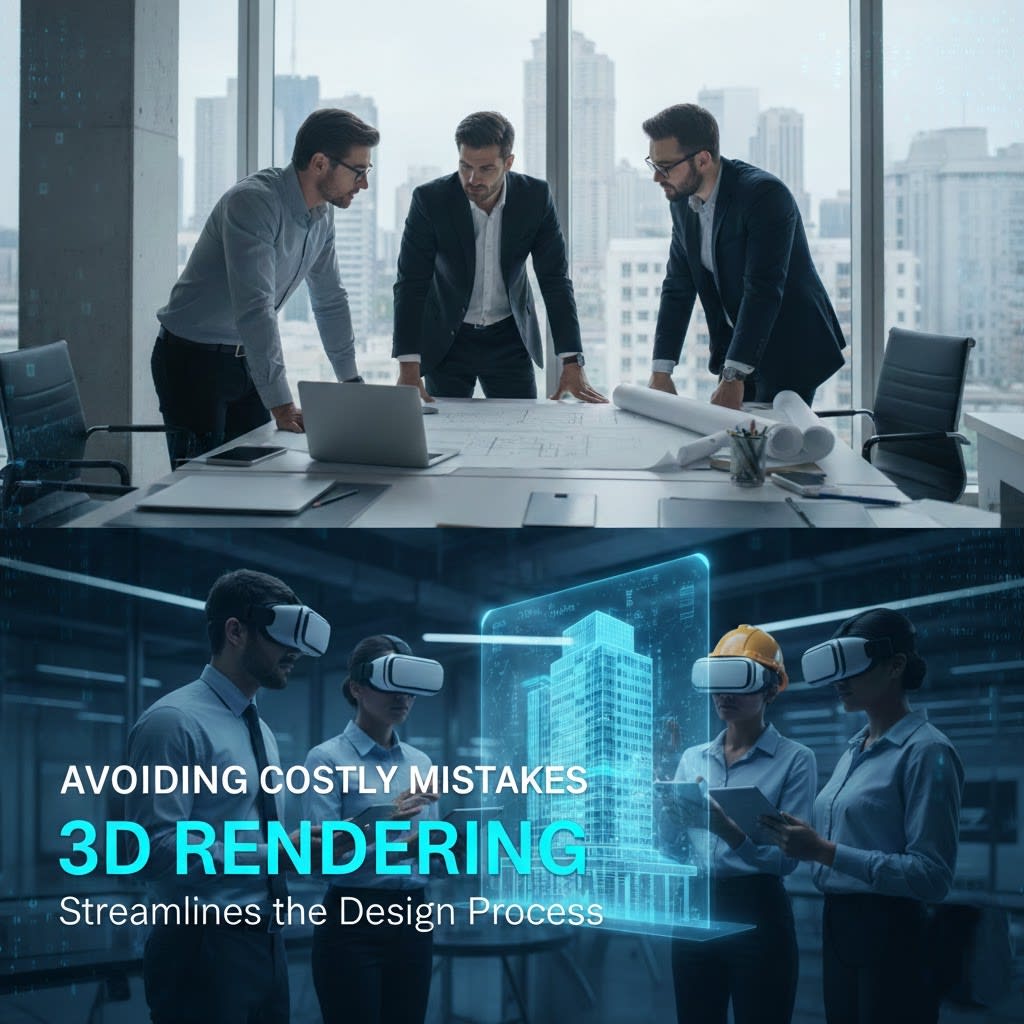
Did you know that according to industry benchmarks, design-related changes during the construction phase can inflate total project costs by as much as 7% to 15%? In an era where global construction margins are tightening—often hovering between 2% and 8%—a single miscommunication in spatial design isn't just a minor hiccup; it’s a direct threat to profitability. As the AEC industry shifts from "traditional representation" to "digital simulation," 3D rendering has emerged not merely as a marketing tool, but as a critical risk-mitigation strategy.
The Evolution from "Drafting" to "Digital Prototyping"
For decades, the industry relied on 2D CAD drawings to convey complex spatial ideas. However, the cognitive gap between a floor plan and a finished structure is where most costly errors reside. Today, the integration of Building Information Modeling (BIM) and high-fidelity visualization has transitioned the industry into the realm of digital prototyping.
Recent market analysis suggests that the global 3D rendering market is poised to grow at a CAGR of over 20% through 2030, driven largely by the demand for "error-free" design cycles. By creating a one-to-one digital twin of a project before a single brick is laid, stakeholders can identify geometric clashes and aesthetic inconsistencies that would otherwise remain hidden in 2D layouts.
Mitigating Design Conflicts Through Photorealistic Accuracy
One of the most significant advantages of modern visualization is the ability to conduct "virtual walkthroughs." When architects and engineers utilize professional 3D rendering services to visualize mechanical, electrical, and plumbing (MEP) systems alongside architectural elements, the clarity gained is unparalleled.
Spatial Coordination: 3D renders allow contractors to visualize the clearance of HVAC ducts against structural beams, reducing RFI (Request for Information) cycles by up to 30%.
Material Integrity: Seeing how light interacts with specific textures helps in finalizing material palettes early. This prevents the "material regret" phase, where expensive finishes are stripped out post-installation because they didn't look as expected under site-specific lighting.
Bridging the Stakeholder Communication Gap
The AEC industry is a symphony of diverse stakeholders—developers, architects, city planners, and end-users. Not everyone can "read" a blueprint. This lack of visual literacy often leads to "late-stage design drift," where clients request changes once they see the physical walls going up.
By implementing 3D visualization early in the schematic design phase, you effectively democratize the design process. When a client can see the exact shadow play in a lobby at 4:00 PM in mid-winter, their feedback becomes proactive rather than reactive. This is particularly crucial in interior spaces; understanding how 3D interior rendering is vital for design projects helps in aligning client expectations regarding volume, flow, and ergonomics long before procurement begins.
The Business Case: ROI of High-Fidelity Visualization
While some firms view 3D rendering as an additional overhead, the quantitative data suggests the opposite. A study by the Economist Intelligence Unit highlighted that "poor project ecosystem collaboration" (often due to lack of visual clarity) costs the global construction industry billions annually.
Reduced Rework: Every dollar spent on a high-quality render can save approximately five dollars in onsite rework costs.
Faster Approvals: Projects utilizing 3D visualization often see a 25% faster approval rate from municipal planning boards, as the environmental impact and aesthetic integration are clearly demonstrated.
Sustainability Gains: Accurate rendering allows for precise solar studies, enabling designers to optimize window placements and reduce future HVAC loads, aligning with LEED and BREEAM standards.
Actionable Takeaways for AEC Professionals
To leverage 3D rendering as a tool for streamlining and cost-saving, consider the following implementation steps:
Integrate Early: Don't wait for the "final presentation" to render. Use low-resolution clay renders during the design development phase to check spatial volumes.
Standardize Data Exchange: Ensure your BIM models are "render-ready" by maintaining clean geometry and accurate metadata, which simplifies the handoff to visualization teams.
Focus on Lighting and Context: A render is only as good as its physics. Use accurate Revit or Rhino data to simulate real-world lighting conditions to avoid "surprises" during the punch-list phase.
Use as a Procurement Guide: Use photorealistic renders as a reference point for contractors to ensure the physical execution matches the approved aesthetic intent.
Looking Ahead: The Future of Design Certainty
The AEC industry is moving toward a future defined by Augmented Reality (AR) and real-time rendering engines. As we move closer to 2030, the line between the "digital model" and the "physical build" will continue to blur. Firms that embrace high-fidelity 3D rendering today aren't just making "pretty pictures"—they are building a culture of precision, transparency, and fiscal responsibility. In a world where mistakes are measured in millions, visual clarity is the ultimate insurance policy.
About the Creator
Tesla CAD Solutions
Tesla CAD Solutions offers expert CAD and BIM services in Australia, specializing in CAD drafting, BIM coordination, 3D rendering, mechanical drafting, Revit family creation, and scan to BIM for efficient, cost-effective project delivery.
Keep reading
More stories from Tesla CAD Solutions and writers in 01 and other communities.
BIM Uncovered: The Reality Behind the Common Misconceptions
If you asked a room full of AEC professionals this question a decade ago, the answers would have been mixed. Today, however, the data is irrefutable: 66-87% of BIM users report a positive Return on Investment (ROI), yet a significant portion of the industry remains hesitant, paralyzed by outdated myths. In an era where digital transformation is no longer optional but a survival mechanism, clinging to common myths about BIM that need to be debunked isn't just a difference of opinion—it’s a business risk.
By Tesla CAD Solutions14 days ago in 01
Real Estate Tokenization Development in 2026: From Pilot Projects to Global Scale
For much of the past decade, real estate tokenization existed at the edges of the property market. It was discussed in innovation labs, tested in limited pilot projects, and explored by forward-looking investors who believed blockchain could modernize real estate ownership. These early initiatives proved one thing clearly. Tokenization worked. What they could not yet prove was whether it could scale reliably across borders, asset classes, and regulatory environments.
By Ethan hunt6 days ago in 01
The 2026 Enterprise App Blueprint: Inside INDI IT Solutions' Development Secret
In the hyper-competitive digital landscape of 2026, the gap between a "good" mobile app and a "high-performance" enterprise solution is no longer measured in seconds, but in milliseconds and micro-interactions. For Fortune 500 companies, an app isn’t just a mobile touchpoint; it is the central nervous system of their customer engagement and operational efficiency.
By Sherry Walker7 days ago in 01


Comments
There are no comments for this story
Be the first to respond and start the conversation.