
Real Estate Tokenization Development in 2026: From Pilot Projects to Global Scale
How Tokenized Property Models Are Scaling Liquidity, Access, and Global Investment

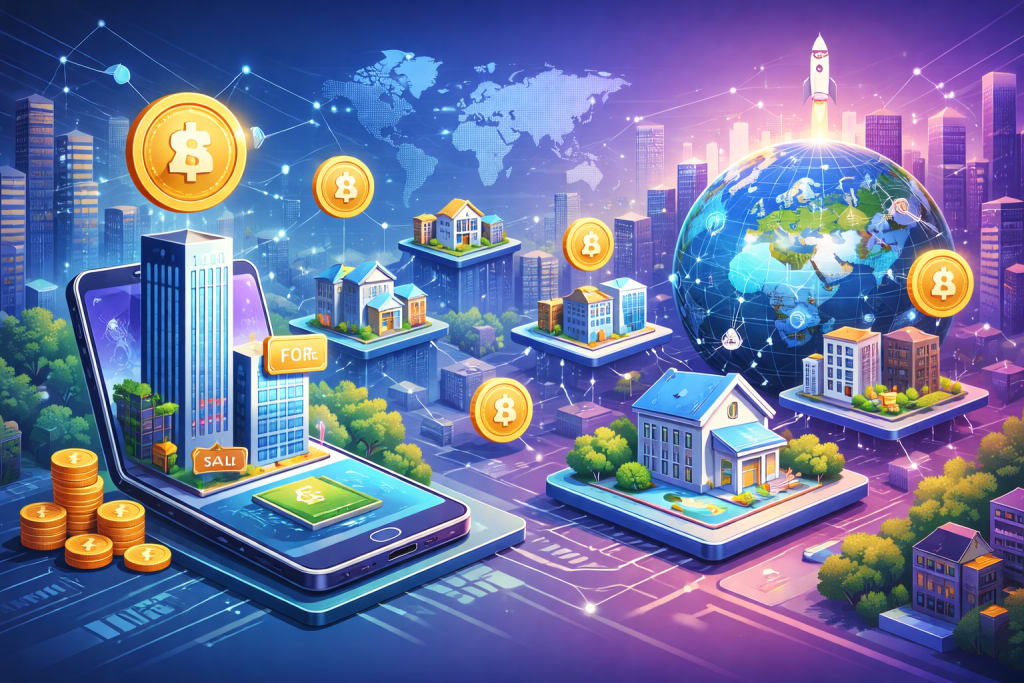
For much of the past decade, real estate tokenization existed at the edges of the property market. It was discussed in innovation labs, tested in limited pilot projects, and explored by forward-looking investors who believed blockchain could modernize real estate ownership. These early initiatives proved one thing clearly. Tokenization worked. What they could not yet prove was whether it could scale reliably across borders, asset classes, and regulatory environments.
By 2026, that question has been answered. Real estate tokenization development has moved beyond proofs of concept and entered a phase of industrial adoption. What was once experimental is now becoming foundational infrastructure for how real estate assets are issued, traded, managed, and financed globally.
This transformation is not happening overnight. It is the result of years of technical refinement, regulatory alignment, and growing institutional confidence. Today, tokenized real estate is no longer positioned as a disruptive alternative to traditional property systems. It is increasingly viewed as an upgrade to them.
Understanding Real Estate Tokenization at a Structural Level
At its core, real estate tokenization refers to the process of converting ownership rights in a physical property into digital tokens recorded on a blockchain. Each token represents a fractional interest in the asset, allowing investors to buy, sell, or hold property exposure in smaller, more flexible units.
What makes tokenization powerful is not just fractional ownership. It is the automation, transparency, and programmability embedded in the system. Smart contracts handle compliance checks, ownership transfers, income distribution, and governance rules. Distributed ledgers provide a single source of truth for asset records. Investors gain real-time visibility into holdings without relying on intermediaries.
In 2026, real estate tokenization is no longer defined by novelty. It is defined by reliability, security, and integration into existing financial and legal frameworks. This evolution has been driven by advances in Real Estate Tokenization Platform Development that focus on enterprise-grade performance rather than experimentation.
Why Early Pilot Projects Were Necessary but Insufficient
The first wave of tokenized real estate projects served an important purpose. They demonstrated feasibility. Developers proved that property ownership could be digitized, fractionalized, and transacted using blockchain infrastructure. However, these pilot projects were often limited in scope.
Most early initiatives focused on a single property, a small investor group, or a controlled regulatory environment. Liquidity was often restricted. Secondary markets were thin or nonexistent. Custody, compliance, and integration with traditional financial systems remained fragmented.
These limitations did not indicate failure. They revealed what needed to be built next. To move from pilot projects to global scale, real estate tokenization required standardized platforms, stronger governance frameworks, and professional service providers capable of supporting complex asset portfolios.
The Rise of Full-Scale Real Estate Tokenization Platforms
By 2026, the industry has largely shifted from one-off tokenization projects to comprehensive Real Estate Tokenization Platforms. These platforms are designed to handle the entire lifecycle of a property asset, from onboarding and legal structuring to token issuance, investor management, and secondary trading.
A modern Real Estate Tokenization Platform integrates identity verification, regulatory compliance, smart contract management, and reporting into a single system. It supports multiple asset types, including residential, commercial, industrial, and mixed-use properties. It also accommodates different ownership models, such as equity, debt, and hybrid structures.
This platform-centric approach is what enables scale. Instead of reinventing the process for each asset, developers can deploy standardized workflows that reduce cost, risk, and time to market. For investors, it creates a consistent and trustworthy experience across multiple tokenized assets.
Institutional Adoption as a Turning Point
One of the most significant developments in 2026 is the growing participation of institutional players. Pension funds, private equity firms, family offices, and real estate investment managers are no longer observing tokenization from the sidelines. They are actively integrating it into their investment strategies.
Institutional adoption has changed the tone of the market. These organizations demand robust governance, audited smart contracts, regulatory clarity, and operational resilience. Meeting these standards has pushed Real Estate Tokenization Development Services to mature rapidly.
As a result, tokenized real estate offerings in 2026 look and feel very different from early experiments. They are structured professionally, aligned with existing investment frameworks, and designed to coexist with traditional property markets rather than replace them.
Regulatory Maturity Enables Global Expansion
One of the key barriers to scaling real estate tokenization in earlier years was regulatory uncertainty. Property law, securities regulation, and cross-border compliance vary widely across jurisdictions. Without clear guidance, many projects remained confined to limited markets.
By 2026, regulatory frameworks have not become uniform, but they have become more navigable. Many jurisdictions now recognize tokenized securities and digital ownership records within existing legal structures. Compliance processes have been embedded directly into tokenization platforms through automated checks and reporting tools.
This regulatory maturity has enabled real estate tokenization to expand globally. Developers can structure offerings that comply with local laws while maintaining a consistent technological foundation. Investors can participate in international property markets with greater confidence and transparency.
Fractional Ownership Redefined for a Global Investor Base
Fractional ownership is often cited as the headline benefit of tokenization, but its true impact is only now being realized. In 2026, fractionalization is not just about lowering investment thresholds. It is about opening global access to previously illiquid and geographically constrained assets.
Through Real Estate Tokenization Services, investors can gain exposure to high-quality properties in different regions without navigating complex legal processes or large capital requirements. Portfolio diversification becomes more efficient. Risk can be spread across asset classes, locations, and development stages.
For property owners and developers, fractional ownership expands the investor pool dramatically. Capital can be raised from a broader audience while maintaining control over governance and asset management. This dynamic is reshaping how real estate projects are financed worldwide.
Liquidity Evolution and Secondary Markets
Liquidity has long been a challenge in real estate investing. Traditional property transactions are slow, costly, and infrequent. Tokenization does not magically solve liquidity, but it fundamentally improves it.
In 2026, secondary markets for tokenized real estate are more structured and regulated than in previous years. While they may not yet match the liquidity of public equities, they offer a significant improvement over traditional real estate exits.
Tokens can be traded more efficiently within approved marketplaces, subject to compliance rules. This flexibility allows investors to rebalance portfolios, manage risk, and access capital without waiting years for asset sales. Liquidity is no longer an abstract promise. It is becoming an operational reality.
The Role of Specialized Tokenization Companies
As the market has matured, specialization has increased. Not every real estate firm wants to build blockchain infrastructure in-house. This has led to the rise of dedicated Real Estate Tokenization company providers that focus exclusively on technology, compliance, and platform operations.
A professional Real Estate Tokenization Development company brings deep expertise in smart contracts, asset structuring, regulatory alignment, and system security. These providers act as long-term partners rather than one-time vendors, supporting clients as their portfolios grow.
This ecosystem approach accelerates adoption. Property developers can focus on asset quality and market strategy while relying on experienced partners to handle the technical and operational complexity of tokenization.
Data Transparency and Investor Trust
Trust is essential in real estate, and tokenization enhances it through transparency. Blockchain-based records provide immutable audit trails for ownership, transactions, and income distribution. Investors can verify asset performance and compliance without relying solely on periodic reports.
In 2026, transparency is not just a technical feature. It is a competitive advantage. Platforms that provide clear, real-time data attract more sophisticated investors and command higher confidence levels.
This transparency also improves governance. Voting rights, profit-sharing rules, and asset management decisions can be encoded into smart contracts, reducing disputes and increasing alignment between stakeholders.
Integration with Traditional Real Estate Operations
One of the misconceptions about tokenization is that it exists in opposition to traditional real estate systems. In reality, the most successful implementations in 2026 are deeply integrated with them.
Tokenized assets still rely on property managers, legal advisors, auditors, and financial institutions. The difference is that many processes are now digitized and automated. Rent collection, expense tracking, and investor reporting are synchronized with tokenization platforms.
This hybrid model allows real estate professionals to adopt tokenization without abandoning proven operational practices. It also makes the transition less disruptive and more sustainable over time.
Technology Advances Supporting Global Scale
The technical foundations of real estate tokenization have improved significantly. Scalability, interoperability, and security were major concerns in earlier years. In 2026, these challenges are being addressed through more efficient blockchain architectures and enterprise-grade infrastructure.
Modern platforms are designed to handle high transaction volumes, complex asset structures, and multi-jurisdictional compliance requirements. Interoperability between different blockchain networks and traditional systems allows assets to move more freely within the financial ecosystem.
These advances are critical for global scale. Without them, tokenization would remain confined to niche markets. With them, it becomes a viable foundation for international real estate investment.
The Economic Impact on Real Estate Markets
The scaling of real estate tokenization is beginning to influence broader market dynamics. Capital flows are becoming more fluid. Smaller investors gain access to opportunities that were once reserved for large institutions. Developers can source funding more efficiently.
This increased efficiency does not eliminate risk, but it redistributes it more evenly. Markets become more transparent, and pricing reflects real-time demand rather than opaque negotiations.
Over time, this could lead to more resilient real estate markets that are better equipped to adapt to economic shifts and global uncertainty.
Challenges That Still Require Attention
Despite the progress made by 2026, challenges remain. Regulatory harmonization across borders is still incomplete. Investor education is ongoing. Cybersecurity and smart contract risk require constant vigilance.
Liquidity, while improved, is not guaranteed in all market conditions. Platforms must continue to evolve to support healthy secondary markets. Governance models must balance automation with human oversight.
Acknowledging these challenges is essential. Tokenization is not a shortcut to effortless returns. It is a structural upgrade that requires responsible implementation and long-term commitment.
Why 2026 Marks a Defining Moment
What makes 2026 different from previous years is not a single technological breakthrough. It is the convergence of multiple factors. Mature platforms, regulatory clarity, institutional participation, and proven use cases have aligned.
Real Estate Tokenization Development has reached a point where scale is no longer theoretical. It is happening. Projects are expanding beyond pilots. Portfolios are growing. Global investor participation is increasing.
This moment represents a shift in mindset. Tokenization is no longer viewed as an experiment. It is viewed as infrastructure.
The Strategic Role of Tokenization Services
For organizations entering this space, choosing the right Real Estate Tokenization Development Services is critical. Success depends on more than issuing tokens. It requires thoughtful asset structuring, compliance strategy, investor engagement, and long-term platform support.
Professional services ensure that tokenized assets are built to last. They help align technology with business goals and regulatory realities. In a market that is becoming increasingly competitive, quality execution is what differentiates leaders from followers.
Looking Ahead Beyond 2026
While 2026 marks a major milestone, it is not the endpoint. Real estate tokenization will continue to evolve as technology advances and markets adapt. New asset classes, financing models, and governance structures will emerge.
What is clear is that tokenization is no longer optional for organizations seeking long-term relevance in the real estate sector. It is becoming a core capability.
The journey from pilot projects to global scale has taken time, but the foundation is now firmly in place. As adoption accelerates, real estate tokenization will play an increasingly central role in shaping how property is owned, financed, and traded worldwide.
Conclusion: From Vision to Reality
Real estate tokenization development has crossed a critical threshold. What began as a bold vision is now a functioning, scalable reality. In 2026, the industry is witnessing the transformation of property markets through digital ownership, automation, and global accessibility.
With the continued development of robust platforms, trusted service providers, and compliant frameworks, tokenization is redefining what is possible in real estate. It is not replacing traditional models overnight, but it is steadily reshaping them from within.
As the sector moves forward, those who understand and embrace this shift will be best positioned to lead in a more connected, transparent, and efficient global real estate economy.
About the Creator
Ethan hunt
Ethan is a blockchain and Web3 specialist focused on building decentralized ecosystems that enhance transparency, security, and global accessibility.
Keep reading
More stories from Ethan hunt and writers in 01 and other communities.
What Makes Real World Asset Tokenization Offerings a 2026 Game-Changer?
Now we are heading into the transformation of the global financial system and 2026 will be the year of Real World Asset Tokenization Offerings. For the past several years, the tokenization of assets was considered a theoretical future state and something that existed only in innovation labs and proof-of-concept projects. What has changed in particular is market readiness, regulatory clarity and enterprise readiness, whether through technology or otherwise.
By Ethan hunt2 days ago in 01
Brook Lang on Thermal Energy Storage
As renewable energy adoption accelerates, the challenge of storing energy when the sun is not shining or the wind is not blowing has become increasingly urgent. While lithium-ion batteries dominate headlines, another powerful solution is gaining traction: thermal energy storage. By capturing and storing heat or cold for later use, thermal storage systems are emerging as cost-effective and scalable “grid batteries” that support a more resilient and flexible energy system.
By Brook Lang Seattle6 days ago in 01
Cabin Fever Because of Snow, Sleet, and Freezing Rain That Turned to Icy Roads
What Is Cabin Fever? The short answer is that cabin fever is restlessness from being in a confined area. Cabin fever is the distressing irritability or restlessness experienced when a person or group is stuck at an isolated location or in confined quarters for an extended time. Research shows that prolonged cold, gray skies, and being stuck indoors can trigger mood shifts similar to “winter blues.”
By Margaret Minnicks5 days ago in Humans



Comments
There are no comments for this story
Be the first to respond and start the conversation.