
Artificial Intelligence & Future Technology: Shaping the World Ahead
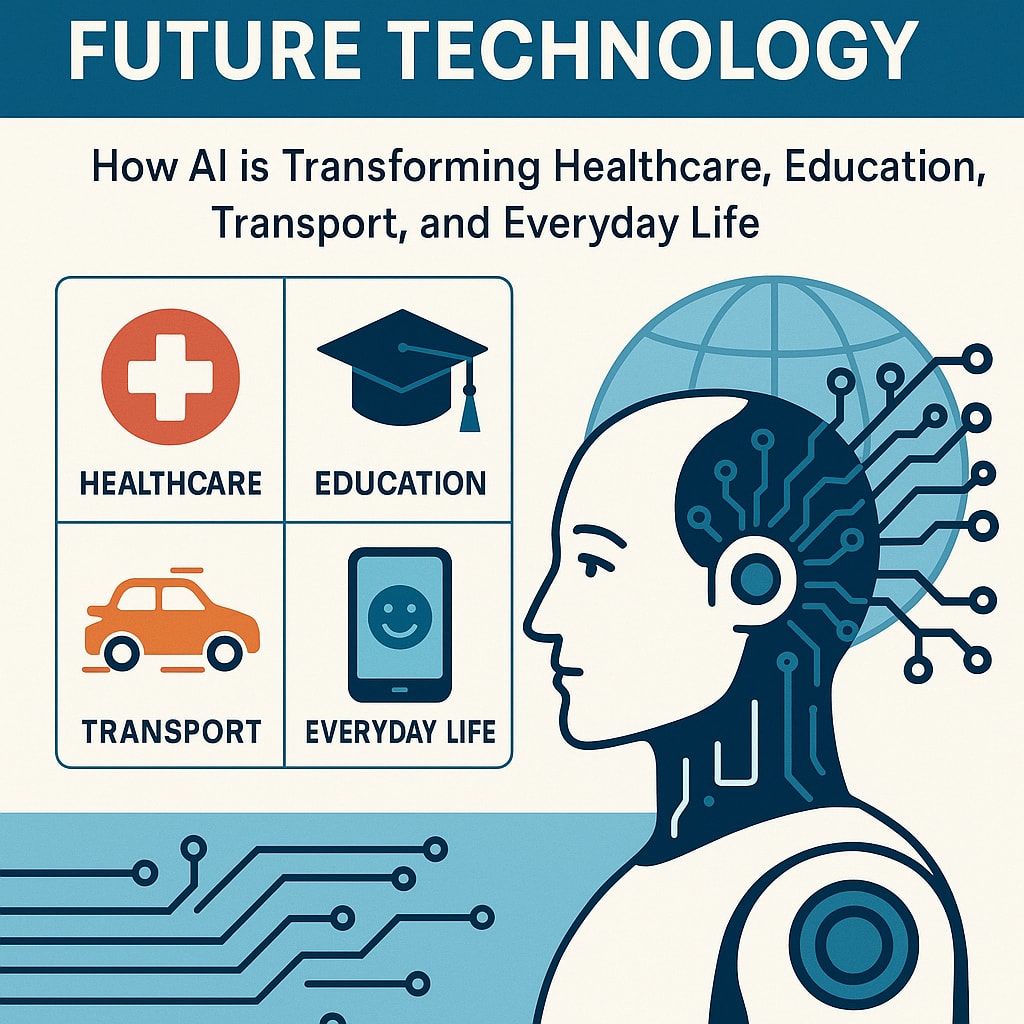
"How AI is Transforming Healthcare, Education, Transport, and Everyday Life"

🧠 Introduction
The 21st century is witnessing a technological revolution unlike any other in history. At the center of this revolution is Artificial Intelligence (AI)—a powerful force that is reshaping industries, redefining human capability, and rewriting the future. Once limited to science fiction, AI has now become a very real, very present part of our daily lives—and its influence is only growing.
From healthcare and education to transport and finance, AI is not just automating processes but enabling smarter, faster, and more personalized experiences. But what does the future hold when machines can think, learn, and make decisions? This article explores how AI is shaping tomorrow’s world and what it means for humanity.
🤖 What is Artificial Intelligence?
Artificial Intelligence refers to machines that can perform tasks requiring human intelligence. This includes things like:
Recognizing speech or images
Understanding natural language
Learning from data
Making decisions
Solving complex problems
Examples of AI already exist all around us—think of Siri on your phone, facial recognition in your camera, Google Translate, or Netflix recommendations. But this is just the beginning. As AI continues to evolve, it will become even more sophisticated, intuitive, and integrated into our daily lives.
🚀 How AI is Transforming Key Sectors
1. Healthcare
AI is becoming a game-changer in medicine. Algorithms can now detect diseases like cancer in their earliest stages, often more accurately than human doctors. Chatbots and virtual health assistants are providing mental health support and basic medical advice, while AI helps researchers analyze genetic data to design personalized treatment plans.
Robotic surgeries assisted by AI are more precise, resulting in fewer complications and quicker recoveries. Emergency response systems, like those used in ambulances and trauma care, are also benefiting from AI-driven decision support.
2. Education
The future of learning is smart and personalized. AI-powered platforms are already being used to:
Identify students’ strengths and weaknesses
Create custom learning paths
Automate grading and assessments
Provide instant feedback
This not only makes education more efficient but also more inclusive. Students with learning disabilities or different learning styles can benefit greatly from adaptive technologies tailored to their needs.
3. Transportation
The rise of autonomous vehicles is perhaps the most visible example of AI in action. Self-driving cars, trucks, and drones are being developed to reduce human error, lower accident rates, and improve traffic efficiency.
Beyond roads, AI is also improving public transportation systems, managing airline schedules, and optimizing shipping logistics—making global trade faster and more reliable.
4. Smart Cities
AI will soon power entire smart cities, where everything is interconnected and optimized:
Traffic lights will respond to real-time conditions
Waste management will be automated
Energy usage will be tracked and adjusted
Public safety systems will use facial recognition and predictive policing
Cities like Singapore, Tokyo, and Dubai are already implementing these technologies, setting examples for others to follow.
⚖️ The Ethical & Social Dilemmas
Despite its promise, AI comes with significant ethical and social challenges:
Job Displacement: As machines take over repetitive or analytical tasks, there’s a growing concern about unemployment in sectors like manufacturing, customer service, and even legal analysis.
Bias and Fairness: AI systems learn from data, and if that data is biased, the outcomes can be discriminatory—impacting hiring decisions, loan approvals, and even policing.
Privacy: AI often requires massive amounts of personal data. How this data is collected, stored, and used is a major concern for individuals and regulators alike.
To ensure a safe and fair AI-powered future, governments and companies must invest in ethical frameworks, transparency, and public awareness.
🌍 Humans and AI: Partners, Not Rivals
Contrary to popular fears, AI is not here to replace us—it’s here to augment human potential. Imagine:
Doctors assisted by AI making life-saving diagnoses
Teachers using AI tools to reach every student
Emergency responders guided by AI in disaster zones
In every field, human creativity, empathy, and decision-making will remain essential. AI is a tool—a powerful one—but it is only as good as the humans who design and use it.
🔮 Conclusion: Creating a Better Tomorrow
Artificial Intelligence is more than just a technological trend; it is a force shaping the very foundation of our future. It offers solutions to some of humanity’s greatest challenges—but only if it is developed responsibly and used wisely.
As we stand at the edge of this new frontier, we must ask ourselves not just what AI can do, but what it should do. The choices we make today will define the world of tomorrow.
Let us use this opportunity not to fear the rise of machines, but to embrace the rise of intelligent collaboration, where technology uplifts humanity, solves real problems, and builds a better, more inclusive world.
About the Creator
Clarity Press
Clarity Press is a professional blog dedicated to publishing clear, insightful, and research-based articles on health, education, and social issues.
Keep reading
More stories from Clarity Press and writers in 01 and other communities.
BS Emergency Care Technology: A Vital Field for Modern Healthcare
In the ever-evolving landscape of global healthcare, rapid response to emergencies has become a critical pillar of patient survival and public health management. The Bachelor of Science (BS) in Emergency Care Technology is an academic program designed to produce skilled professionals who can deliver high-quality emergency medical services (EMS) in various critical and pre-hospital settings. As the demand for efficient emergency care systems continues to grow, the significance of this degree is becoming increasingly apparent.
By Clarity Press9 months ago in Education
Elon Musk called medical school "pointless," but Jeff Bezos wants Gen Z to finish college before starting their own companies — as AI threatens entry-level jobs
The job market is becoming volatile by the minute as generative AI becomes more prevalent and gains broad adoption across organizations worldwide. Last year, Salesforce CEO Marc Benioff revealed that the company is seriously debating hiring software engineers, citing "incredible productivity gains" from agentic AIs.
By Dena Falken Esq3 days ago in 01
JD Vance: ‘despicable toady for Trump’ – and 2028 candidate in all but name
JD Vance has moved quickly from outsider to one of the most influential figures in American politics. As vice president, he has positioned himself as Donald Trump’s most aggressive defender while quietly building a future of his own. Publicly, he presents loyalty. Privately, many see preparation.
By Dena Falken Esqabout 5 hours ago in 01



Comments
There are no comments for this story
Be the first to respond and start the conversation.