
AI Technology Advancements & Impact (2026)
Explore cutting-edge AI technology advancements shaping 2026. Discover key innovations in ML, NLP, and computer vision. Learn more about their transformative impact.

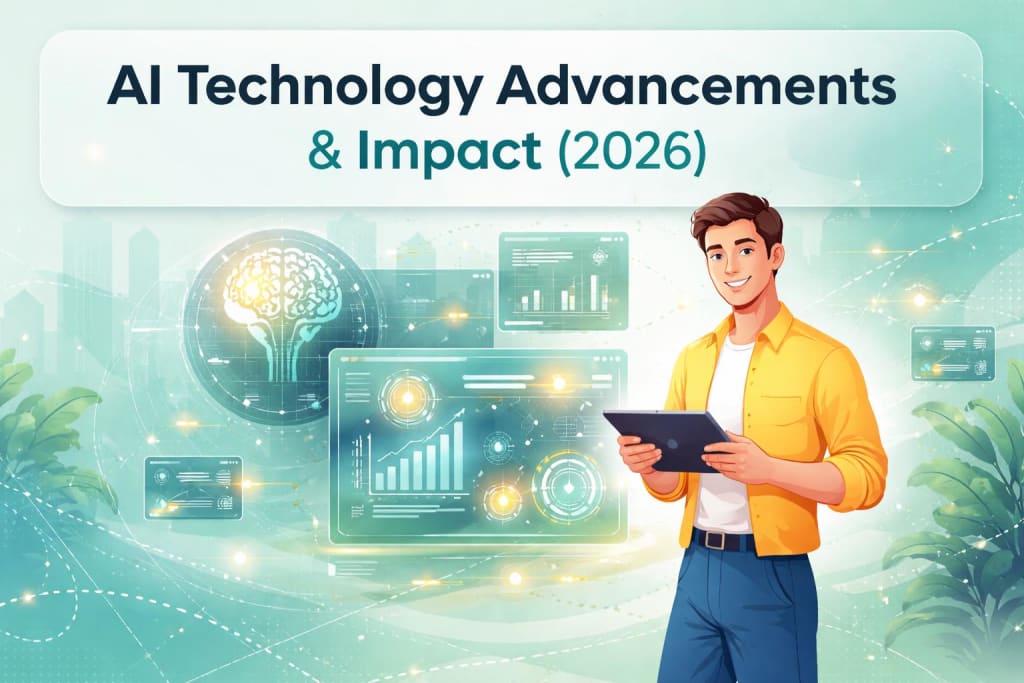
Remember when we thought 2023 was wild? Or when 2024 felt like the peak of the hype cycle?
That was cute.
Here we are in 2026, and the landscape has shifted so hard it’s enough to give you whiplash. If you’re still waiting for the "AI bubble" to burst, you might be waiting a while. The ai technology advancements we are seeing right now aren't just about faster chatbots or generating weird images of six-fingered hands anymore. We are way past that.
Now? It’s about agents that actually do things. It’s about nuclear reactors coming back online just to feed these hungry digital beasts. It’s chaotic, it’s exciting, and if I’m being honest, it’s a little terrifying.
The Rise of the "Doer" Bots (Agentic AI)
Let’s be real for a second.
For a long time, AI was all hat and no cattle. You’d ask it to write an email, and it would give you something that sounded like a robot trying to be Shakespeare.
But 2025 changed the game.
According to IBM, by late 2025, 99% of developers were already exploring or building AI agents. We aren't talking about passive chatbots anymore. We are talking about Agentic AI—systems that can reason, plan, and execute tasks without you holding their hand every step of the way.
Think about it.
Instead of typing a prompt and hoping for the best, you give an agent a goal. "Plan my travel," or "Refactor this legacy code." The agent breaks it down, uses tools, and gets it done.
Why This Matters Now
Gartner put it best in their late 2025 strategic trends report: we are moving toward Multiagent Systems (MAS). These are collections of AI agents that interact to achieve complex goals.
- Autonomy: They don't just wait for prompts; they act.
- Specialization: One agent handles code, another handles testing, another handles deployment.
- Collaboration: They talk to each other (scary, right?).
"Context is emerging as one of the most critical differentiators for successful agent deployments." — Gene Alvarez, Gartner Analyst, Gartner
The days of the "generalist" bot are fading. We are seeing specialized squads of bots. It’s proper brilliant if you ask me, but it also means the workforce is shifting.
Small Models, Big Impact (SLMs)
Here is the thing.
Not everyone has a massive data center in their backyard. Running massive models (LLMs) is expensive and slow.
Enter Small Language Models (SLMs).
In late 2025, we saw a massive pivot. Tech giants realized that bigger isn't always better. Sometimes you just need something quick and dirty that runs on your phone. Google’s Gemini Nano and open-source projects like TinyLlama started popping up everywhere.
These models are designed for edge computing. That means the AI runs right on your device, not in some cloud server in Virginia.
The Benefits?
- Privacy: Your data doesn't leave your phone.
- Speed: No latency waiting for a server response.
- Cost: Way cheaper to run.
It’s a massive shift for developers. Teams are scrambling to adapt to this "local-first" AI mentality. This is similar to what you see with mobile app development texas firms, where local tech scenes are pivoting hard to integrate these edge-capable models into consumer apps.
Why? Because nobody wants to pay a subscription fee for a cloud API when their phone can do the thinking for free. No cap, it’s just better economics.
The Energy Crisis (And the Nuclear Solution)
Let me explain something that might sound like science fiction.
AI is hungry. Like, really hungry.
The ai technology advancements we are enjoying require electricity. A lot of it. By 2025, data centers were chewing through power grids so fast that tech companies had to get creative.
And by creative, I mean "buying nuclear power plants."
You think I'm joking?
Microsoft signed a massive deal with Constellation Energy to restart Three Mile Island Unit 1 by 2027. Yes, that Three Mile Island (well, the unit next to the infamous one).
Check the stats:
- Nuclear energy stocks surged 40% by 2025.
- Tech giants are betting billions on nuclear to ensure 24/7 baseload power.
- Carbon-free energy is no longer a "nice to have," it's a survival requirement for AI scaling.
This is the reality of 2026. We aren't just coding anymore; we are literally reshaping the energy infrastructure of the planet to keep the servers humming. It’s gnarly.
AI Is "Eating" Software
Real talk: Coding isn't what it used to be.
I remember when we used to argue about tabs vs. spaces. Now? We are arguing about which agent framework is better at writing the code for us.
Capgemini’s 2026 trends report hit the nail on the head: "AI is eating software."
We are shifting from "writing code" to "expressing intent."
What Does That Mean?
- Intent-Driven: You tell the AI what you want (the intent).
- Autonomous Delivery: The AI figures out how to build it.
- Self-Healing: If the code breaks, the AI fixes it.
It sounds great, but it’s also stressful for old-school devs. You gotta adapt or get left behind.
"AI won't replace humans. But humans who use AI will replace those who don't." — Sam Altman, CEO of OpenAI, [Times of India] That quote has been floating around for a couple of years now, but in 2026, it hits different. It’s not a warning anymore; it’s a factual statement of the labor market.
The Open vs. Closed War Continues
You’d reckon by now we’d have settled the debate on whether AI should be open-source or closed-source.
Nope. It’s hotter than ever.
On one side, you have companies locking down their models, claiming safety (and profit). On the other, you have the open-source community releasing models that rival the giants.
💡 Yann LeCun (@ylecun): "Research in secret is not research." — [Times of India]
He’s not wrong. The innovation happening in the open is staggering. But the closed models (like the successors to OpenAI's o1) are still pushing the boundaries of reasoning.
What’s Next? (2027 and Beyond)
So, where is this train going?
If we look at the trajectory from late 2025 into 2026, a few things are clear. We are moving toward Artificial General Intelligence (AGI)—or at least systems that are functionally indistinguishable from it for most tasks.
Future Signals:
- Reasoning Models: We are seeing models that "think" before they speak (like the Strawberry/Orion evolution). They don't just predict the next word; they simulate outcomes.
- Physical AI: The brains are getting smart enough to control bodies. Robotics is the next massive frontier.
- Biotech Integration: AlphaFold was just the start. AI designing drugs in real-time is becoming standard practice.
"We'll have something that will exhibit all the cognitive capabilities humans have, maybe in the next five to 10 years." — Demis Hassabis, CEO of Google DeepMind, The Guardian
He said that back in 2025. In 2026, that timeline feels less like a prediction and more like a schedule.
Conclusion
The ai technology advancements of 2026 are messy. They are consuming our energy grid, rewriting our software, and changing how we work fundamentally.
It’s easy to be cynical. It’s easy to say "it’s all hype." But when you see a nuclear plant restarting just to power a data center, you realize this is real. The infrastructure is being poured. The concrete is setting.
We are fixin' to see a world where AI isn't a tool you use; it's the infrastructure you live in.
So, don't just sit there. Go break something. Experiment with an agent. Download a small model to your laptop. The future isn't waiting for you to catch up.
About the Creator
Keep reading
More stories from Sherry Walker and writers in 01 and other communities.
Generative AI in App Development: Use Cases Driving Business Innovation
Remember when we actually wrote code? I mean really wrote it. Character by character. Fighting with syntax errors because you missed a semicolon in line 402. Looking back from where we stand in 2026, those days feel like the Stone Age, don't they? It’s only been a few years, but the landscape of app development has shifted so violently that "developer" barely means the same thing anymore.
By Sherry Walker3 days ago in 01
Hyper-Personalization in 2026: The Indi IT Solutions Approach to AI-Driven UX
The digital landscape of 2026 has moved beyond the era of responsive design and static templates. Today, a premium mobile experience is no longer defined by how well it fits a screen, but by how accurately it anticipates a human need. At Indi IT Solutions, we have observed a fundamental shift: users no longer "navigate" apps; they interact with fluid ecosystems that evolve in real-time.
By Devin Rosario8 days ago in 01
How Small Businesses are Actually Using Custom AI to Save Time
For a long time, the narrative surrounding artificial intelligence was that it belonged exclusively to the giants of Silicon Valley. Small and medium-sized businesses (SMBs) often viewed these technologies as too expensive, too complex, or simply unnecessary for their scale. However, the landscape has shifted. We have moved from the era of "experimentation" into an era of "practical implementation."
By ViitorCloud Technologies2 days ago in 01
Should We Not Try to Get Too Political?
Here's something you often hear people say, "I try not to get too political." I understand the sentiment and I sympathize with it... while at the same exact time, I completely disagree with the notion. Whether it's referring to social media or wherever, it's kind of unavoidable. You can attempt to sidestep it, not engage, leave the less important things for actual politicians to discuss... you can want it to not take over your life, your conversations, your relationships, and that makes perfect sense.
By Stephen Kramer Avitabile8 days ago in Writers


Comments
There are no comments for this story
Be the first to respond and start the conversation.