
AI Search Tools vs Google: The Future of Finding Information Online
Exploring the rise of AI-powered search engines, how they compare to Google, and what the future of online information discovery means for users and businesses

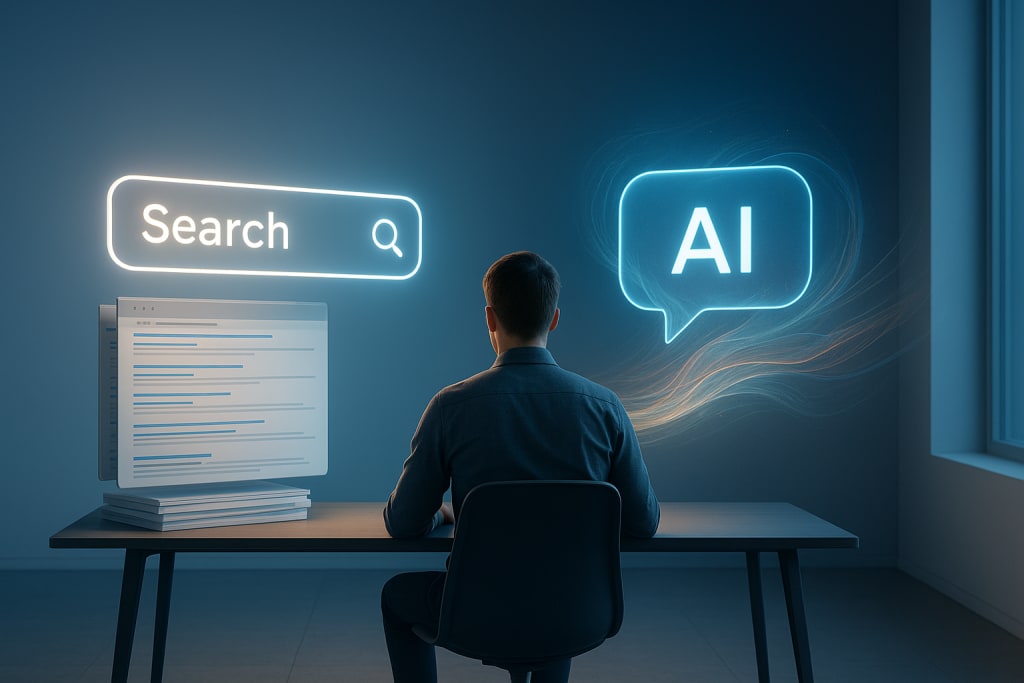
For over two decades, Google has shaped the way we access knowledge, becoming the go-to entry point for billions of users worldwide. The familiar white page, colorful logo, and quick list of blue links have defined how we interact with the internet. But in recent years, AI search tools—from conversational assistants like ChatGPT and Perplexity to AI-infused browsers and apps—have begun to challenge that dominance.
The shift is subtle yet revolutionary. Instead of sifting through lists of links, users are now asking AI tools to think with them, process complex ideas, and deliver answers that feel tailored and conversational. This isn’t just about technology. It’s about how humans approach knowledge itself.
Why Google Became the World’s Search Giant
Google’s rise wasn’t accidental. Its PageRank algorithm, launched in the late 1990s, was groundbreaking because it ranked web pages not only by keywords but also by how many other pages linked to them. Over time, the algorithm grew to consider hundreds of signals—from mobile optimization and site speed to content quality and authority.
The result was a platform that:
- Answered questions fast. No other tool matched Google’s speed.
- Captured nearly all of the web. Its index became a near-complete map of the internet.
- Created a business ecosystem. Advertising through Google Ads became a primary way for businesses to reach customers.
Yet as powerful as it is, the user experience has started to feel cluttered. Sponsored results often dominate the first page. Content farms pump out articles designed for search rankings, not for readers. And while Google remains essential, many users feel it takes too long to cut through noise to get to the information they need.
How AI Search Tools Are Rewriting the Rules
AI-powered search systems flip the script. Instead of showing you a buffet of options, they attempt to serve the most digestible answer immediately.
Here’s what sets them apart:
- Conversational Flow: Ask a question in natural language—“What are the best diets for heart health?”—and you’ll get a structured, readable summary. Follow up with “What about low-carb options?” and the AI keeps context without restarting the search.
- Synthesized Responses: Instead of clicking five links, AI can merge information from multiple sources into one cohesive overview.
- Personal Adaptation: Over time, these tools can learn your preferences, such as whether you want highly detailed explanations, bullet-point summaries, or step-by-step guides.
- Multi-Modal Search: Many AI tools are integrating images, charts, and even audio alongside text, expanding beyond what Google’s traditional text-based format provides.
Think of it as moving from a search engine to an answer engine.
The Advantages of AI Search in Everyday Life
Why are people shifting toward AI-driven search? The reasons go beyond novelty.
Clarity in Complexity
Google is excellent for simple questions (“What’s the capital of France?”). But for complex ones—like “Explain the pros and cons of nuclear fusion as a long-term energy solution”—Google gives you a stack of articles to sort through. AI, on the other hand, delivers a synthesized explanation in one go.
Time Efficiency
Professionals, students, and researchers often don’t have the bandwidth to sift through dozens of links. AI compresses hours of research into a digestible format.
Interactive Research
Traditional search feels static. AI turns it into a back-and-forth process, where follow-up questions refine the answer instead of starting from scratch.
Content Generation Support
Beyond just answers, AI tools can draft emails, summarize long documents, or even brainstorm marketing campaigns—functions traditional search engines were never built for.
The Risks and Shortcomings of AI Search
Despite the hype, AI search tools aren’t without flaws—and these flaws matter.
Accuracy Concerns
AI is known for “hallucinations,” confidently providing false or outdated information. Unlike Google, which displays its sources, AI answers can sometimes lack transparency.
Citation Gaps
While some tools are improving at providing links, many responses still blend data without clear attribution. This can be problematic for academic, legal, or medical queries where sources matter.
Bias and Blind Spots
AI tools are trained on existing data. If that data is biased, incomplete, or outdated, the AI’s answers will reflect those limitations.
Overdependence
There’s a danger in treating AI responses as final truth. Without critical thinking, users may rely too heavily on answers that should only serve as starting points.
Why Google Still Matters
Despite the excitement around AI, Google retains major strengths that keep it at the center of online search.
- Up-to-the-Minute Results: AI models are often trained on older datasets. Google excels at surfacing breaking news and live updates.
- User Choice: Google doesn’t just answer—it lets you explore different viewpoints across multiple sources.
- Global Ecosystem: Search is deeply integrated with Maps, YouTube, Gmail, Android, and Chrome. This synergy gives Google an advantage that AI startups can’t easily replicate.
- SEO-Driven Discovery: Businesses still depend heavily on organic rankings to drive traffic.
For now, if you want authoritative sources, breaking news, or multiple perspectives, Google is still the stronger choice.
The Future of Search: A Convergence
The likely outcome isn’t replacement but convergence. Google has already begun weaving AI into its search results, with AI-generated snapshots appearing above traditional links. At the same time, specialized AI tools are emerging that focus on particular domains—health, law, finance, education.
We’re heading toward a dual search experience:
AI for answers. Quick, synthesized, conversational responses.
Google for exploration. Broader, deeper dives into primary sources.
In other words, AI and Google aren’t battling for the same ground—they’re building two sides of the same coin.
What This Means for Users and Businesses
For everyday users, this evolution means more efficiency and flexibility. You’ll choose AI for quick answers and Google when you want depth, variety, or reassurance.
For businesses, however, the stakes are higher:
- SEO Must Evolve: Ranking first on Google may no longer guarantee visibility if AI platforms summarize content without clicking through.
- Authority is Everything: AI models tend to favor authoritative, trustworthy content. Brands will need to invest in credibility, not just keywords.
- Content Must Shift: The days of creating content purely for Google rankings are fading. Future-proof content will focus on expertise, originality, and usefulness—qualities AI algorithms can detect and surface.
Those who adapt early to the answer-first era of search will gain an edge.
A New Era of Search
We stand at the beginning of a massive shift in digital behavior. Google revolutionized how we find information. AI is revolutionizing how we understand it.
The transition won’t be instant. People will continue to rely on Google for many tasks, but they’ll increasingly turn to AI for context, clarity, and speed. As the tools mature, the lines between search and conversation will blur even more.
Ultimately, the future of search isn’t about man versus machine or Google versus AI. It’s about people demanding smarter, faster, more human-like ways of interacting with knowledge. And that future is arriving much sooner than most realize.
About the Creator
Richard Bailey
I am currently working on expanding my writing topics and exploring different areas and topics of writing. I have a personal history with a very severe form of treatment-resistant major depressive disorder.
Keep reading
More stories from Richard Bailey and writers in 01 and other communities.
The Rise of AI Wearables: How Smart Glasses, Brain-Sensing Headbands, and Fitness Trackers Are Redefining Daily Life
Artificial intelligence has shifted from being a background tool into something more personal, more immediate, and much closer to our bodies. The latest wave of AI-powered wearables—from sleek smart glasses to neurotechnology headbands and advanced fitness trackers—isn’t just about convenience. It’s about creating a constant feedback loop between human behavior and intelligent machines.
By Richard Bailey6 months ago in 01



Comments
There are no comments for this story
Be the first to respond and start the conversation.