
AI in CRM(Customer Relationship Management)
Transforming Customer Relationships and Sales Strategies with AI-Powered CRM Solutions

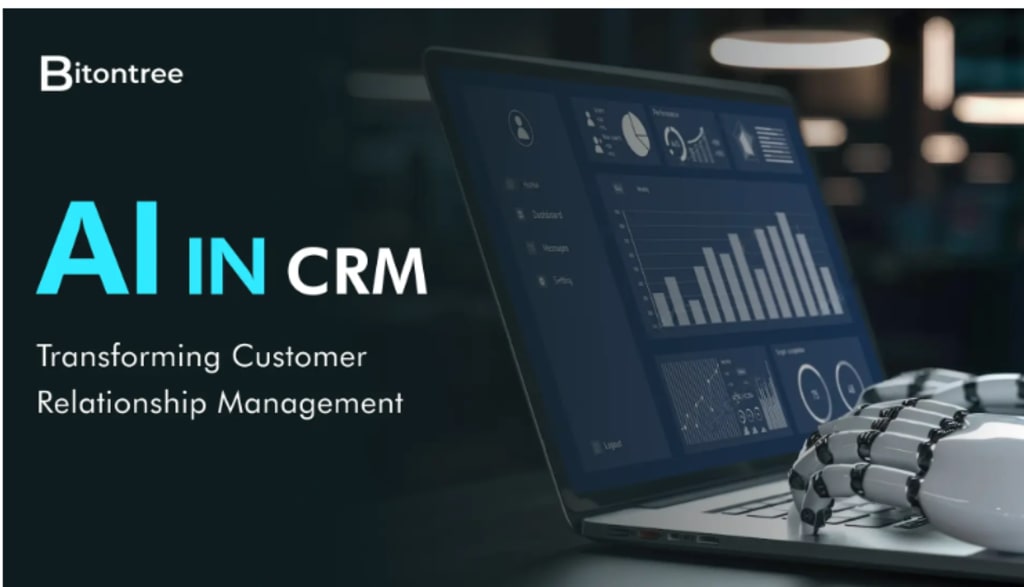
CRM, or Customer Relationship Management platforms, is a system designed to help companies manage all the activities and interactions with potential clients and their existing customer base. 95% of customer service leaders believe that CRM platforms effectively improve their productivity, and 60% of them have actually witnessed their productivity improve.
Imagine what AI for customer engagement would do if it were integrated into CRM platforms? CRM tools empowered by AI behave like smart employees, predicting customer needs, automating cumbersome processes, and giving clients more personalized experiences at scale.
Salesforce's 2024 State of CRM report found that businesses using AI in sales CRM have 4.1x higher customer retention rates and 2.8x faster sales cycle times than those using legacy systems.
The use of AI in CRM systems is revolutionizing the way businesses engage with customers at every touchpoint. From predictive analytics in CRM that anticipate customer behavior to natural language processing that drives intelligent chatbots, AI allows companies to deliver hyper-personalized experiences at scale while significantly boosting operational efficiency.
Understanding AI-Powered CRM Solutions
AI-powered CRM software means customer relationship management platforms that are improved with artificial intelligence technologies. AI enhances CRM by employing advanced machine learning in CRM to analyze patterns in customer behavior, anticipate future needs, and suggest optimal ways to engage customers. As they analyze more data, these systems evolve and refine their algorithms over time, providing ever more accurate forecasts and recommendations.
Traditional CRMs derive value from tracking past customer interactions, helping businesses reactively manage their relations. In contrast, AI-powered CRMs help businesses proactively engage with customers by anticipating their needs before they arise. Now, this evolution from being reactive to being predictive and prescriptive in how brands manage their relationship with customers represents a new paradigm of understanding and serving customers in a deeper and more meaningful fashion.
Generative AI integrated into CRM platforms makes content generation simpler. The marketers need not spend 2 hours brainstorming a strategy to initiate a campaign. With AI-driven insights, they can instantly generate personalized content, craft email sequences, and optimize messaging based on real-time customer data. This not only saves time but also enhances engagement by delivering the right message to the right audience at the right moment.
Leading AI Technologies Revolutionizing CRM
AI-powered CRM solutions can automate routine tasks, deliver hyper-personalized experiences, and analyze customer data to provide AI-driven insights. Let’s understand the technologies behind the advanced CRM systems:
- Machine Learning (ML):
ML algorithms are fundamental to AI-powered CRM platforms, as the algorithms integrated can analyze large volumes of past customer data to discover patterns that help predict future behaviour.
These algorithms drive recommendation engines, making suggestions based on past purchases; predictive lead scoring models, identifying high-value prospects; and churn prediction systems, flagging customers at risk of cancelling.
In contrast to predefined rules (and the entire rules-based filtered detection system), the ML model improves as it sees more and more data (potentially in real-time), adjusting to changes in customer behavior and market conditions.
- Natural Language Processing (NLP):
NLP helps CRM systems comprehend, interpret, and produce human language, ensuring functionality for applications such as AI chatbots, voice assistants, and sentiment analysis tools.
The integrated ML and NLP models can make sense out of unstructured data sources such as customer service emails, transcripts of phone calls, social media posts, etc., turning the content into structured insights that businesses can take action upon.
Sentiment analysis can also be implemented. It is a NLP-specific application that provides companies with insights into customer emotions and satisfaction levels through their communications, which allows them to respond more empathetically and efficiently.
- Predictive Analytics:
Predictive analytics in CRM is based on statistical models and machine learning techniques, which help to predict future outcomes based on the historical data available. These systems crunch historical sales data, customer interactions, and external market factors to predict everything from individual customer lifetime value to overall sales pipeline performance.
Predictive analytics helps businesses allocate their resources more effectively and make confident, data-driven decisions by identifying trends and patterns that would be impossible to detect manually.
- Computer Vision:
Computer vision is proving to be an integral player in today's CRM systems. It can power features, like:
- Visual product search where customers can upload an image of a product to find similar items.
- Facial recognition to provide a tailor-made experience for customers at a store.
- Automated analysis of visual documents such as contracts or forms.
For instance, TechSee has launched an Open Integration Platform, which is a full API platform that adds computer vision AI and augmented reality to the CRM platform to improve their customer experience
Read The Full Blog:- https://www.bitontree.com/blog/ai-crm-transforming-customer-relationships
About the Creator
Bitontree
At Bitontree, we help tech leaders scale teams and solve challenges. Founded in 2019, we deliver enterprise solutions and partner with brands like IKEA and Bajaj, building trust for 5+ years.
Understanding Quality and Comfort in Modern Streetwear
Streetwear has evolved beyond flashy logos and limited drops. Today's consumers increasingly prioritize comfort, durability, and versatility over hype-driven purchases. This shift reflects a maturing market where people want clothing that actually performs well in daily life rather than pieces that look good only in photos.
By Madhuri Janviabout 5 hours ago in 01
Cost to Develop an App Like TikTok: Full Guide (2026)
So, you reckon you have the next billion-dollar idea? You want to build a TikTok killer. Join the club, mate. In 2026, everyone and their grandmother is trying to pivot to video, thinking a simple app wrapper and a few API calls will print money.
By Sherry Walker8 days ago in 01



Comments
There are no comments for this story
Be the first to respond and start the conversation.