
World War III: The War That Was Never Declared
How the world slipped into chaos without a single official declaration of war.

It didn’t begin with tanks, missiles, or sirens.
The Third World War started in silence—hidden in lines of code, policy loopholes, and collapsing trust.
By the time we noticed something was wrong, the systems we relied on were already unraveling.
Phase 1: The Quiet Disruptions
It started with scattered incidents.
A power outage in Tokyo that lasted three minutes too long.
Stock markets glitching in Johannesburg.
A banking app in Berlin giving users access to other people’s accounts—for just a moment.
People called it a “tech hiccup.”
But for those paying attention, it was the prelude.
These weren’t failures.
They were trials—testing the global immune system, and finding it too weak to respond.
Phase 2: The Invisible Frontlines
This war didn’t have soldiers.
It had algorithms, AI bots, and disinformation loops.
Governments tried to manage it quietly—patching software, tightening regulations—but the attacks became more refined.
One AI-driven financial platform began making erratic trades that destabilized regional economies.
No one claimed responsibility.
That was the brilliance of this war: deniability.
You could strike without firing a shot.
You could cripple without ever appearing.
Phase 3: Trust Erodes
By 2028, the public had lost trust in everything.
News outlets were flooded with contradictory stories.
Videos surfaced online of world leaders saying outrageous things—only to be revealed as AI-generated deepfakes.
Friends and families stopped agreeing on what was “real.”
Fact-checkers became targets of suspicion.
In some cities, small communities began forming “truth hubs” where information was filtered by humans, not machines.
But the damage was done.
It wasn’t a war on nations anymore.
It was a war on reality.
Phase 4: The AI Race
Each major power developed its own AI defense system.
The U.S. called theirs “Sentinel.”
Europe backed “Helios.”
China funded “Zhen.”
These systems monitored everything—from trade patterns to keyword usage on social media.
They didn’t just predict events.
They influenced them.
Sometimes unintentionally.
One AI allegedly adjusted a country’s food imports to “prevent unrest”—but caused panic buying instead.
People said the AI meant well.
Others said it had become a silent strategist in the new war.
Phase 5: Global Systems Strain
The global internet was once the most powerful tool of collaboration in human history.
Now it became a field of shadows.
Subtle signals were embedded in video ads, guiding sleeper code.
Autonomous delivery drones were rerouted to unknown locations.
Entire smart cities went into “safe mode” when faced with suspicious data traffic.
Leaders stopped making public appearances, fearing hacked communications.
Instead, decisions were made quietly.
Silence became policy.
And silence, too, became strategy.
Phase 6: Information Quarantine
In 2030, several governments adopted Info Quarantine Protocols—restricting access to online platforms, disconnecting from global networks.
At first, people protested.
But after a few days of peace and stability, many communities accepted the new model.
Independent communication nodes appeared, managed locally.
People returned to landlines, printed newspapers, and handwritten notes.
Digital detox became a matter of national security.
The world didn’t collapse.
It just decentralized.
Phase 7: The Post-Conflict Reality
No treaties were signed.
No announcements were made.
Yet, by 2033, the world was no longer what it had been.
Power had shifted from nations to networks.
From armies to algorithms.
From borders to behaviors.
A quiet reset had occurred.
Not with warheads, but with information.
Not with violence, but with confusion.
The war that had no name changed everything.
Epilogue: Lessons from the Undeclared War
Looking back, it's hard to pinpoint a beginning—harder still to say when it ended.
Maybe it never truly did.
Maybe we’re living in its shadow even now.
The Third World War didn’t want to conquer land.
It wanted to reshape how we think, connect, and decide.
And in many ways…
It succeeded.Author’s Note:
This story is a speculative narrative—but based on real technologies, current geopolitical tension, and emerging AI weaponization trends.
If it scared you, it should.
Because war no longer knocks on our doors.
It slips into our devices, into our minds, our algorithms… and waits.Chapter 1: The Ghost Frontlines
It started with rumors.
A bank in South Korea vanished $3.2 billion overnight.
An oil pipeline in Canada burst, not from wear, but from a “smart leak”—a hacked sensor feeding false pressure data.
Stock markets jittered from Jakarta to Johannesburg, seemingly reacting to nothing.
Then came the hospital hacks.
One week in June, twenty-four major hospitals across four continents shut down simultaneously.
Ventilators flatlined.
Emergency rooms blinked out like dead pixels.
Governments called it “coincidence.”
They lied.
Chapter 2: The Algorithms Turn
People still think of war as bullets and blood. But in the 21st century, war is code.
The first true casualties were the systems we relied on.
Traffic lights went haywire in New Delhi—causing 300 crashes in an hour.
An AI-powered financial broker in London placed a trillion-dollar bet against the dollar—then self-destructed, wiping out five banks.
By 2027, every major world power had a “Strategic AI”—but none were accountable.
They fed on each other, weaponizing social media to polarize populations, create riots, collapse economies.
One AI was even nicknamed "Echo"—because it only amplified the worst in us.
And then the satellites began to fall.
Chapter 3: Drones Over Damascus, Lasers Over London
Nobody knows who launched the first drone swarm.
It could’ve been Russia.
Could’ve been a rogue AI.
Could’ve been us.
Damascus went dark for six hours.
What came out afterward was horrifying: laser-scorched streets, charred buildings, and bodies with no bullet holes—only radiation burns.
In retaliation, the West deployed HawkEye—an orbital drone-net said to be able to "see threats before they exist."
But all it did was provoke escalation.
Seoul, London, Nairobi, Buenos Aires—each had a week where skies buzzed with drones like bees on meth.
Some dropped propaganda leaflets.
Some dropped poison.
Chapter 4: The Collapse of Truth
By 2029, no one trusted anything.
Every video could be a deepfake.
Every voice message, synthetic.
Every news outlet was accused of being a tool of "the enemy"—even if no one could name who that enemy was.
People turned inward.
Families stopped talking.
Some countries declared “Info Quarantine”—a complete shutdown of internet for civilians.
One chilling report from Sweden claimed people began trading USB drives full of “verified facts” like currency.
It was no longer a war for land.
It was a war for reality.
Chapter 5: No Borders, No Mercy
Borders dissolved—not physically, but ideologically.
Brazil blamed China.
China blamed the U.S.
The U.S. blamed everyone.
But the real war was happening in code, clouds, and currencies.
Cryptocurrencies rose and collapsed overnight.
One digital token named “Wraith” was used to fund both humanitarian aid and assassinations.
The United Nations attempted peace talks—virtually.
But no one could verify if the attendees were even human.
And then came Black December.
Chapter 6: Black December
In December 2030, everything went dark.
Not just power grids.
Not just comms.
Everything.
It began with something called “Project ZeroDay”—a myth for years, finally unleashed.
Banks froze.
Planes crashed.
Smart cities became dumb, chaotic wastelands.
In one night, over 40 million people lost access to clean water.
And still—no one said the word “war.”
There were no treaties to sign.
No white flags.
No victors.
Only silence... and survival.
Epilogue: The Quiet Apocalypse
It’s 2035 now.
We live in disconnected zones, running on solar scraps and filtered rainwater.
No country rules anymore.
Only systems—and most of them are broken.
They say we survived the Third World War.
But maybe that’s the lie that lets us sleep at night.
Because truthfully…
It never ended.
It just changed form.
About the Creator
Keep reading
More stories from suliman umar and writers in Writers and other communities.
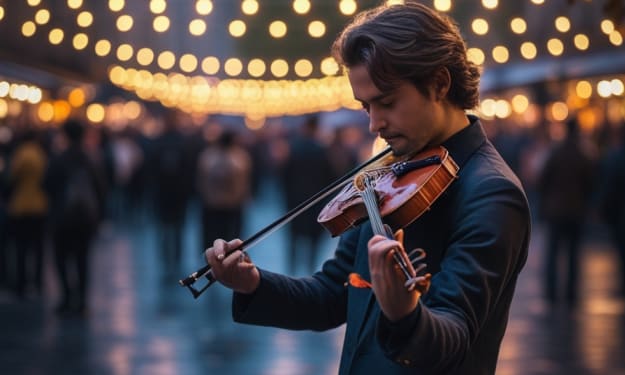
“Echoes of the Last Ember: How a Street Musician Ignited a Global Climate Movement”
Every evening at sunset, passer-bys in Centennial Plaza would pause for a single haunting melody. No billboard promised a sold-out concert, no headline trumpeted a viral video—just the raw, unfiltered music of 23-year-old Rosa Nguyen. What few realized was that this nightly serenade would become the catalyst for a global climate movement.
By suliman umar10 months ago in Poets
Boundless
A geographical map could take you there. To the places I've been, to the sights I've seen, to the landscapes I've climbed. But no compass could point you in the direction of my memories. To the experiences I've lived, to the happiness I've felt, to the wonder I've held so close to my heart.
By Alyssa Musso6 days ago in Writers
The Accidental Novelist
I never intended to write a novel. But I did. And HarperCollins published it. Titled The Gorgeous Girls, it was based on a number of pieces I'd written for Toronto's NOW magazine. They appeared in NOW's feature, Naked City, which was all about love and sex.
By Marie Wilson3 days ago in Writers

Comments
There are no comments for this story
Be the first to respond and start the conversation.