
William Faulkner
"The poet’s voice need not merely be the record of man, it can be one of the props, the pillars to help him endure and prevail."--William Faulkner, Nobel Banquet Speech

The speech is below, in case his accent is too thick for you to understand, like the attendees at the Nobel Banquet in 1950. Faulkner finished his short, brilliant speech and was met with devastating silence, his Mississippi drawl rendering his speech unintelligible to most of those international ears.
And then they read his speech in the newspaper the next morning and were absolutely blown away. When I am blessed to teach literature instead of endless courses of Freshman Comp, I make my students read it. I read it myself at least once a year, to remind me why I do this, why I struggle with all of these overwhelming emotions to create alchemy on the page, distilling rage, grief, and pain into something beautiful or perhaps scathingly witty. Instead of telling you about the speech or why it speaks to me, I give it to you so that it may speak to you as it will.
I will never cease to be in awe of Faulkner. A friend and I audited a Faulkner seminar our last semester of undergrad. That same semester, one day we ditched our French class, abducted a classmate, and drove to USCAiken for ECU's production of The Complete Works of William Shakespeare, Abridged. It was hands-down one of the best afternoons of my life. That same friend and I went to another production of the same play (yes, we also took Shakespeare together), this time at The Shakespeare Tavern in Atlanta (if you haven't been, go). But I digress. Our Faulkner professor, Margaret Yonce, affectionately known as Peggy, earned her PhD. at Ole Miss, and she told us about going to Faulkner's grave on his birthday with her classmates and bourbon. We adored Peggy and brought her a peace lily one day, with a "my name is" sticker that we labeled "Snopes." Dr. Yonce also told us about hunts Faulkner would have at Rowan Oak, where jiggers of bourbon were served on either the hour or half hour, I forget which. When Faulkner was writing screenplays in Hollywood, he called the studio and asked if he could work from home; they said yes, and were surprised when he went home to Mississippi. Peggy Yonce also told us about Faulkner's resignation from the Ole Miss post office. If you haven't had the pleasure of reading it before, here it is:
As long as I live under the capitalistic system, I expect to have my life influenced by the demands of moneyed people. But I will be damned if I propose to be at the beck and call of every itinerant scoundrel who has two cents to invest in a postage stamp.
This, sir, is my resignation.
It should be noted that Faulkner was reported to spend his time as Ole Miss postmaster drinking bourbon and playing cards in the back room. Dealing with the mail wasn't much of a priority. My rebel heart loves this.
If you haven't read any Faulkner, start with As I Lay Dying or Sanctuary (beautifully dark), which contains a few of my all-time favorite literary quotes (no, I"m not saying how many favorites I have):
"You're not being tried by common sense, [ . . .] you're being tried by a jury."
and
"Put the son of a bitch in a coffin. Let's have two funerals."
and this one, that sounds like a description of Mitch McConnell to me:
His face had a queer, bloodless color, as though seen by electric light; against the sunny silence, in his slanted straw hat and his slightly akimbo arms, he had that vicious depthless quality of stamped tin.
And now, here's the text of that famous speech:
William Faulkner’s speech at the Nobel Banquet at the City Hall in Stockholm, December 10, 1950 *
Ladies and gentlemen,
I feel that this award was not made to me as a man, but to my work – a life’s work in the agony and sweat of the human spirit, not for glory and least of all for profit, but to create out of the materials of the human spirit something which did not exist before. So this award is only mine in trust. It will not be difficult to find a dedication for the money part of it commensurate with the purpose and significance of its origin. But I would like to do the same with the acclaim too, by using this moment as a pinnacle from which I might be listened to by the young men and women already dedicated to the same anguish and travail, among whom is already that one who will some day stand here where I am standing.
Our tragedy today is a general and universal physical fear so long sustained by now that we can even bear it. There are no longer problems of the spirit. There is only the question: When will I be blown up? Because of this, the young man or woman writing today has forgotten the problems of the human heart in conflict with itself which alone can make good writing because only that is worth writing about, worth the agony and the sweat.
He must learn them again. He must teach himself that the basest of all things is to be afraid; and, teaching himself that, forget it forever, leaving no room in his workshop for anything but the old verities and truths of the heart, the old universal truths lacking which any story is ephemeral and doomed – love and honor and pity and pride and compassion and sacrifice. Until he does so, he labors under a curse. He writes not of love but of lust, of defeats in which nobody loses anything of value, of victories without hope and, worst of all, without pity or compassion. His griefs grieve on no universal bones, leaving no scars. He writes not of the heart but of the glands.
Until he relearns these things, he will write as though he stood among and watched the end of man. I decline to accept the end of man. It is easy enough to say that man is immortal simply because he will endure: that when the last dingdong of doom has clanged and faded from the last worthless rock hanging tideless in the last red and dying evening, that even then there will still be one more sound: that of his puny inexhaustible voice, still talking.
I refuse to accept this. I believe that man will not merely endure: he will prevail. He is immortal, not because he alone among creatures has an inexhaustible voice, but because he has a soul, a spirit capable of compassion and sacrifice and endurance. The poet’s, the writer’s, duty is to write about these things. It is his privilege to help man endure by lifting his heart, by reminding him of the courage and honor and hope and pride and compassion and pity and sacrifice which have been the glory of his past. The poet’s voice need not merely be the record of man, it can be one of the props, the pillars to help him endure and prevail.
From Nobel Lectures, Literature 1901-1967, Editor Horst Frenz, Elsevier Publishing Company, Amsterdam, 1969
* The speech was apparently revised by the author for publication in The Faulkner Reader. These minor changes, all of which improve the address stylistically have been incorporated here.
Every effort has been made by the publisher to credit organizations and individuals with regard to the supply of audio files. Please notify the publishers regarding corrections. Copyright © The Nobel Foundation 1950
William Faulkner – Banquet speech. NobelPrize.org. Nobel Prize Outreach 2025. Thu. 30 Oct 2025. <https://www.nobelprize.org/prizes/literature/1949/faulkner/speech/>
About the Creator
Harper Lewis
I'm a weirdo nerd who’s extremely subversive. I like rocks, incense, and all kinds of witchy stuff. Intrusive rhyme bothers me.
I’m known as Dena Brown to the revenuers and pollsters.
MA English literature, College of Charleston
Keep reading
More stories from Harper Lewis and writers in Writers and other communities.
Recitation
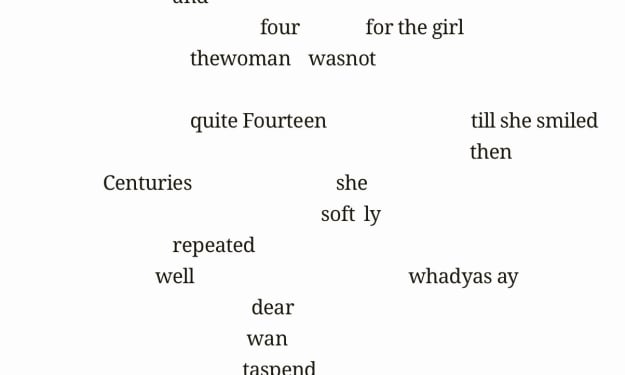
I love reciting this poem. For me, there’s a glimmer of sadness embedded in the sardonic wit, and there’s also a small epiphany within it for me, in the line “thewoman wasnot/quite Fourteen till she smiled/then/Centuries.” There’s an acknowledgment of feminine wisdom and knowledge that’s generally lacking in masculine poetry, and there’s something in her value being double that of the room. I, of course, know she’s worth much more than that. There’s also something else in that six for me outside of dollars, an echo of Persephone’s pomegranate seeds perhaps, or maybe some other allusion I can’t articulate, but this poem does what poetry should do—it makes me look at things differently
By Harper Lewis3 months ago in Writers
Cleaning The Freezer
Anne Bernays and Pamela Painter — What If? Writing Exercise for Fiction Writers prompts The Exercise — Make a list yourself of things that are done in small units of time. Here are several suggestions: Naming a pet or a child, breaking up with someone, playing a game such as Risk or Monopoly, washing a car, stealing something, waiting or standing in line for something, packing to go somewhere, cleaning the refrigerator, having a birthday party, etc. Now write a four-to-seven-page story staying within the confines of a particular time unit. For example, a birthday party story would probably last only a few hours, or an afternoon or evening; naming a pet might span a longer period of time but will still be focused on one activity. The Objective - To recognize the enormous number of shaped time units in our lives. These units can provide a natural substructure and shape for a story and make the writing of a story seem less daunting.
By Denise E Lindquista day ago in Writers
Center Stage with Gina C.
*** I'm keen to republish the interviews I did for my series with Vocal creators. It's been a few years and I thought it might be nice to revisit these wonderful conversations. I'll be releasing them one at a time for a few weeks/months.
By Heather Hubler6 days ago in Interview



Comments (1)
I used to keep a copy of the speech in my room whenever I needed a push to keep writing. Thank you for this!