
Why Your Blog Isn’t Ranking—and How to Fix It Today
“The Hidden SEO Mistakes Killing Your Traffic and Proven Fixes to Skyrocket Visibility”
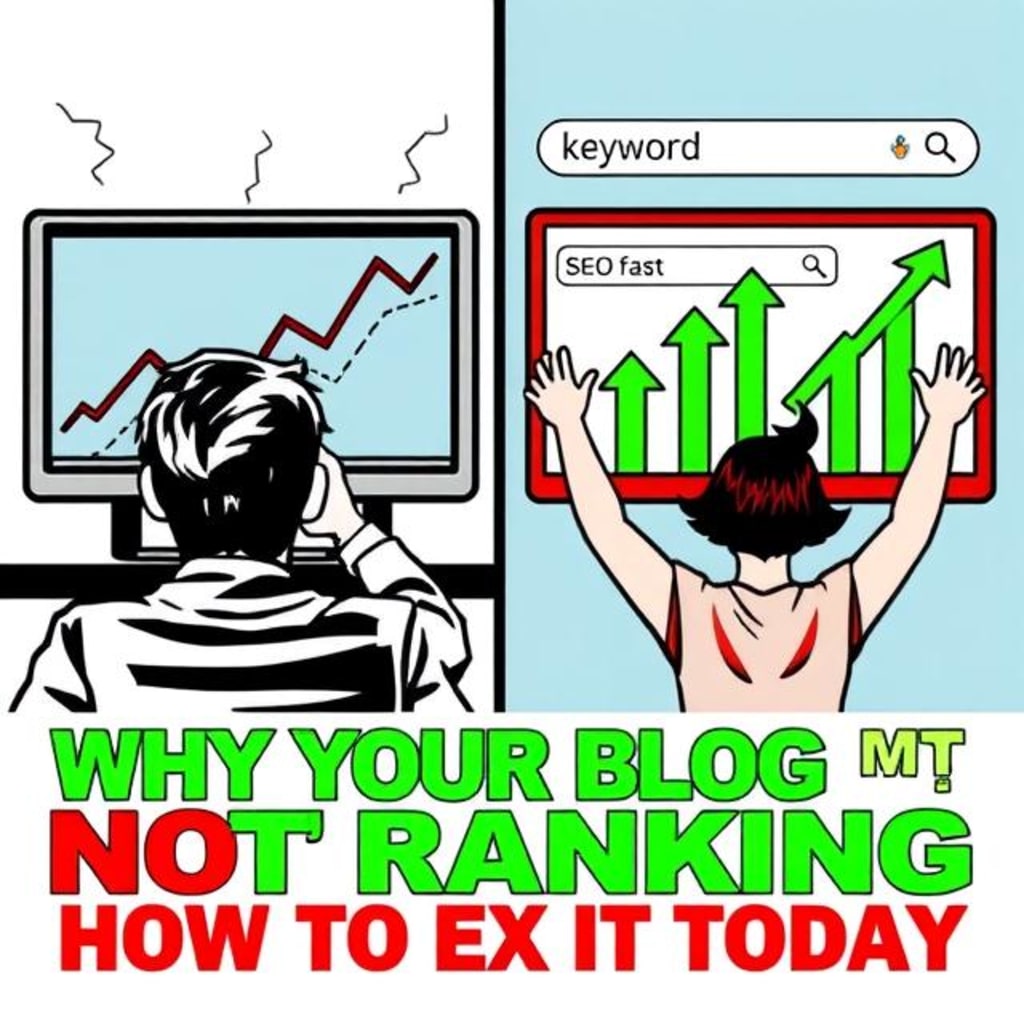
You pour your heart into your blog. You write helpful, detailed posts, format them nicely, maybe even share them on social media—but still, crickets. No traffic. No rankings. No results.
You’re not alone.
Many bloggers struggle to rank in Google, not because their content isn’t good, but because they’re unknowingly making SEO mistakes that sabotage their visibility.
The good news? You can fix most of these issues today—if you know where to look.
Let’s break down the most common reasons your blog isn’t ranking—and the exact steps to fix them right now.
1. You’re Targeting the Wrong Keywords
The Mistake:
Most bloggers write about topics they think people are searching for, without validating keyword demand. Others go after high-volume keywords that are far too competitive.
The Fix:
Use keyword research tools like Ahrefs, SEMrush, Ubersuggest, or Google Keyword Planner.
Focus on long-tail keywords with low competition but decent search volume. These are easier to rank for and bring more qualified traffic.
Use Google’s “People Also Ask” and autocomplete to discover real search terms.
Example Fix:
Instead of targeting “weight loss tips,” target “weight loss tips for new moms over 40.”
2. Your Content Doesn’t Match Search Intent
The Mistake:
You might write a 3,000-word essay when searchers just want a quick answer—or a product list when they’re expecting a how-to guide.
The Fix:
Analyze the top 5 results for your keyword. What type of content ranks? (Listicle, guide, comparison, video?)
Match the format, tone, and depth of those results while adding unique value.
Don’t just write for keywords—write for what users actually want.
Quick Tip: If people search “how to bake sourdough,” they want a step-by-step recipe, not a blog about bread history.
3. You’re Not Optimizing On-Page SEO
The Mistake:
Even great content gets buried if it’s not optimized. Many bloggers skip essential on-page elements like meta titles or use the same H1 and title tag.
The Fix:
Use this basic on-page SEO checklist:
Title tag: Use your main keyword, make it click-worthy.
Meta description: Summarize your post in 150 characters, include a call-to-action.
H1 tag: Clear headline with your primary keyword.
Subheadings (H2, H3): Break content into scannable chunks.
Internal links: Link to other relevant posts on your blog.
Image alt tags: Describe images using relevant keywords.
Bonus Tool: Use Yoast SEO or Rank Math if you’re on WordPress—they guide you through every optimization.
4. Your Site Loads Too Slowly
The Mistake:
Google penalizes slow sites. A page that takes over 3 seconds to load may lose over 50% of visitors.
The Fix:
Use Google PageSpeed Insights or GTmetrix to test load speed.
Compress images using tools like TinyPNG or ShortPixel.
Use a lightweight theme and minimal plugins.
Implement caching plugins like WP Rocket or W3 Total Cache.
Pro Tip: Choose a fast web host—slow hosting equals slow ranking.
5. You’re Not Building Backlinks
The Mistake:
Backlinks (links from other sites to your content) are one of Google’s top ranking factors. No backlinks = no authority = no ranking.
The Fix:
Write guest posts on related blogs.
Create link-worthy content (original research, stats, infographics).
Reach out to bloggers for broken link building (find broken links on their site and offer your article as a replacement).
Use tools like HARO (Help a Reporter Out) to get featured in media articles.
Even 5–10 quality backlinks can push a page up several positions.
6. Your Blog Has Technical SEO Issues
The Mistake:
Your site might have crawl errors, duplicate content, or a confusing structure—making it hard for Google to index.
The Fix:
Run a full audit using tools like Screaming Frog, Ahrefs Site Audit, or Google Search Console.
Check for:
Broken links
Duplicate meta tags
404 errors
Pages without proper canonical tags
Make sure your site is mobile-friendly and uses HTTPS.
Pro Tip: Submit an updated sitemap in Google Search Console to help Google crawl your site faster.
7. You’re Not Publishing Consistently
The Mistake:
Posting once a month—or sporadically—tells Google your site is inactive. Fresh content equals relevancy in Google’s eyes.
The Fix:
Create a content calendar and stick to it.
Aim for at least 1 high-quality blog post per week.
Refresh old content regularly (update dates, improve info, add new stats).
Consistency builds trust—with your readers and with Google.
8. Your Content Is Thin or Generic
The Mistake:
If your post is 500 words of fluff or just repeats what 100 other blogs say, you won’t rank.
The Fix:
Write in-depth, comprehensive content that’s better than what's already ranking.
Use the Skyscraper Technique: Find top-ranking content and make yours longer, better structured, and more actionable.
Add original insights, examples, charts, or case studies.
Aim for: 1,500+ words of quality, not just quantity.
9. You’re Not Promoting Your Content
The Mistake:
“Publish and pray” is not a strategy. If no one sees your blog, no one links to it—and Google doesn’t notice.
The Fix:
Share posts across multiple platforms (Twitter, LinkedIn, Facebook Groups, Reddit, Quora).
Build an email list and send out new posts to subscribers.
Repurpose your content into:
Threads (Twitter/X)
Reels
Infographics
Pinterest pins
Use paid ads (even small $5 boosts) to get early traction.
Remember: You should spend as much time promoting as you do writing.
10. You’re Ignoring Google’s Helpful Content Update
The Mistake:
Since Google’s Helpful Content Update, thin affiliate pages, AI-spam, or SEO-only articles are being penalized. Google wants content written by people, for people.
The Fix:
Focus on experience, expertise, authority, and trust (E-E-A-T).
Share first-hand experience—what worked, what didn’t.
Use real photos, personal anecdotes, and quotes.
Ask yourself: Would I find this post useful if I landed on it with zero context?
If not, rewrite it until it’s genuinely helpful.
Bonus: A Simple 5-Step Plan to Fix Ranking Today
If you're overwhelmed, here’s what to do today:
Pick one underperforming blog post from your site.
Research keywords—find a more focused long-tail version.
Update the content to match search intent, improve structure, add value.
Fix on-page SEO: update title, meta, headers, internal links.
Promote it—post on 3 platforms and email it to your list.
Track progress in Google Search Console over the next 2 weeks.
Final Thoughts: You CAN Rank—If You Act Smartly
Google doesn’t hate your blog. It just doesn’t see enough reason to rank it higher than the competition—yet.
The solution isn’t more posts. It’s better posts, smarter strategy, and consistent SEO hygiene.
You don’t need to be an expert to make progress—you just need a process.
So stop wondering “why am I not ranking?” and start fixing it—today.
About the Creator
Keep reading
More stories from Hamza Habib and writers in Writers and other communities.
Content Marketing Trends That Are Dominating 2025
It’s 2025, and content marketing is no longer just about posting blogs or tweeting links. We’ve entered a new era—one where brands must not only speak but also listen, adapt, automate, and personalize their content at scale. In this hyper-saturated digital landscape, attention is the most valuable currency—and those who master content marketing are winning the war for it.
By Hamza Habib8 months ago in Beat
What to Know About Spanish Book Translation in 2026
Maria took two years to write her first novel. When a Spanish-language publisher came calling, she faced an unforeseen hurdle: finding someone with the ability to translate her book without losing its voice. Three translators later, she learned that spanish book translation consists of so much more than converting English words into equivalents in Spanish.
By Hillshire Media2 days ago in Writers




Comments
There are no comments for this story
Be the first to respond and start the conversation.