
Why the World is Now Copying India's UPI Model
Why the U.S. & Europe Are Struggling to Match UPI's Success


UPI: India's Silent Revolution That Shook the World
A few years ago, if someone had said that India would lead the world in digital payments, most people would have laughed. After all, India was a country where cash ruled, ATMs had long queues, and online banking was considered a luxury. But today, the world is watching in awe as India's Unified Payments Interface (UPI) transforms not just the way Indians transact but also how global economies look at digital payments.
What started as a simple mobile-based payment system in 2016 has become a game-changer. It is no longer just an Indian success story - it is a global case study. From small roadside vendors to billion-dollar businesses, everyone in India is using UPI. Countries that once saw India as a laggard in technology are now trying to adopt the same model. So, what makes UPI so special? Why is the world interested in India's payment revolution? And more importantly, what does this mean for India's future?
The Beginning of a Digital Payment Revolution
UPI was introduced by the National Payments Corporation of India (NPCI) in 2016 with a simple goal - making digital transactions fast, easy, and secure. Before UPI, India had several payment methods like NEFT, RTGS, and IMPS, but all of them had limitations. Either they were slow, expensive, or required too many details. UPI removed all these hurdles.
With just a mobile number or a QR code, payments could be made in seconds. No need to carry cash, no need to swipe cards, and no need for lengthy bank details. For a country with a huge unbanked population, UPI was like giving superpowers to ordinary people. And the best part? It was free.
How UPI Changed India
From a tea seller in Varanasi to a tech startup in Bengaluru, everyone started using UPI. Within a few years, it became the backbone of India's digital economy. People no longer had to worry about carrying change, businesses didn't have to wait for days to receive payments, and banks saw a massive reduction in cash handling costs.
But the real impact was beyond convenience. It was a mindset shift. Indians, who were once skeptical about digital payments, started trusting technology. Today, even a vegetable vendor in a small village confidently accepts UPI payments without any fear of fraud. This trust in digital transactions laid the foundation for India's growing fintech sector.
UPI also played a crucial role during the COVID-19 pandemic. When physical transactions became risky, UPI ensured that India's economy didn't come to a halt. People could pay for essentials, businesses could function, and even government welfare schemes could be distributed seamlessly.
UPI has not only transformed the way Indians transact but has also positioned India as a global leader in digital payments. Let's delve deeper into this transformation, supported by compelling data and insights.
The Meteoric Rise of UPI:
UPI's growth trajectory is nothing short of remarkable. In January 2024 alone, UPI processed a staggering 12.20 billion transactions worth ₹18.41 lakh crore (approximately $222.17 billion), marking a 41.72% increase in transaction value compared to January 2023. The average transaction value stood at ₹1,430, with the system processing approximately 5,390 payments every second.
By July 2024, UPI had over 300 million monthly active users in India
In 2024 UPI Made 24 Lack Crore Rupees
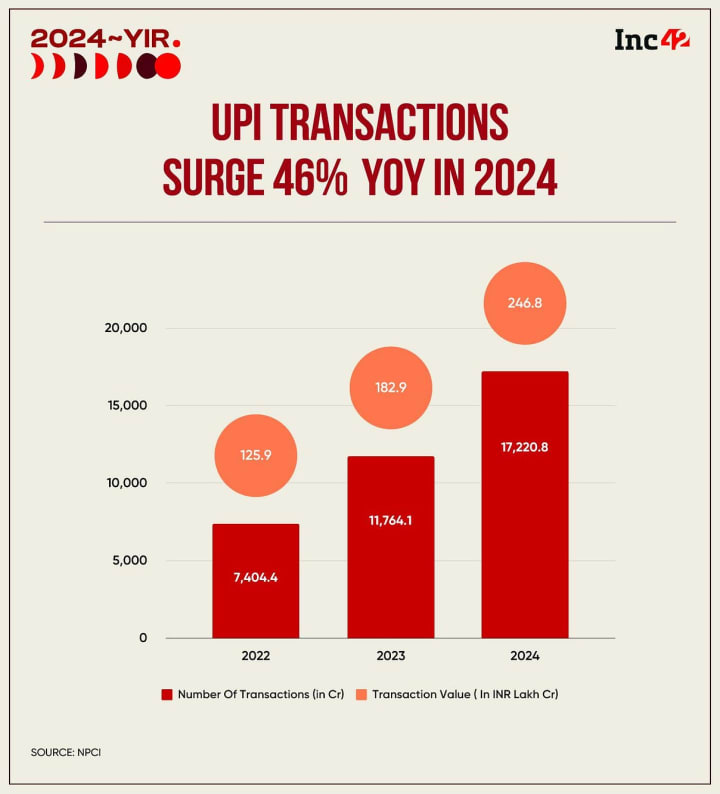
underscoring its widespread acceptance. This rapid adoption has positioned India as the global leader in instant payments, accounting for 46% of all real-time digital transactions worldwide.
India's Global Rise Through UPI
What India did with UPI was unheard of. While countries like the US and Europe still rely on slow and expensive card-based systems, India leapfrogged directly into instant mobile-based payments. And the world took notice.
Several countries, including Singapore, UAE, France, and Nepal, have either integrated UPI or are in the process of doing so. The Reserve Bank of India (RBI) is actively working to take UPI global, with collaborations happening in multiple regions. Even developed nations are exploring how they can implement a UPI-like system.
For India, this is more than just financial technology - it is soft power. Just like the world embraced Bollywood, Yoga, and Ayurveda, UPI is becoming a global brand. It is India's way of showing that innovation is not just limited to Silicon Valley - it can come from India too.
Why the World Is Interested in UPI
Cost-Effectiveness - UPI transactions are almost free, making them a great alternative to expensive credit card networks.
Real-Time Payments - Most global banking systems still take hours or days to process transactions, while UPI does it in seconds.
Financial Inclusion - Many countries struggle with banking access, and UPI provides a model to include the unbanked population.
Scalability - UPI has shown that a country with 1.4 billion people can use a digital payment system without major glitches.
The world is now divided into two kinds of countries - those that are adopting UPI and those that are thinking about it.
The Future of UPI
So, what's next? The journey of UPI is far from over. India is now expanding its capabilities with features like:
UPI Lite - A system for small transactions without internet connectivity.
Cross-border UPI Payments - Soon, Indian travelers might be able to pay via UPI in multiple countries.
Credit on UPI - A new feature that will allow users to take small loans directly through their UPI apps.
If things go as planned, UPI could become the world's standard for instant payments. Imagine a future where an Indian tourist in Paris buys coffee using UPI, or an African farmer receives aid directly into a UPI-linked wallet. This is not just a dream - work is already in progress.
The Real Question: Is the World Ready?
India has done its part by proving that UPI works. But is the world ready to accept an Indian technology over its own? Some global financial giants might resist because UPI threatens their billion-dollar transaction fee business. Credit card companies and banks have a lot to lose if UPI becomes a global norm.
However, history shows that when a technology is too powerful to ignore, it finds its way. Just like email replaced fax machines and smartphones replaced landlines, UPI has the potential to replace outdated payment systems worldwide.
Conclusion
UPI is not just about payments; it is about India's global rise. It has put India in the league of technological innovators, challenged traditional financial systems, and empowered millions. While the West debates digital currencies and slow payment systems, India has already moved ahead.
The next time you scan a QR code and pay via UPI, remember - you are not just making a transaction. You are part of a silent revolution that is reshaping the world.
About the Creator
Neeraj Tiwari
Neeraj Tiwari
Journalist | Blogger | Video Creator
I dedicated to providing insightful and fact-based content. My expertise lies in space, science, history, geopolitics, education, living beings,sports, climate change, and current affairs.
Keep reading
More stories from Neeraj Tiwari and writers in Writers and other communities.
Women: The Backbone of Society and the Light of the Future
Introduction: Why Women's Day Matters Every year on March 8th, we celebrate International Women's Day. But is one day enough to truly understand and appreciate the role of women in our society? Women are the foundation of families, the strength of economies, and the driving force behind progress.
By Neeraj Tiwariabout a year ago in Humans




Comments
There are no comments for this story
Be the first to respond and start the conversation.