
When Silence Learns to Speak
How Writing Opened a Door I Thought Was Locked Forever


Silence was the first language I ever learned.
Not the silence of peace, but the silence that grows inside a person when their truth feels too fragile to release. I carried it like a second skin—thin, invisible, and impossible to peel away. People saw me as quiet, composed, gentle. They didn’t see the storms that raged beneath my ribs. They didn’t hear the words I swallowed day after day because I didn’t know where to put them.
For years, my heart lived behind a locked door. And I convinced myself I had thrown away the key.
Then, one restless night, I found an old notebook hiding inside a drawer I rarely opened. Its edges were frayed, the pages slightly yellowed—like it had been waiting for me longer than I realized. I sat down, the room dim and soft, and wrote the first sentence without thinking. It was clumsy, uneven, almost afraid of itself… but it was mine.
I closed the notebook immediately, as if the words inside were too raw to look at. But something had shifted—so gently I almost missed it. A small crack in the old silence, like a whisper slipping through a wall.
The next night, I returned. And the next. The pages began to collect the pieces of me I had hidden in corners of my memory—pieces I thought time had washed away. My writing didn’t come in beautiful lines at first. It came in tremors. In breaths I didn’t know I’d been holding. In the quiet trembling of hands still afraid to tell the truth.
But with every page, the silence inside me loosened its grip.
I wrote about things I had avoided for years—the wound I had never cleaned, the goodbye that still echoed, the dream I let die quietly so no one would ask why. At times, my chest ached as I wrote, as if each sentence tugged at a thread that held me together. But I kept writing, because something in me knew: the pain I put into words no longer had power to haunt me in the dark.
Writing did not heal me overnight.
But it made the hurt honest.
And honesty, even when it stings, is a kind of medicine.
I began to notice small things—beautiful things—that writing pulled out of me. Grief softened when it was described. Hope brightened when it was named. The person I used to be—the one I thought I had lost—started showing up in the lines between paragraphs, waving timidly like a forgotten friend.
There were nights when my tears fell onto the page, leaving tiny watercolor blooms on the paper. There were mornings when I read what I had written and felt the ache of recognition—yes, this was me, and I had survived it. Writing became not just a place to put my hurt, but a place to retrieve my own strength.
One day, I wrote about a memory I had buried so deeply it felt like unearthing a fossil. When I finished, I didn’t feel broken. I felt… released. As if the words themselves had unlatched a heavy door in my chest. I sat there for a long time, breathing differently. Breathing freely.
That was the moment I realized something powerful:
My silence had not protected me—it had imprisoned me.
And my words, fragile as they were, were building me a way out.

Writing became the key I thought I had lost. Every page opened something inside me: a forgotten laugh, a hidden sorrow, a flicker of courage I didn’t know belonged to me. I discovered that my voice wasn’t weak or trembling—only unused. Like a bird that had spent too long inside a cage, unsure if its wings still worked.
But wings remember.
Voices remember.
Hearts remember.
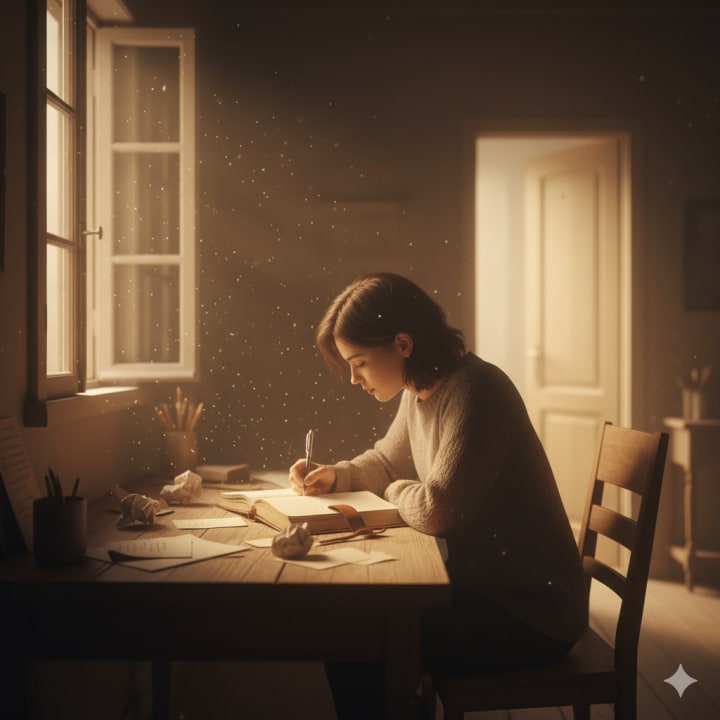
Today, when I sit down with my notebook, I no longer fear the door inside me. I know now that it was never locked. It was simply waiting—for my hand, my honesty, my willingness to open it. Writing didn’t fix me. It revealed me. It showed me the parts of myself I had buried under years of quietness and taught me that even the softest whisper carries power when it finally speaks.
I learned that silence can break you.
But breaking silence can save you.
And now, every time I write, I am reminded of a simple truth:
The soul finds its voice not when it is ready—but when it is brave.
About the Creator
john dawar
the best story writer
Keep reading
More stories from john dawar and writers in Writers and other communities.
Ink Made of Memory
One rainy evening, I opened an old notebook and found pieces of myself I thought had disappeared. The pages, worn from years of neglect, were filled with scribbled lines and trembling handwriting—fragments of thoughts I once thought too fragile to hold onto. At first, I felt the rush of nostalgia, the same familiar twinge of vulnerability I’d felt when I first wrote them. But as I sat there, reading the half-finished thoughts, I realized something unexpected: they had become bridges back to the person I once was.
By john dawar4 months ago in Writers
Unofficial Challenge: Black History Celebration
Forward: February 28th, 10:53 PM, EST... The final hour of Black History Month, 2026. Hello fellow writers. I've had this challenge waiting in my drafts for most of the month. But I held off on publishing it, until now.
By Sam Spinelli3 days ago in Writers
Alone in the Jungle
The canopy is so dense that it suffocates all light. I am slashing through the dense boscage to get to the light, but I don’t know which way to go, or if I will ever get out of the forest. This jungle feels often filled with peril, and lonely. I came to this tangle of vines, underbrush, and unknown unfamiliar territory, with a dream, a goal, a determination. I planned and still plan to reach the end of the primeval and reach the inner sanctum of a place that is not easily traversed. I am a writer, and I want to write as a career.
By Alexandra Grant6 days ago in Writers


Comments
There are no comments for this story
Be the first to respond and start the conversation.