
What is an Archetype?
Four characteristics of one of storytelling’s most powerful tools

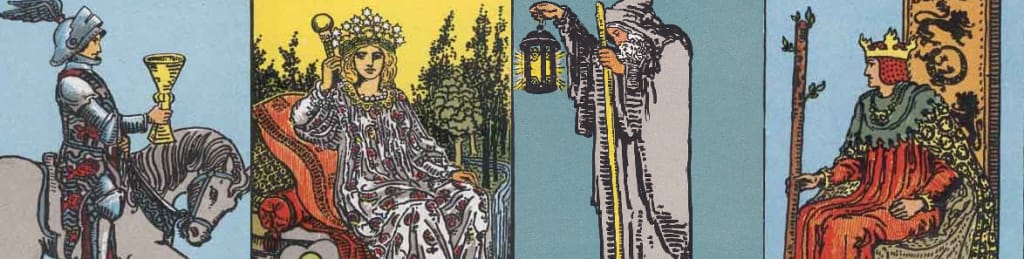
"…giants, dragons, paradises, gods, and the like are themselves the expression of certain basic elements in man's spiritual experience."
In the dreams of his patients, the hallucinations of schizophrenics, and ancient myths from across the world, psychoanalyst Carl Jung discovered certain recurring images and characters. He called these Archetypes.
If you’ve read anything about storytelling, chances are you’ve come across the term associated with fairy stories and myths. But archetypes turn up in all kinds of storytelling – novels, movies, even video games. They are a special class of symbol, distinct from allegory, and much more than mere tropes. Jung attributed their origin to mankind’s ‘collective unconscious’: a kind of shared memory or psychic interconnection. Other thinkers of a more materialist bent believe they are a part of the primordial framework of the human mind. Me, I think there’s a more reasonable explanation.
By their very nature archetypes are difficult to define, but they’re easy to recognise and understand. If I were to say, “Once upon a time, there was a King…” you already know who I’m talking about. So would anyone who ever heard the words, “Once upon a Time…”
Instead of trying to define archetypes, it’s enough to describe them. In my experience, all archetypes have four characteristics:
1. Archetypes are Polyvalent
Unlike allegory, an archetype does not have a one-to-one substitution of image for concept. Rather, it sits at the centre of a complex web of related concepts. C.S. Lewis objected to Freud’s reductive view that the King of Once Upon a Time simply represents the Father. There is no doubt the archetypal King represents fatherliness, but also goodness, wisdom, justice, majesty, generosity, responsibility, and many more concepts all bonded together. It’s not simple at all. The archetype forms at the intersection between all these related concepts, becoming a kind of super-concept: the King represents Kingliness.
2. Archetypes are not Arbitrary
Drawing a random list of concepts and qualities from a hat will not create or reveal an archetype. Certain qualities and concepts are related to one another, and others are alien. It is easy to see that Wisdom and Kindness belong together, but Wisdom and Cruelty do not. A man may be intelligent and cruel, or even foolish and cruel, but not wise and cruel. A man may be foolish and kind, but kindness elevates intelligence to wisdom. An archetype is more than the sum of its symbolic parts. It represents the true connection that relates and integrates all the component concepts.
3. Archetypes are Irreducible
With allegory, one may at any point drop the image and discuss the concept itself. With archetypes this is impossible. The image is the concept; the concept is the image. How can one discuss Kingliness without discussing the archetypal King? It is the standard by which we judge actual kings. Any king who is cruel, avaricious, or foolish we would consider a bad king; his character is un-kingly in that it does not correspond to the archetype. Herein lies the difficulty of providing clear definitions of archetypes; they are characters “to be seized in an intuition rather than built up out of concepts; we need to know them, not to know about them.”
4. Archetypes are Universal
The obsessive, alcoholic detective will be familiar to any western cinemagoer; it will mean little to the Samburu tribesman of East Africa, and nothing at all to the 12th century peasant. But all three will have a clear and similar understanding of the King of Once Upon a Time. Tropes, mere story-telling conventions, remain particular to the culture that generated them. Archetypes travel. They are built on the true connections of real concepts that any reasonable person should be able to apprehend.
That archetypes represent real truths is a better explanation for their universality than the ‘collective unconscious’ or primordial embedding. In ‘The Abolition of Man’ C.S. Lewis makes the case for Objective Values. He argues that concepts like Justice, Love, Beauty, these things are not arbitrary, defined by cultural conditioning or personal preference. They are real, self-evident truths. You cannot reason beyond them because they are themselves the very foundations of reason. Archetypes, therefore, express reality beyond predicates. They require acceptance that their constituent concepts are all real, objective values that can be apprehended by reason, so they themselves can be comprehended.
If archetypes are apprehended by reason, not innate imprints on the human psyche, it is reasonable to assume that we may, if not invent, at least discover new archetypes.
“It may be that when we are trying to express clearly to ourselves or to others a conception which we have never perfectly understood, a new metaphor simply starts forth, under the pressure of composition or argument. When this happens, the result is often as surprising and illuminating to us as to our audience; and I am inclined to think that this is what happens with the great, new metaphors of the poets. And when it does happen, it is plain that our new understanding is bound up with the new metaphor.”
Archetypes are complex metaphors, and their discovery comes about in the very same manner as C.S. Lewis describes stumbling across a new metaphor. Considering an image, the mind finds it connects with a concept, then multiple concepts, and then finds it cannot account for the connection between these concepts without the image. Nevertheless, the connection is true; and if true, the connection must have existed before the mind ever contemplated it. The Lion was not promoted to King of Beasts by the contrivance of a poet. The poet merely recognised the Lion was kingly, and the King leonine.
The power of archetypes lies in their truth; their drawing connections between truths and inviting us to look for ourselves and see if it is not so. Contrary to popular belief, they are not simple. Not just a cardboard cut-out story-writing shortcut. What they express is so complex it can only be accomplished through symbol. If you lose the image, you lose the concept. If I had to produce some definition of what an archetype is, I would say it is not an echo from the collective unconscious, nor a shadow from the primordial brain, but it this: an irreducible metaphor.
About the Creator
Alec Liddle
I'm a writer, filmmaker, and musician from Northern Ireland, obsessed with telling better stories
Keep reading
More stories from writers in Writers and other communities.
Unofficial Challenge: Black History Celebration
Forward: February 28th, 10:53 PM, EST... The final hour of Black History Month, 2026. Hello fellow writers. I've had this challenge waiting in my drafts for most of the month. But I held off on publishing it, until now.
By Sam Spinelli6 days ago in Writers
Neighbours
The end of the row was dominated by the red brick, iron-railed schools. The small infant school was separated by a central drive from the Juniors, the lair of the terrifying Miss Chudleigh, “Ugly Chugly” we called her, but not if she was in earshot. At the top of the drive was the Secondary Modern, where they put your head down the bog and pulled the chain.
By Keith Butler3 days ago in Writers
A More Human Vocal
When we launched Vocal nearly a decade ago, the world was a very different place. LLMs did not exist, and stories were created one at a time by people sitting down to write, revise, and share something personal. Many of our assumptions about publishing, trust, and participation were built for a world where effort and output were inseparable.
By Justin @ Vocala day ago in Resources
"Scream 7" (2026): Running out of Fresh Screams
This is the seventh time we’ve had a Ghostface crisis. Scream 7 is the latest edition of the Scream franchise. Sydney Prescott and her family are under attack by another anonymous killer dressed in a Ghostface costume. While having issues with her daughter, Tatum, they run from the bloody murders, trying to determine who is behind it all.
By Marielle Sabbag5 days ago in Horror




Comments (1)
Terrific work! Keep it going