
What happened to Feminism?: The Invention of the Action Heroine in film
I’m looking at three films to figure out why movies love to punish strong women, and what it actually takes for a female character to have real power on screen.
From Spectacle to Story
Action women in cinema are not a new concept. They have been an important fixture since the beginnings of Japanese film, from the early “cinema of attractions” to more modern narrative cinema. But to understand the complex relationship between women and their roles on screen, it helps to start with film history itself.
Film theorist Tom Gunning once wrote that “in the earliest years of exhibition, the cinema itself was an attraction. Early audiences went to exhibitions to see machines demonstrated… rather than to view films.” This exhibitionist mode, which he later called the cinema of attractions, relied on the power of the moving image to surprise, thrill, or excite, with little concern for story. In this early mode, women appeared less as characters and more as visual stimuli, which made it difficult for female action to feel meaningful or intentional.
Gunning noted that women in this period were often tied to “female nudity or revealing clothing, decay, and death,” their bodies used as erotic spectacle rather than as agents of story. It was only when cinema began moving toward narrative storytelling, as seen in D. W. Griffith’s work, that women could begin to act as characters with motives and goals. Yet even in narrative film, gender-based disparities persist. Female action still struggles under the weight of expectations, lack of agency, and voyeuristic spectacle. This essay explores how cinema has long struggled to connect power with femininity, and how only by shifting the camera from objectifying women’s bodies to aligning with their sensory experience, through what scholar Laura Marks calls haptic visuality, can female protagonists truly become action heroines.
Punished For Her Strength
The first step to realizing women’s action is acknowledging their womanhood and maintaining it despite sexist ideas of strength and weakness. Legal scholar Catharine MacKinnon describes this as a problem of “gender hierarchy… male supremacy and female subjugation.” Her framing helps explain why female power is often treated as threatening within patriarchal systems, something revenge stories struggle to reconcile.
Lady Snowblood is a clear example. The story begins when four people attack Yuki’s parents, killing her father and leaving her mother imprisoned. Yuki is literally born to get revenge, trained her whole life to hunt down those responsible. On one hand, she subverts traditional gender norms by controlling the story while her victims become grotesque spectacles of destruction. Yet she is also described as having an uncontrollable bloodlust: “beneath her beautiful face raged a desire to hunt down her enemies.” That description turns her vengeance into something innate and demonic rather than chosen.
In a world where “men are trained to be strong and women are trained to be weak,” as MacKinnon writes, Yuki stands out, but the film punishes her for it. Her violence is not treated as noble duty like that of a male samurai. It is treated as aberration. To be heroic, she must lose her femininity. Lady Snowblood builds its tension on that contradiction. Yuki’s power comes at the expense of her womanhood.
Miya(left) in The Great Killing (1964)
Agency and the Limits of Choice
Agency of self does not always equal agency in story. Philosopher Donald Davidson explained that “seeing something as an action of an agent is seeing it in relation to an agent’s reasons or intentions.” Female protagonists often lack that realized will and exist instead as figures at the mercy of the plot.
Yuki is labeled an asura, a demon of wrath, since birth. This strips her of humanity and aligns her vengeance with something innate rather than chosen. She was trained from childhood to be an instrument of revenge, fulfilling the wishes of others rather than her own. Her fate was sealed before she could form her own identity. If “action is an event which has the agent as its cause,” as Davidson wrote, then Yuki does not truly have agency. She moves the story, but the story does not come from her.
Spectacle of Suffering
If Yuki’s story shows how narrative cinema punishes female strength, Miya’s arc in The Great Killing reveals an even darker truth. Miya is the only woman among men on both sides of the conflict. She strategizes, fights, and earns respect as an equal participant. Yet the film still turns her into a spectacle.
There are multiple scenes where she is physically overpowered by her own allies, moments that linger far too long. The camera’s fixation makes the violence feel like part of the entertainment. Alfred Hitchcock once joked, “Torture the women,” a line that film scholar Linda Williams cited to explain how horror and action cinema often turn female pain into spectacle. Laura Mulvey’s famous essay Visual Pleasure and Narrative Cinema builds on this, noting that “in a world ordered by sexual imbalance, pleasure in looking has been split between active or male and passive or female.”
That is exactly what happens here. Miya’s body becomes the site of viewer sensation rather than her own intention. Even as she fights back, the audience’s gaze traps her in passivity. Her heroism is overshadowed by voyeurism. Her strength is eclipsed by her pain.
Ichiko in 100 Yen Love (2014)
Reclaiming the Gaze
Haptic visuality offers a way to reclaim women’s bodies from spectacle and give them genuine narrative power. Laura Marks describes haptic visuality as a mode that “addresses the body of the viewer directly, inciting sensations in the skin.” Instead of provoking reactions through gore or eroticism, haptic images invite the viewer into the character’s sensory world. The viewer does not just see. They feel.
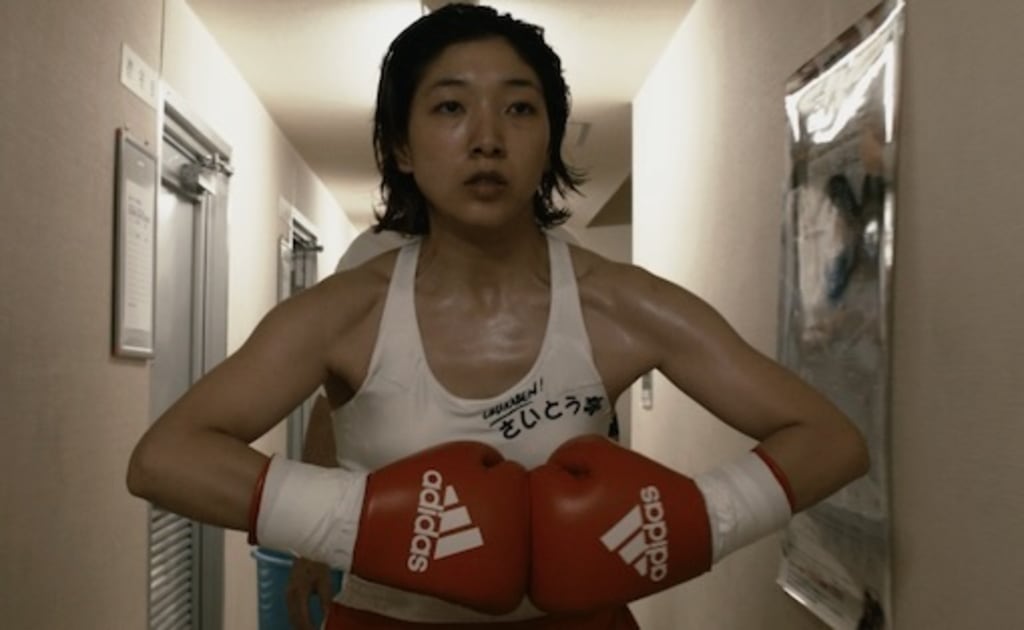
Ichiko in 100 Yen Love embodies this. She is a woman who fights yet remains entirely herself. The boxing scenes are not flashy montages. They linger on her ragged breathing, sweat, and exhaustion. The camera stays close enough that we feel each punch with her. Our empathy becomes physical. Every bruise and gasp for air feels shared. She is not a spectacle. She is a presence.
Even in her assault scene, the framing changes what could have been exploitation into revelation. The film holds on her face, the tremor of shock giving way to resolve. The sequence becomes about endurance rather than voyeurism. The audience is invited into her experience rather than kept outside it. That intimacy transforms her from object to subject.
The Rise of the Action Heroine
Even when women are strong, cinema often strips them of meaningful choice. Even when they have choice, it turns them into objects of the gaze. Haptic visuality offers a solution. By allowing viewers to experience what the heroine feels, both physically and emotionally, it restores her humanity.
Through this lens, the action heroine becomes something new, not defined by spectacle or gendered binaries but by agency and empathy. We stop just watching her and start feeling with her. That shift, from objectified body to embodied experience, is what makes her truly heroic.
About the Creator
Keep reading
More stories from writers in Writers and other communities.
Ludacris and Nelly draw backlash over bookings at MAGA-coded music festival
Ludacris and Nelly headlining a mostly right-wing event is good for them. It’s also great for the genre of hip hop. The two rap veterans have showcased their talents on other stages. Why can’t they perform for mostly MAGA folks and grab that bag?
By Skyler Saunders5 days ago in Beat




Comments
There are no comments for this story
Be the first to respond and start the conversation.