
Voices of Tomorrow
In a world shaped by silence, the new generation speaks with thunder.
The world hadn’t ended in fire or flood. It ended in silence.
No alarms. No protests. Just the slow dimming of noise, like a volume dial turning down humanity’s spirit.
In the city of Niora, silence was the law. The Sound Code, passed two decades earlier, had turned every public word into a monitored whisper. Even laughter in the wrong context could lead to a knock on the door—one no one ever answered the same way twice. Music? Gone. Books with poetry or passion? Redacted. Every conversation monitored, every thought molded through the VoiceNet chip installed in every child at birth.
It was called “peace.” But to anyone paying attention, it was a graveyard.
Among the crumbling outer sectors of Niora, beyond the radius of surveillance drones and hollow-eyed enforcers, the silence cracked.
A boy named Elian cracked it.
He was sixteen, lean with wild eyes and a mind that saw patterns where others saw rules. Born in a district too poor to maintain its infrastructure, his VoiceNet chip had glitched at birth. It never activated. His parents, too fearful to report it, had raised him in secrecy, teaching him to pretend—to mimic the dull, emotionless speech of others while keeping his real voice buried beneath layers of caution.
But Elian had questions. Too many. Why could no one sing? Why were the old instruments burned? Why did every face look like it had forgotten joy?
Then, on a night brushed with stormclouds, he found a notebook buried under the floorboards of an abandoned train station. It had no author. Just pages filled with strange symbols, fragments of melody, and something he’d never seen before:
Lyrics.
He read the lines over and over, whispering them to himself, and for the first time, something inside him resonated. A feeling he couldn’t describe, like thunder behind his ribs.
In the weeks that followed, he taught himself to speak differently. Not flat and filtered, but with rhythm. With intention. Then, he began to hum. Softly at first, in the alleys and ruins, mimicking the rise and fall of sound from the notebook.
He didn’t know the drones had heard him. That a low-level surveillance AI flagged it. But by then, it was too late.
Because others had already found him.
Leira, the daughter of a council worker, who had secretly recorded the echo of her grandmother’s lullaby before she passed.
Juno, who built crude instruments from scrap metal and wood and had never once followed a rule she didn’t rewrite.
And Sami, mute since the Purge, but who communicated in beats tapped into walls—her silence more powerful than any scream.
Together, they formed what would become the spark of change: The Resonance.
They met in shadowed basements, forgotten stations, and rooftops where the wind could carry their experiments away. Leira hacked VoiceNet dampeners. Juno found a way to redirect old broadcast towers. And Elian wrote.
He wrote songs—new ones and old lines reborn. His voice deepened as he read them aloud, and one night, as they stood beneath a broken dome and let the sound fly, something miraculous happened.
A drone hovered nearby.
And it didn’t report them.
Instead, it paused. Its lights flickered.
Then it dropped to the ground, dead.
Somehow, Elian’s voice—layered with the right notes and frequencies—had interfered with the machine’s code. They realized then: the silence wasn’t just psychological. It was structural. Engineered through frequency control. The right sound could break it.
That’s when the plan formed.
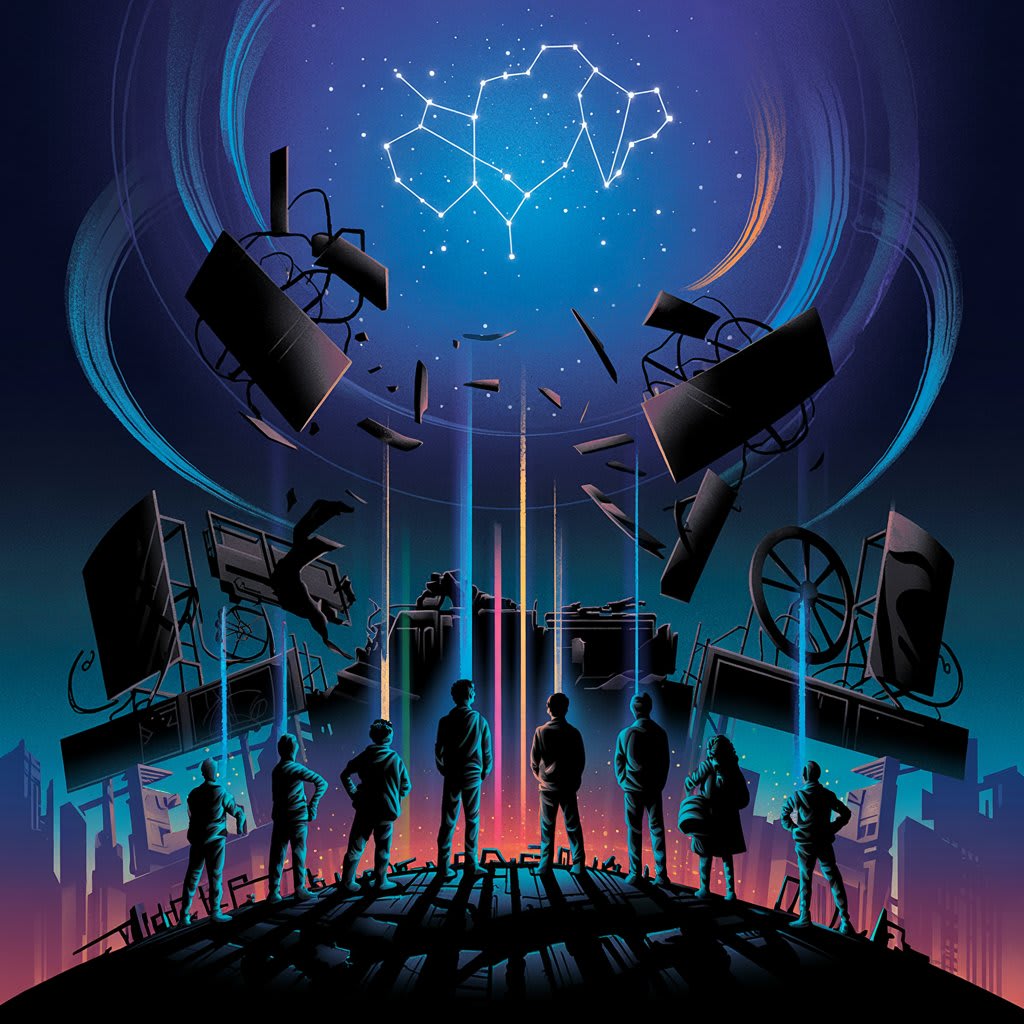
On the Day of Harmony—a global broadcast event designed to “reinforce collective unity”—The Resonance would hijack the main transmission tower. They would play a song. Not just any song. A song stitched from the dreams of the silenced. Words that had waited a generation to be spoken.
They called it The Awakening Verse.
Getting to the tower took everything: stolen credentials, rigged transports, and sacrifices they never spoke of again. But they reached the core. Elian stood before the microphone—sweating, shaking, fire in his chest.
When he opened his mouth, his voice wasn’t just his own.
It was everyone’s.
The lullabies, the laughter, the grief, the dreams.
It hit the city like a storm. Screens shattered. Chips malfunctioned. For the first time in twenty years, people heard something real.
And remembered what it meant to feel alive!
About the Creator
MUHAMMAD Hukamran
Hello this is Muhammad HUKAMRAN
✅ Content creator
✅Book writer
✅ Story writer
✅ Content writer
Much moreeee
Facebook: https://www.facebook.com/share/15WT7WRfqq/
Instagram:https://www.instagram.com/mhukamazhari_1?igsh=enlnZnAyenUzNzVr
Keep reading
More stories from MUHAMMAD Hukamran and writers in Writers and other communities.


Comments
There are no comments for this story
Be the first to respond and start the conversation.