
Top 10 Balance Exercises for Older Adults
Top 10 balance exercises for older adults that require no equipment. Learn home workout routines, including strength, resistance, and stretching exercises, to improve stability and prevent falls.

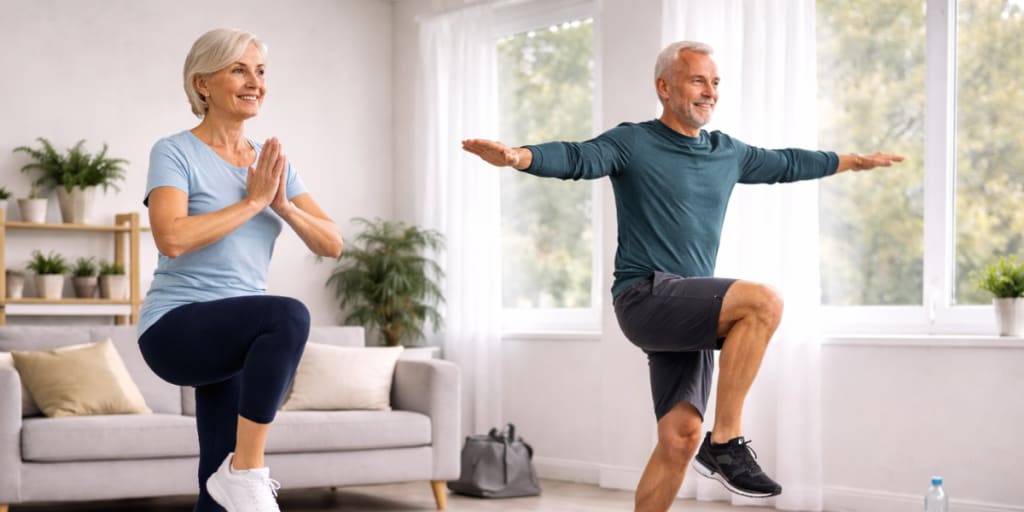
Table of Contents
Introduction: Why Balance Matters as We Age
Understanding the Importance of Balance Training
Top 10 Balance Exercises for Older Adults
1. Single-Leg Stance
2. Heel-to-Toe Walk
3. Standing Knee Lifts
4. Side Leg Raises
5. Back Leg Raises
6. Calf Raises
7. Sit-to-Stand Exercise
8. Tandem Stance
9. Clock Reach
10. Weight Shifts
Complementary Exercises for a Complete Home Workout
Resistance Exercises for Older Adults
Stretching Exercises for Older Adults
Strengthening Exercises for Older Adults
Safety Tips for Your Home Workout Routine
Creating Your Home Workout Schedule
Frequently Asked Questions (FAQs)
Conclusion: Taking the First Step
Introduction: Why Balance Matters as We Age
As we get older, maintaining balance becomes crucial for independence and quality of life. Falls are one of the leading causes of injury among seniors, but the good news is that balance can be improved at any age. The beauty of a home workout routine is that you can practice these exercises in the comfort and safety of your own space, and the best part? This no-equipment home workout guide means you can start today without spending a dime.
These balance exercises for older adults not only help prevent falls but also strengthen your core, improve posture, and boost confidence in daily activities. Let's explore ten effective exercises you can incorporate into your routine, along with complementary strength exercises for older adults and stretching exercises for older adults to create a well-rounded fitness program.
Understanding the Importance of Balance Training
Before diving into specific exercises, it's essential to understand why balance training matters. As we age, our proprioception—the body's ability to sense its position in space—naturally declines. Combined with reduced muscle strength and flexibility, this creates a perfect storm for instability.
Balance exercises for older adults work by:
Strengthening stabilizing muscles in the legs, core, and ankles
Improving coordination between the brain and body
Enhancing spatial awareness
Building confidence in movement
The exercises we'll cover are gentle exercises for older adults, meaning they're designed to challenge you without putting undue stress on joints or risking injury.
Top 10 Balance Exercises for Older Adults
1. Single-Leg Stance
This foundational balance exercise is perfect for beginners. Stand near a chair or wall for support, then lift one foot off the ground, holding for 10-30 seconds. Switch legs and repeat. This simple move is one of the most effective strengthening exercises for older adults because it engages your entire standing leg, from your toes to your hip.
Pro tip: As you improve, try closing your eyes for an added challenge.
2. Heel-to-Toe Walk
Walking in a straight line with your heel touching your toes mimics tightrope walking. This exercise improves linear balance and is excellent for everyday activities like walking on uneven surfaces. Take 20 steps forward, then turn and walk back.
3. Standing Knee Lifts
Stand tall and slowly lift one knee toward your chest, hold for a few seconds, then lower. Alternate legs for 10-15 repetitions per side. This exercise doubles as one of the best knee exercises for older adults while simultaneously challenging your balance and strengthening your hip flexors.
4. Side Leg Raises
Hold onto a sturdy surface for support. Lift one leg out to the side, keeping it straight, then slowly lower it back down. This no-equipment home workout move strengthens the hip abductors, which are crucial for lateral stability and preventing side falls.
Complete 10-12 raises per leg for 2-3 sets.
5. Back Leg Raises
Similar to side leg raises, this exercise targets your glutes and lower back. Standing behind a chair, lift one leg straight back without bending your knee or pointing your toes. Hold for a second, then lower. These resistance exercises for older adults use your body weight to build strength in the posterior chain.
6. Calf Raises
Stand with feet hip-width apart, holding onto a counter or chair for light support. Rise up onto your toes, hold for 2-3 seconds, then slowly lower down. Calf raises strengthen the lower legs and ankles, which are essential for maintaining balance during everyday activities. Aim for 15-20 repetitions.
7. Sit-to-Stand Exercise
This functional movement mimics getting up from a chair—something we do dozens of times daily. Start seated in a sturdy chair, then stand up without using your hands if possible. Lower back down with control. This is one of the most practical strength exercises for older adults because it directly improves independence in daily life.
Repeat 10-15 times for 2-3 sets.
8. Tandem Stance
Stand with one foot directly in front of the other, heel to toe, as if standing on a tightrope. Hold this position for 30 seconds, then switch which foot is in front. This narrow base of support challenges your balance system more intensely than a regular stance.
9. Clock Reach
Imagine you're standing in the center of a clock. Lift your right leg and reach it toward 12 o'clock (forward), then 3 o'clock (side), then 6 o'clock (back). This exercise improves multi-directional balance and coordination. Complete 5 reaches in each direction per leg.
10. Weight Shifts
Stand with feet hip-width apart. Shift your weight to your right foot, lifting your left foot slightly off the ground. Hold for 10 seconds, then shift to the left. This simple exercise teaches your body to control weight transfer, which is essential for walking and changing direction safely.
Complementary Exercises for a Complete Home Workout
Resistance Exercises for Older Adults
While balance is crucial, incorporating resistance exercises for older adults amplifies your results. Bodyweight exercises like wall push-ups, chair squats, and modified planks build the muscle strength needed to support balance. Strong muscles act as shock absorbers and stabilizers, making you less prone to losing your footing.
Stretching Exercises for Older Adults
Flexibility is the often-forgotten component of balance training. Stretching exercises for older adults should target the calves, hamstrings, hip flexors, and shoulders. Gentle stretches held for 20-30 seconds after your balance routine improve range of motion and reduce the risk of muscle strains. Try seated toe touches, standing quad stretches, and doorway chest stretches.
Strengthening Exercises for Older Adults
Beyond balance-specific moves, include strengthening exercises for older adults that target major muscle groups. Bodyweight squats, lunges (holding onto support), and modified push-ups build overall functional strength. Stronger muscles mean better control and stability in all movements.
Safety Tips for Your Home Workout Routine
When practicing these gentle exercise routines for older adults, keep these safety guidelines in mind:
Always have support nearby: Keep a sturdy chair, counter, or wall within reach
Wear proper footwear: Non-slip shoes with good support are ideal
Start slowly: Begin with shorter holds and fewer repetitions
Listen to your body: If something causes pain (not just discomfort), stop
Clear your space: Remove tripping hazards like rugs or clutter
Stay consistent: Practice 3-4 times per week for best results
Creating Your Home Workout Schedule
The beauty of this no-equipment home workout program is its flexibility. Here's a sample weekly schedule:
Monday/Thursday: Focus on balance exercises (exercises 1-10), 20-25 minutes Tuesday/Friday: Strengthening exercises for older adults, 15-20 minutes Wednesday/Saturday: Stretching exercises for older adults and gentle movement, 15 minutes Sunday: Rest or gentle walking
Remember, consistency beats intensity. It's better to do 15 minutes daily than an exhausting hour once a week.
Frequently Asked Questions (FAQs)
Q: How long does it take to see improvement in balance?
Most older adults notice improvements within 4-6 weeks of consistent practice. Balance, like any skill, develops gradually with regular training.
Q: Can I do these exercises if I have arthritis or joint pain?
Yes, these are gentle exercises for older adults designed to be low-impact. However, always consult your doctor before starting any new exercise program, especially if you have existing health conditions.
Q: What if I can't do an exercise without holding on?
That's perfectly fine! Using support is encouraged when learning. As you build strength and confidence, you can gradually reduce how much you rely on support.
Q: Are these exercises safe after a fall?
If you've experienced a fall, work with a physical therapist or healthcare provider to ensure you're doing exercises appropriate for your recovery. These exercises can be part of fall prevention, but professional guidance is important after an injury.
Q: How do I know if I'm progressing?
Track how long you can hold balance positions, how many repetitions you complete, and how confident you feel during daily activities. Being able to reduce support or close your eyes during exercises is also a sign of progress.
Q: Can these exercises help with dizziness?
Balance exercises can improve vestibular function over time, which may help with some types of dizziness. However, if you experience frequent dizziness, consult a healthcare provider to rule out underlying medical conditions.
Conclusion: Taking the First Step
Starting a home workout routine focused on balance doesn't require expensive equipment or a gym membership. These balance exercises for older adults, combined with resistance exercises for older adults, stretching exercises for older adults, and targeted knee exercises for older adults, create a comprehensive program for healthy aging.
The key is to start where you are, progress at your own pace, and remain consistent. Every single-leg stance, every calf raise, and every weight shift is an investment in your independence, confidence, and quality of life. Your future self will thank you for the time you invest today in building better balance.
Remember, it's never too late to improve your balance and strength. Begin with just one or two exercises, and gradually add more as you build confidence. Your journey to better balance starts with a single step—make that step today.
About the Creator
Theworkouthaven.com
Welcome to The Workout Haven
This space was born from a simple belief: fitness should be accessible, enjoyable, and sustainable for everyone, regardless of where you are in your journey.
Keep reading
More stories from Theworkouthaven.com and writers in Writers and other communities.
Chick-fil-A Cool Wrap Nutrition
Are you looking for a lighter meal option at Chick-fil-A that doesn't compromise on flavor? The Chick-fil-A Cool Wrap has become one of the most popular menu items for health-conscious diners. In this comprehensive guide, we'll break down everything you need to know about this fresh, flavorful wrap.
By Theworkouthaven.com2 months ago in Writers
The Man Who Never Opened His Mail
For almost six years, Arif did something most people would find impossible. He never opened his mail. Every week, envelopes slipped through the narrow slot of his apartment door and landed on the floor like small white accusations. Bills. Warnings. Government letters. Bank statements. Words he was too afraid to read.
By shakir hamid2 days ago in Writers




Comments
There are no comments for this story
Be the first to respond and start the conversation.