
The Simandou project with an investment of more than US$20 billion was put into operation
Simandou project

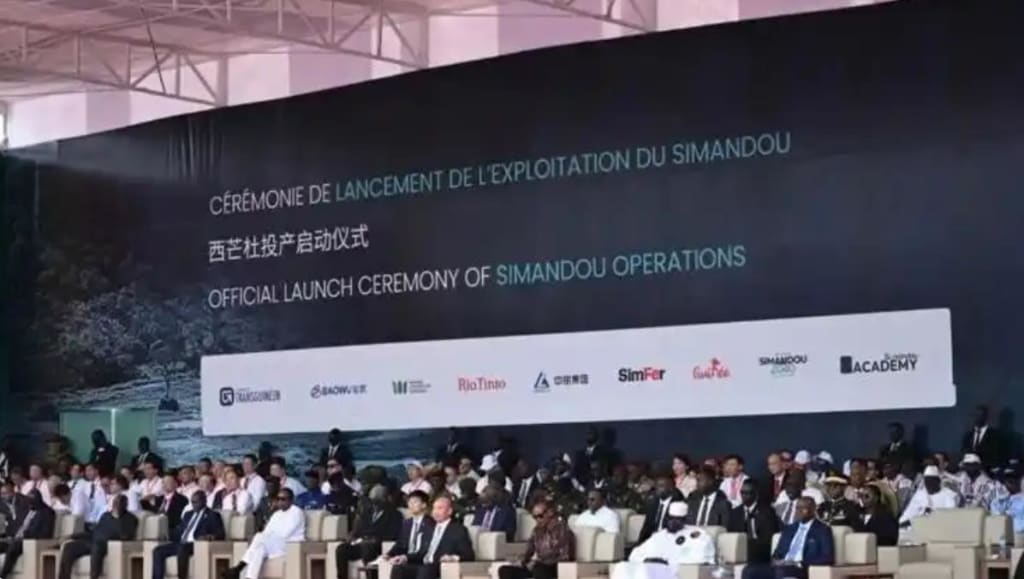
On November 11, local time, the launch ceremony of the Simandou project was held grandly at the Port of Maribaya in Guinea. Guinean President Mamadi Doumbouya, Chinese Vice Premier Liu Guozhong, Rwandan President Kagame, and Gabon President Nguema attended the commissioning ceremony. Sun Yong, Chinese Ambassador to Guinea, Lin Tao, Deputy Secretary-General of the State Council of China, Zhang Zhili, Vice Minister of Agriculture of China, Zhao Zhiyuan, Assistant Minister of Foreign Affairs of China, Wang Jiming, Deputy General Manager of China Baowu Group, and representatives of all relevant parties of the project attended the commissioning ceremony. Win Alliance (Win Alliance is a multinational consortium formed by Winning International Group (45%), China Hongqiao Group's Weiqiao Aluminum (35%), French investment company UMS in Guinea (20%) and China Yantai Port Group), China Baowu, China Aluminum Group and Rio Tinto Group attended.
The Simandou Iron Ore Project in the Republic of Guinea in western Africa is one of the highest quality and largest mining projects in the world. The project covers mines, railways, ports and other systems, with a total investment of more than 20 billion US dollars. Among them, the mine is divided into two blocks: northern and southern blocks. Since the Simandou northern block project entered the substantive construction stage in June 2024, Baowu has collaborated with various shareholders and participating units to adopt "Chinese standards", "Chinese design", "Chinese construction" and "Chinese equipment" to complete the completion of the mine, railway and port ahead of schedule, and complete the project's production goals with high quality and efficiency.
Hu Wangming, chairman of China Baowu Group, said in an interview with reporters recently that the successful commissioning of the Simandou project is an important milestone in the history of global mining. During the project development process, all parties have always focused on the overall situation, based on the long-term, adhered to the principles of marketization, rule of law, and internationalization, ensuring high-standard and high-quality advancement of the project. Once the Simandou Iron Ore Project reaches capacity and operates stably, it will provide a solid foundation of green raw materials for the development of the global steel industry, and will also inject lasting impetus into Guinea's economic and social development.
Jiba Diakite, Chief of Staff of the Presidential Office of Guinea and Chairman of the Simandou Strategic Committee, said at the ceremony that with great joy and excitement, we witnessed the shipment and export of the first batch of iron ore from the Simandou project. This is a historic moment that the Guinean people have been looking forward to for decades. For this, we would like to express our sincerest gratitude to all the parties, partners, employees and community members involved in this extraordinary project. The Guinean government will build a sustainable development partnership based on the Simandou 2040 plan to make natural resources an engine for the country's sustainable development.
Part One: Simandou Project Commissioning Process and Product Introduction
1. Introduction to Simandou’s basic situation and shipping plan
The Simandou Iron Ore Project consists of the northern block (Mining Areas 1&2) and the southern block (Mining Areas 3&4), with a total resource of more than 4.6 billion tons. It is the world's largest undeveloped high-grade iron ore resource and the largest mining and related infrastructure project in Africa.
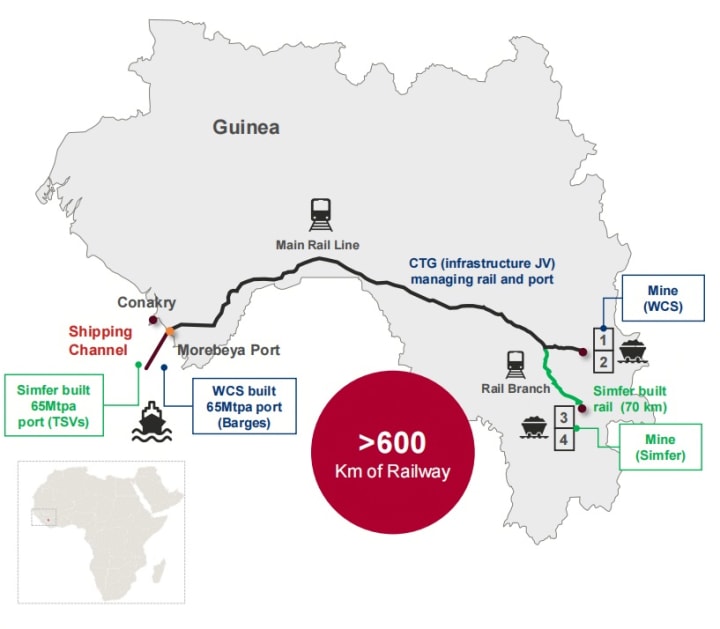
In terms of development entities, the Simandou project has formed a cooperation pattern with multiple international and local governments. The northern block is jointly developed by Win Consortium (WCS, led by Winning International Group of Singapore and Shandong Weiqiao Aluminum of China) and Baowu Resources Group. The iron ore reserves exceed 1.8 billion tons and the iron grade is about 65.5%. The southern block is led by Simfer Company and is jointly participated by a Chinese consortium led by Rio Tinto Group and Chalco Iron Ore Holdings Co., Ltd. The iron ore reserves are 2.8 billion tons and the iron grade is about 65.5%. The Trans-Guinea Company (CTG) is leading the development of railways, ports and other infrastructure supporting the Simandou iron ore project. The company is a joint venture jointly established by the Guinean government, Win Consortium (WCS) and Simfer in July 2022.
The core and biggest challenge of the Simandou iron ore project lies in its "mine-railway-port" integrated system project with a total investment of more than 20 billion US dollars. After years of construction, the project infrastructure has gradually made decisive progress and will be connected to the system in the second half of 2025.
(1) Railway system:
The Trans-Guinea Railway with a total length of more than 600 kilometers is the lifeline of the project. The northern block is led by Win Alliance and Baowu to build the 552-kilometer main double-track railway; the southern block is led by Simfer, Rio Tinto, and Chinalco, and the China Railway 18th Bureau and others have completed the main project of the mine branch line. The total length is about 70 kilometers, using a 25-ton axle load standard. Five bridges and one tunnel will be built along the line to connect to the 552-kilometer main railway line.
(2) Port system: dual-hub layout on the Atlantic coast.
The Maribaya Port and the SimFer dedicated port together form an export hub and are currently in the final stages of construction. By September 2025, SimFer Port has completed the construction of all 419 rock-socketed piles. Key facilities such as the heavy oil power station, belt conveyor system and operation center administrative building are in place and have entered the final equipment commissioning stage. The port will use advanced transfer ships to operate to overcome the limitations of hydrological conditions and ensure an annual shipping capacity of 65 million tons.
2. Basic introduction to Simandou iron ore products
In terms of product indicators, the average iron ore grade of the Simandou project is 65.5%. More importantly, its harmful impurity content is extremely low, with the average aluminum content and silicon content being less than 3% and 2% respectively. The characteristics of high quality and low impurities can not only reduce the smelting costs of steel companies, but also reduce pollutant emissions and meet the needs of the green transformation of the global steel industry.
Specifically, according to information disclosed by Rio Tinto, Simandou sample products were subjected to sintering and pelletizing experiments respectively. The results showed that compared with sintering, the pelletizing process consumes less energy, emits less carbon, and significantly reduces SOx and NOx emissions. If production costs are further reduced in the future and a stable supply of high-quality raw materials is ensured, flux-based pellets will have strong growth potential. The Simandou iron ore product itself has a low silica content, providing an efficient and cost-effective way to produce high-quality flux-based pellets. Pellet tests confirmed that replacing magnetite concentrate with Simandou ore and optimizing the hardening temperature resulted in strong compressive strength and improved reducibility. At the same time, Simandou iron ore product is also a valuable sinter raw material. For steel mills that rely on high-silicon varieties, blending with Simandou iron ore products can reduce silica content and improve iron grades, thereby increasing the use of low-cost, high-silicon products or low-price fluxes.
Part 2: Analysis of the Impact of the Simandou Project on Iron Ore Prices
The Simandou project plans to reach a total full production capacity of 120 million tons within 30 months after being put into operation, with the north and south blocks each having a capacity of 60 million tons. Although the project has been successfully put into production in November 2025, the impact on global iron ore supply this year is more symbolic, and the actual increase is expected to total no more than 1 million tons. Taking into account various factors such as infrastructure differences and equity background, the overall pace of production in the northern mining area is expected to be relatively faster. Among them, taking into account the instability in the initial stage of the project's commissioning, the total output of the north and south blocks is expected to reach 20 million tons. The subsequent 2027-2028 will be a critical period for increasing production. It is expected that the output release will accelerate, and the total output in 2028 will be close to 80 million tons. Conservative estimates suggest that the northern block and southern block will reach full production in 2029 and 2030 respectively.
There is no doubt that the Simandou project will play an important role in the increase in global iron ore production in the next five years. The project's commissioning is expected to break the existing pattern dominated by Australia and Brazil and form a new situation of "Australia-Brazil-Africa" multi-country supply. Specifically, it is estimated that global iron ore production is expected to reach 2.925 billion tons in 2030, an increase of 313 million tons compared with 2025. Among them, iron ore production in Africa is expected to exceed 250 million tons in 2030, accounting for 8.6% of the world, an increase of 4.5 percentage points from 2025.
At the same time, global iron ore demand is expected to decline overall in the next five years. As the world's largest iron ore market, China's overall market demand for steel will gradually decrease due to industrial structure upgrades and production capacity replacement. Although the growth in steel demand in emerging countries such as India and Southeast Asia will replace part of the demand, it is expected that the overall global iron ore demand will still show a downward trend. Therefore, the gap between supply and demand in the global iron ore market is expected to further expand from 2025 to 2030, causing continued downward pressure on iron ore prices. From the perspective of product structure, Simandou iron ore will be dominated by high-grade lump ore and powdered ore. Considering that the steel industry will still face certain downward pressure next year, or continue to squeeze the profits of finished products, steel mills are expected to continue to reduce costs and increase efficiency next year, thereby suppressing the demand for high-grade ore and creating a situation where the gap between supply and demand of high-grade ore will further expand. Therefore, overall the premium level of high-grade ore may be further restricted next year.
About the Creator
SINOSTEEL STAINLESS STEEL PIPE
Sinosteel Stainless Steel Pipe Technology (Shanxi) Co., Ltd. is the manufacturer of Stainless Steel Pipe and Special Alloy Pipe. Steel pipes with an outer diameter from 8mm to 3600mm, with wall thicknesses from 0.2mm to 120mm.
Keep reading
More stories from SINOSTEEL STAINLESS STEEL PIPE and writers in Writers and other communities.
China’s import and export data of steel, rare earths, automobiles, etc. from January to October
According to statistics from the General Administration of Customs of the People's Republic of China, China's import and export data of steel, rare earths, automobiles, etc. from January to October are as follows:
By SINOSTEEL STAINLESS STEEL PIPE2 months ago in Writers
It's Winter
Anne Bernays and Pamela Painter — What If? Writing Exercise for Fiction Writers prompts The Exercise —Write a scene involving two characters. Have the point-of-view character presume something entirely different about the situation from what the other character's overt behavior seems to imply. For example, a landlord comes to visit, and the tenant suspects that it isn't a visit but an inspection. Make up several situations in which one character can fantasize or project or suspect or even fear what another character is thinking. The Objective - To show how your characters can use their imaginations to interpret the behavior and dialogue of other characters.
By Denise E Lindquist18 days ago in Writers
Where Dreams Loved Me Back
chapter 1 Chapter One: The Quiet I Learned to Carry Matthew’s perspective, I don’t remember when life started feeling heavy. It wasn’t sudden — it was gradual, like carrying a bag that someone kept adding weight to until one day I realized I couldn’t put it down anymore.
By Anshu Giri4 days ago in Writers


Comments
There are no comments for this story
Be the first to respond and start the conversation.