
The Science of Why We Love Stories
A writer-friendly piece breaking down psychology and neuroscience behind storytelling, written in an accessible and engaging way.

The Science of Why We Love Stories
By Hasnain Shah
Why do stories matter so much to us? Think about it: every culture on Earth, no matter how old or how isolated, has stories. From cave paintings in Lascaux to TikTok videos today, humans have always been obsessed with telling and listening. It isn’t just entertainment. Neuroscience and psychology suggest that storytelling is hardwired into our brains.
So let’s explore why our minds are built to crave stories—and why, as writers, we can never underestimate their power.
🧠 Stories Are Brain Food
When you read a dry fact, say: “The grass is green,” your brain processes it in a fairly limited way. But if I tell you: “The grass shimmered in the morning sun, damp with dew that clung like tiny jewels to each blade,” suddenly your brain lights up.
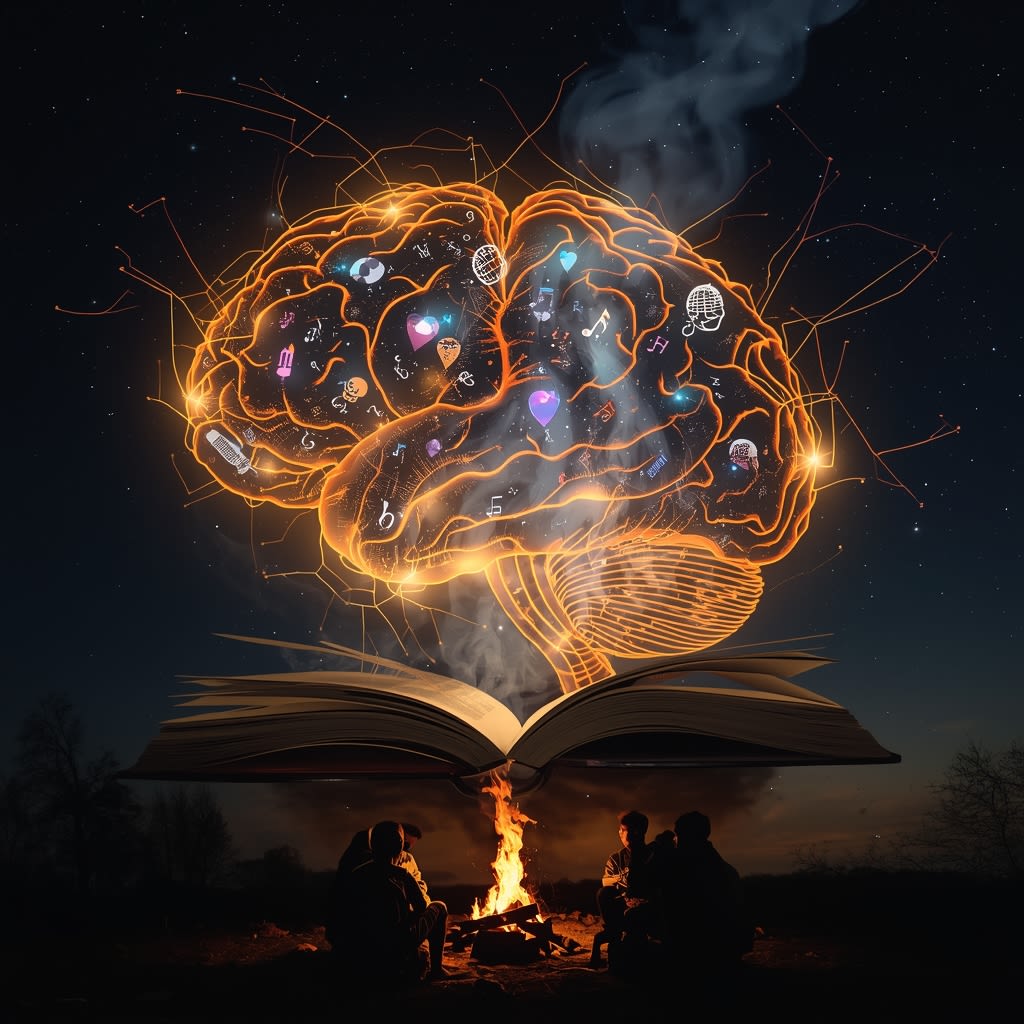
Why? Because stories don’t just engage the language centers of the brain. They activate sensory regions too. Neuroscientists call this neural coupling. When someone tells you about a delicious meal, your brain’s taste and smell areas activate almost as if you were eating it yourself.
This means stories trick the brain into believing we are experiencing something first-hand. That’s why a novel can make your heart race, a movie can make you cry, and a bedtime story can soothe a restless child.
💡 Stories Are How We Learn
Long before textbooks or PowerPoints, humans shared knowledge through storytelling. “Don’t eat that berry—it made Uncle sick.” “Beware of the crocodile near the bend in the river.” Wrapped inside a story, survival lessons were memorable and easy to pass on.
Psychologists call this narrative transportation—when a story pulls us in so deeply, we absorb lessons and morals without even realizing it. In fact, research shows people are more likely to remember and act on information if it’s presented as a story rather than as bullet points.
Think about advertising. You might forget a product description, but you’ll remember the commercial where a dog waits for its owner to come home. The emotional hook makes the message stick.
❤️ Stories Create Empathy
One of the most beautiful powers of storytelling is empathy. When we read about someone else’s struggles, our brains release oxytocin, the same hormone that fosters trust and bonding.
Oxytocin is sometimes called the “love hormone,” but in the context of stories, it helps us imagine lives beyond our own. It’s what allows us to feel sadness for a fictional character, or joy when a stranger in a memoir finds healing.
This is why stories can change minds and even societies. A statistic about refugees may be ignored, but a single refugee’s story can move people to act. Numbers inform us. Stories transform us.
🧩 Stories Organize Chaos
Life is messy. Random events, half-remembered conversations, sudden changes. Our brains hate disorder, so we constantly weave experiences into coherent narratives. This is called the narrative bias.
For example, if you miss a bus, you might tell yourself a story: “Maybe it saved me from an accident down the road,” or “It’s just bad luck, like always.” Neither explanation may be true, but the act of putting chaos into a story makes it easier to process.
As writers, we can see how natural this instinct is. Even when reality offers fragments, our brains crave arcs: beginnings, conflicts, resolutions. We want life to make sense, and stories give us that illusion of order.
✍️ What This Means for Writers
Understanding the science behind storytelling isn’t just fascinating—it’s practical.
Use sensory detail. Engage more parts of the brain by going beyond facts to touch on sight, sound, taste, and touch.
Hook with emotion. Facts inform, but feelings persuade. Let readers feel before they think.
Build empathy. Create characters readers can see themselves in—or learn to love despite differences.
Offer meaning. Even in fiction, stories resonate when they give shape to life’s chaos.
The beauty is, you don’t have to “force” any of this. Our brains are already primed to respond. As long as you tell an honest, compelling story, the biology takes care of the rest.
🌍 Why We’ll Always Need Stories
Here’s the simplest way to put it: stories connect us. They connect neurons in the brain, they connect lessons across generations, and they connect people across boundaries of culture and time.
Long after the facts are forgotten, the story remains. That’s why humanity has carried them for tens of thousands of years—and why, if you’re a writer, your stories might outlive you too.
So the next time you sit down to write, remember: you’re not just telling tales. You’re feeding a hunger wired into the human brain itself. And there’s nothing more powerful than that.
About the Creator
Hasnain Shah
"I write about the little things that shape our big moments—stories that inspire, spark curiosity, and sometimes just make you smile. If you’re here, you probably love words as much as I do—so welcome, and let’s explore together."
Keep reading
More stories from Hasnain Shah and writers in Writers and other communities.
When Silence Speaks Louder: Navigating Friendships That Fade
When Silence Speaks Louder: Navigating Friendships That Fade By Hasnain Shah Friendships rarely end with a slam of the door. More often, they dissolve quietly, like sand slipping through our fingers when we weren’t paying attention. The last message left on “read,” the coffee dates that keep being postponed, the promises of “we’ll catch up soon” that somehow stretch into months. What once felt constant begins to feel like silence, and that silence says more than any words ever could.
By Hasnain Shah6 months ago in Humans
I Chose Self-Publishing Because 70% Royalties Sounded Better. Then 70% Of Zero Changed My Mind.
I have a self-published book, and it was a flop. Only sold 10 copies type of flop. But I didn't choose self-publishing after careful consideration of both paths. I chose it because it seemed obviously better, and I didn't want to interrogate that assumption.
By Ellen Frances4 days ago in Writers




Comments
There are no comments for this story
Be the first to respond and start the conversation.