
The Protagonist is the Byline
Or: That's not a byline. But it works.


Slight problem: I do not actually know what a byline is. I'll look it up on Merriam-Webster.
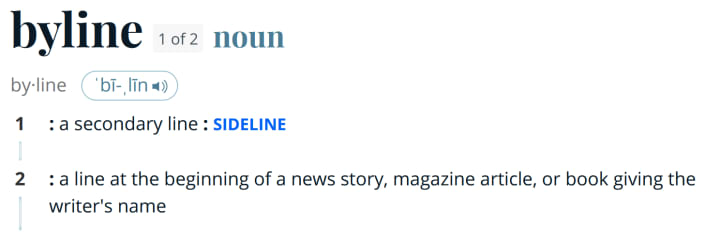
Uh-huh. So I've done that thing again where I hear words, never look them up, and act like I know their meaning based on feeling. Later on I'll use the word and still not look it up, because I feel like I'm correctly using the word. And so I continue on with my mistaken perception until I have to look up a word, like today.
But hear me out. Those feelings may have been on the right track.
Backstory: I've been working on a certain piece. It's fun. I'm fulfilled. I'm alive—I feed myself, stay hydrated, take stretch breaks, and step away from the project when I feel like clawing my scalp off. I make sure I'm not away from it too long either, because I'm very aware of my tendency to abandon projects if I make too little or no progress at all.
Meaning, after I finished the first major arc and the narrative staled, I scrabbled to find my drive. After all, there's no continuing a draft if I’m not engaged with it.
"Make an outline!"
I did that. Twice. First I started with a list, a simple "and then... and then..." series of events. Some were hypothetical. Some I knew were definite scenes of character development. Then, keeping in mind the need for rising tension, I selected events and rearranged them based on cause/effect, action/reaction.
So I had a plot. Great!
But my writing hand wasn't moving.
Not great!
"Just write through it!"
This certainly did the job of embossing more graphite onto a blank page. If writing were just a matter of getting as many words onto the page as possible and extracting the best out of it through edits and revisions—uh, wait, that’s college-level writer’s workshop talking, isn't it?
This is the writing regimen that leads to the evergreen memes you see flooding the writing community on Tumblr. Head-banging the keyboard. Staring at a blank screen and counting time with the blinking cursor. Thinking about writing but never actually writing. "Just writing" through the desolation is the torture writers tend to glorify. Personally? I don't subscribe to that method.
Writing, after all, is my haven, my catharsis, my safest place to explore myself, my worlds, my hyperfixations, and humanity at large. If I’m going to wrestle with boredom, I’d rather binge video games. Or start another project.
Then how do I inspire myself again? Where do I find the will to keep writing without torturing myself?
Like other agonizing puzzles, I returned to the basics. Before worldbuilding, before plot structure, before narrative perspective or even what genre I wanted to write, I examined my characters. I needed to pick through, in particular, my protagonist.

Lo and behold, my protagonist had desiccated into a reaction machine churning out banal actions for some amorphous goal I barely recognized. Drying paint had more purpose than my protagonist. So I opened a new page, labeled it CHARACTER STUDY, and took incremental dives through my protagonist’s layers. I started with an image, a question—where is your happy place?—and carried on a cycle of asking and answering prompts about my protagonist’s inner and outer worlds.
What I learned? He has neither sweeping goals or revolutionary ambitions, but he does desperately wish for a certain normality to his life. He’s highly skilled at the one way he knows to get that wish granted, but something’s warning him he’s going the wrong way. His arc, I realized, had to be characterized by a series of escalating events with very little breaks in between. Pressurized tension and omnipresent strain would tell my protagonist’s story.
And that's how I realized:
The protagonist is the byline.
My misconception led me to believe "byline" meant "an invisible line," like a transparent wire suspending a colorful mobile. A protagonist is like that wire, their desires, ambitions, emotions, and actions determining the pacing, mood, and tone of a story. This holds true no matter how big or little of a goal a protagonist sets out to accomplish. We follow the arc—a type of line—of the protagonist. We follow the flow of emotions—another line—of the protagonist. If we illustrate the journey of a protagonist and map the highs and lows of that journey, we end up with a line.

A well-defined, compelling protagonist is literally the line of a story. A secondary line to the plotline. A byline.
And on the topic of a strong, relatable protagonist, we segue into the second definition of “byline”: “a line at the beginning… giving the writer’s name.” It’s the line toward the top of this page telling you this article is by me, Nagisa.
Stay with me now. We're almost done.
Though a writer physically produces the protagonist’s story, the best stories are collaborative efforts between the writer and the protagonist. A writer’s engagement determines the depth of the protagonist, whose soul and world the immersed reader fully inhabits.
A good story, therefore, is not only the physical and emotional toil of the writer, but also the protagonist's invitation, welcoming readers to share their trials, tribulations, and vulnerabilities. A writer cannot communicate a story without a protagonist's input.
So, a good story is just as much by the protagonist as it is by the writer.
The protagonist is the byline.
But of course, I’m no expert. I’m just another writer navigating my own course through the craft.
About the Creator
Nagisa K.
Reflective essays (with some photos) on Fridays and short stories every other Sunday as I power along the path to publication!
Maybe I meander. Maybe I think back to Okinawa. I go to a lot of places in my head.
No AI in my writing, ever.
Unofficial Challenge: Black History Celebration
Forward: February 28th, 10:53 PM, EST... The final hour of Black History Month, 2026. Hello fellow writers. I've had this challenge waiting in my drafts for most of the month. But I held off on publishing it, until now.
By Sam Spinelli4 days ago in Writers
What to Know Before Starting a Concrete Project in San Jose
Concrete is often seen as a simple building material — gray, strong, and permanent. But once you begin planning a driveway, patio, or foundation, you quickly realize that concrete work is far more technical than it appears. In a place like San Jose, where property values are high and curb appeal matters, making informed decisions about your concrete project can significantly impact both durability and long-term value.
By Abbasi Publisher2 days ago in Writers
When the Shelter Closes
Across the street from my house, a man slept under a tree, his dog by his side. My first, naive thought: he must be traveling through. But he kept coming back, often sleeping there during the day. Then it hit me—that person might not have a home.
By Bride of Sound7 days ago in Humans


Comments
There are no comments for this story
Be the first to respond and start the conversation.