
The Mad Love of Lila and Majnun
A Journey Through Desire, Sorrow, and the Power of the Heart

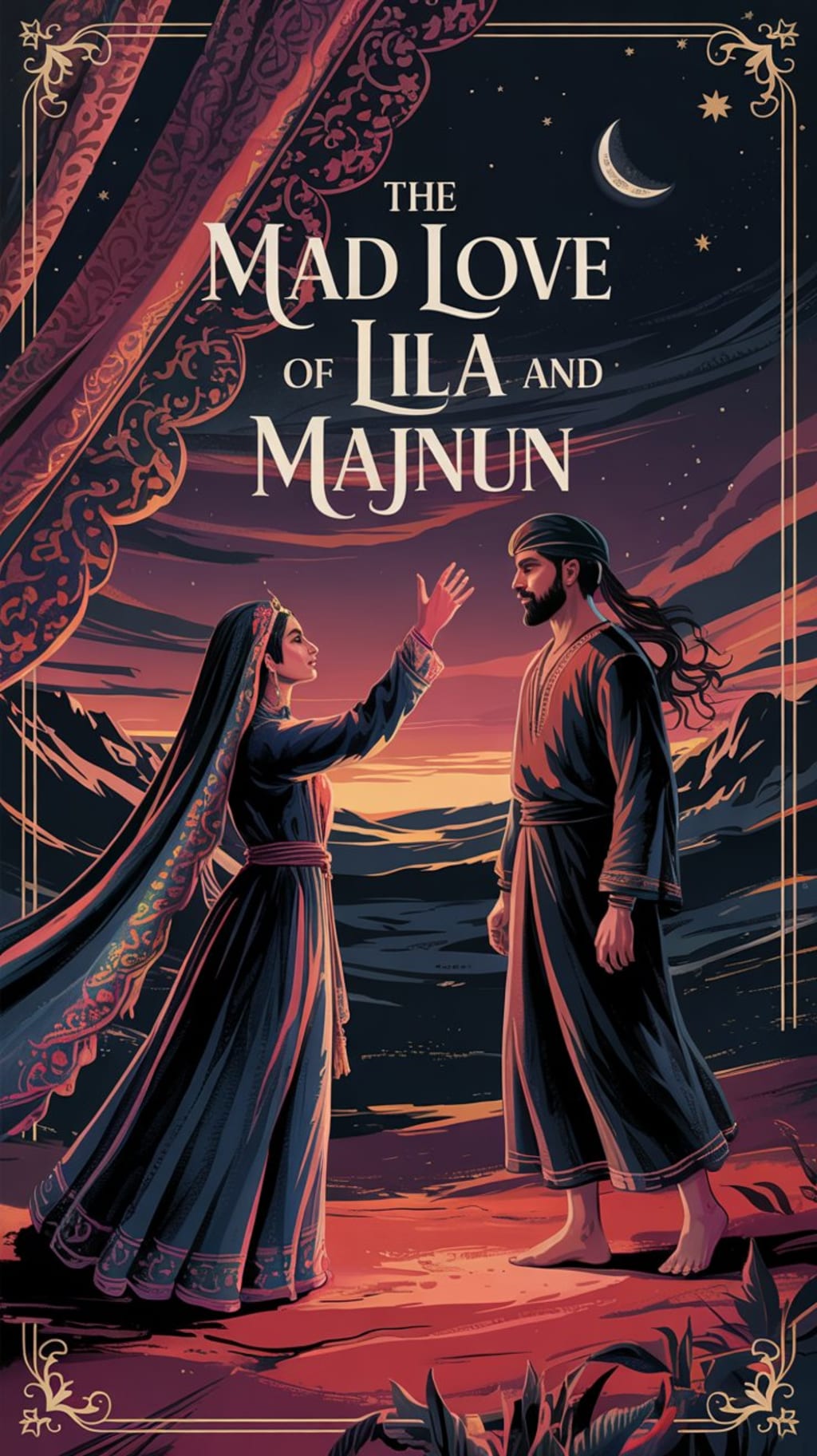
In the golden haze of an ancient desert, where the winds whispered secrets and stars hung low over moonlit dunes, two souls were bound by a love so intense it threatened to consume them.
Lila, the daughter of a nobleman, was known throughout the land for her beauty, grace, and sharp mind. Her presence stirred the air like a song too delicate for words. Many suitors came to her father’s gate, hoping to win her heart, but none could match the passion burning in the eyes of Qays, the poet's son.
Qays was a dreamer. From the first time he saw Lila under the shade of an olive tree, he felt the world tilt. She smiled at him, just once, and in that smile, he saw eternity. From that moment on, he wrote verses that floated through the village like the scent of jasmine at dusk. He wrote of her eyes, her voice, her laughter, and the ache of longing that bloomed in his chest like fire. People began calling him “Majnun” — the madman — because of how consumed he became with love.
Their souls met in secret, through glances, poems passed beneath windows, and brief meetings by the river. Their love was pure, but in the eyes of society, it was dangerous. Lila’s father, proud and ambitious, saw Qays as unsuitable — a poor poet with no title or wealth to offer. When he learned of their secret courtship, he forbade Lila from ever seeing him again. He locked her away and arranged a marriage to a wealthy merchant from a distant city.
Lila wept. She refused to eat, to smile, to speak. Her heart was no longer hers. It beat only for Majnun.
When Qays heard of her impending marriage, something inside him broke. He wandered into the desert, barefoot and silent, speaking only to the stars and the animals. He refused food, slept beneath the sky, and scribbled verses into the sand with trembling fingers. The villagers pitied him. Some feared him. But none could reach him. He had become a ghost of a man, living only in the memory of Lila’s love.
Meanwhile, Lila was married off to a man she did not love. Though he offered her luxury and comfort, her spirit wilted. Every night, she would sit by her window, staring into the dark, hoping to catch a whisper of Majnun’s poetry on the breeze.
Years passed. Qays, now fully Majnun, wandered from village to village, his beard unkempt, his robes tattered. He recited poetry to trees and sang to the moon. But his verses, even in madness, touched hearts. Travelers carried his words across the land, and even those who never met him wept at the sound of his longing.
One day, a traveler passed by Lila’s home and sang a line of Majnun’s latest verse:
"Even the wind cannot touch her, yet it dances in my veins with her name."
Lila’s heart surged. She knew he was alive. She knew he still loved her.
With the help of an old servant who remembered the days of their secret meetings, Lila sent a message. A small piece of parchment, folded like a petal, hidden in a box of dates. It found its way to Majnun through the kindness of strangers.
When Majnun read the note — just a single line, “I have not forgotten the olive tree” — he fell to his knees. It was their tree, their place. It was where he had first known love.
Driven by a sudden clarity, Majnun returned to the village. He did not enter the town or knock on her door. He simply sat by the olive tree, day after day, hoping to see her once more.
Lila, now pale and fragile from years of grief, begged her husband to let her walk to the tree, just once. To her surprise, he agreed. He had come to see that her soul would never belong to him, and perhaps in this last walk, she might find peace.
She approached the tree at twilight. Majnun was there, as thin as a reed, his eyes closed, head resting on the bark. When he opened his eyes and saw her, the world seemed to pause. Neither spoke. There was no need. Their silence said everything.
Lila knelt beside him, her hand reaching for his. For the first time in years, they touched. And in that touch, they felt whole again.
But love like theirs was too powerful for this world. Lila’s body, long weakened by sorrow, could bear no more. Her heart gave out in Majnun’s arms. He did not weep. He simply held her, whispered her name, and then closed his eyes.
By morning, they were both gone — Lila, at last free of her earthly cage, and Majnun, his soul flying after hers like a flame chasing the wind.
The villagers buried them side by side beneath the olive tree. No one disturbed the ground again. Flowers began to grow there, blooming even in the heat of summer, even in the heart of the desert.
Their story spread far beyond their homeland — a tale of love so deep it transcended reason, so pure it could not be contained by the world of men.
Some say that on moonlit nights, if you sit by an old tree and listen closely, you can hear Majnun’s poetry carried on the wind, and the soft whisper of Lila’s laughter in the leaves.
Moral:
True love does not die. It may be denied, broken, or hidden—but it lives on in every word, every breath, and every echo of the heart. And sometimes, love must go mad to remain pure.
About the Creator
It's Winter
Anne Bernays and Pamela Painter — What If? Writing Exercise for Fiction Writers prompts The Exercise —Write a scene involving two characters. Have the point-of-view character presume something entirely different about the situation from what the other character's overt behavior seems to imply. For example, a landlord comes to visit, and the tenant suspects that it isn't a visit but an inspection. Make up several situations in which one character can fantasize or project or suspect or even fear what another character is thinking. The Objective - To show how your characters can use their imaginations to interpret the behavior and dialogue of other characters.
By Denise E Lindquist18 days ago in Writers
Point The Blame At Your Heart
I write some poems, but not as many as others on Vocal. Most of my poems are about love—wanting love, sad love, or feelings of love. I think I am a big softie inside! Here we go. We blame love stuff on our hearts. We say “loving you with all my heart” and “you break my heart.” All love and feelings are linked to our hearts. We blame everything good or bad on hearts.
By Rosalina Jane4 days ago in Writers
Smart phones, Humans and Aliens.
WARNING. I will be tapping into one of your favorite creative tensions: The absurdity of humans worshipping their glowing rectangles as if they were tiny oracles. There’s something deliciously poetic about that contradiction, and it lends itself beautifully to an instructive proviso.
By Novel Allen4 days ago in Poets


Comments
There are no comments for this story
Be the first to respond and start the conversation.