
The Impact of AI on Modern eLearning Platforms (By: Streak Ranker)
The Impact of AI on Modern eLearning Platforms

Key Insights into AI's eLearning Revolution
- Personalized Learning Journeys: AI meticulously tailors educational content and pacing to each individual learner's unique needs, strengths, and learning styles, fostering deeper comprehension and engagement.
- Automated Efficiency: From content generation to grading and administrative tasks, AI streamlines and automates various processes, freeing educators to focus on high-value instructional design and student interaction.
- Enhanced Engagement & Support: Through adaptive assessments, intelligent tutoring systems, and gamified experiences, AI creates dynamic, interactive, and highly supportive learning environments available 24/7.
Artificial intelligence (AI) has profoundly transformed modern eLearning platforms, fundamentally reshaping how education is delivered, experienced, and managed. As of 2025, AI is not merely an add-on but a foundational element, seamlessly integrating advanced technologies like machine learning and predictive algorithms to create more personalized, efficient, and engaging educational experiences. This transformative impact spans across various dimensions, benefiting learners, educators, and organizations alike.
The Core Pillars of AI-Driven eLearning Transformation
The integration of AI into eLearning platforms manifests in several key areas, each contributing to a more adaptive, inclusive, and effective learning ecosystem.
Hyper-Personalization and Adaptive Learning
One of the most significant contributions of AI to eLearning is its ability to deliver hyper-personalized learning experiences. AI algorithms analyze vast amounts of individual learner data, including interactions, performance, preferences, and even emotional states, to dynamically tailor content, pacing, and assessments. This ensures that learners engage with material perfectly suited to their unique needs and learning styles, which significantly increases retention and motivation.
Customized Learning Paths
AI can create customized learning paths that adapt in real-time. If a student struggles with a particular concept, the system can automatically provide additional resources, practice problems, or tutorials designed to address those specific gaps. Conversely, if a learner demonstrates mastery, the platform can accelerate their progression to more advanced topics. This dynamic adjustment supports diverse learning needs, including those with disabilities, by ensuring that content is neither too easy nor overly difficult.
Emotion Recognition and Engagement
Advanced AI features, such as emotion recognition technology, allow platforms to gauge user engagement and adjust content difficulty or pacing accordingly. This responsiveness ensures that learning remains adaptive and effective, making the educational journey more inclusive and responsive to individual differences.
Automated Content Creation and Curation
AI-enabled tools are revolutionizing content development by automating the generation of educational materials. This automation significantly reduces the time and costs associated with traditional course development, freeing educators to concentrate on instructional design and student engagement.
Rapid Content Generation
Natural Language Generation (NLG) and other generative AI capabilities enable platforms to swiftly produce explanations, summaries, quizzes, and microlearning modules. AI can also create interactive materials like videos and instantly translate content into multiple languages, democratizing access to high-quality education globally.

AI tools facilitate dynamic content generation and adaptive learning experiences in eLearning.
Curating Relevant Materials
Beyond creation, AI also plays a crucial role in curating relevant materials based on learner progress and interests. This ensures content relevance and can even assist in ensuring compliance with industry-specific standards in professional development contexts.
Intelligent Tutoring and Enhanced Student Support
AI-driven virtual assistants and chatbots offer immediate, 24/7 support to learners, providing a level of accessibility and responsiveness previously unattainable. These intelligent systems simulate human-like interactions, answering questions, clarifying doubts, and guiding students through their courses.
Real-time Feedback and Guidance
Intelligent Tutoring Systems (ITS) powered by AI provide real-time feedback and guidance, enhancing learner engagement by offering instant support. This immediate reinforcement helps students understand concepts more effectively and reduces the need for constant human intervention, making learning more efficient.
24/7 Accessibility
The availability of AI agents around the clock significantly improves accessibility and learner satisfaction, allowing students to receive support precisely when they need it, regardless of time zones or instructor availability.
Streamlined Assessment and Data-Driven Analytics
AI simplifies the assessment process and provides invaluable insights into learner progress, enabling more informed educational decisions.
Automated Grading and Feedback
AI automates grading tasks, providing quick and unbiased evaluations of assignments and exams. This streamlines assessments, giving students timely feedback while freeing educators for higher-level instructional activities like course design and strategic interventions.
Predictive Analytics and Insights
AI platforms generate comprehensive analytics by monitoring learner progress, identifying knowledge gaps, and even predicting future performance or potential challenges before they arise. This data-driven approach helps educators refine their curricula, optimize instructional design, and implement intervention strategies more effectively.
Increased Engagement and Motivation through Gamification
AI enhances learner engagement by adapting content, pacing, and incorporating interactive, immersive experiences. Gamification, boosted by AI, transforms static courses into dynamic experiences.
Immersive Learning Experiences
AI can gamify learning experiences, incorporating elements like rewards, simulations, and virtual scenarios to make education more enjoyable and relevant. Intelligent systems track user interactions to dynamically adjust game-like features, fostering social learning and collaboration.
Simulated Real-Life Scenarios
By simulating real-life scenarios, AI makes education more immersive and practical, allowing learners to apply theoretical knowledge in a safe, controlled environment, which significantly improves knowledge retention and practical skills.
The Broader Impact: Accessibility and Efficiency
Beyond direct learning enhancements, AI also addresses critical aspects of accessibility and operational efficiency in eLearning.
Breaking Down Language Barriers
Natural Language Processing (NLP), a key AI capability, allows for real-time translation and accessible content for diverse learners worldwide. This promotes inclusivity by breaking down language barriers and accommodating various learning needs.Streamlined Administration
AI streamlines administrative tasks, such as content updates and user management, allowing educators and administrators to focus on teaching, course design, and strategic improvements rather than time-consuming logistical burdens. These efficiencies are particularly evident in virtual classrooms and mobile learning applications, ensuring seamless, on-the-go education.
Ethical Considerations and Challenges
While the benefits are substantial, the growing use of AI in education also presents challenges that require careful consideration. Concerns about data privacy, the potential for bias in AI algorithms, and the ethical implications of using student data need robust solutions. Ensuring responsible AI implementation requires transparent data usage, strong data protection measures, and a commitment to inclusion and equity to maintain trust in learning environments.
Quantitative Snapshot: Perceived Impact of AI in eLearning (0-5 Scale)
This radar chart illustrates the perceived impact of AI across key dimensions within eLearning platforms. The values represent an opinionated analysis of AI's current transformative power on a scale from 0 (no impact) to 5 (profound impact).
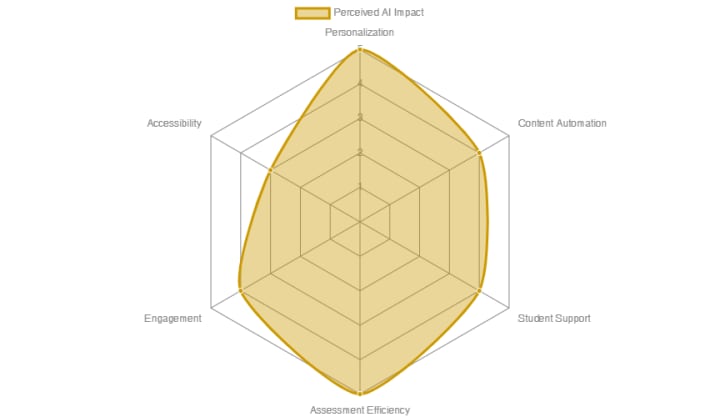
The radar chart highlights that AI's impact is strongest in "Personalization" and "Assessment Efficiency," indicating these areas have seen the most significant transformation. "Content Automation," "Student Support," and "Engagement" also show very strong impacts, reflecting AI's ability to fundamentally change how educational materials are created and how learners interact with them. While "Accessibility" is also positively impacted, it shows slightly less perceived impact compared to other areas, suggesting ongoing development in this domain.
Comparative Analysis: Benefits vs. Challenges of AI in eLearning (0-10 Scale)
This bar chart provides a comparative view of the perceived benefits against the prominent challenges of integrating AI into eLearning platforms. The values are an opinionated analysis on a scale of 0 to 10.
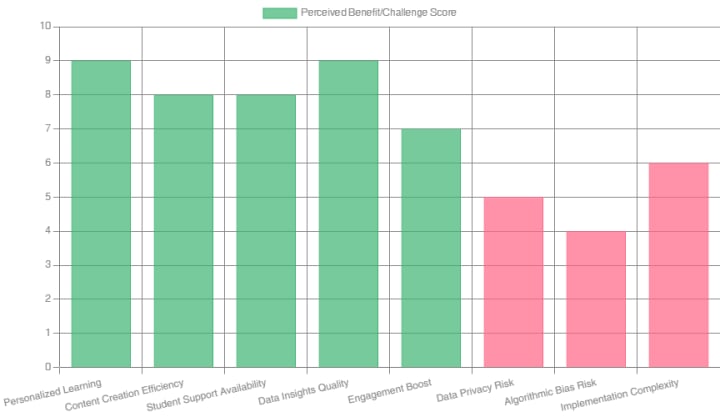
This bar chart illustrates a clear trend: the perceived benefits of AI in eLearning significantly outweigh the current challenges. "Personalized Learning" and "Data Insights Quality" are seen as the highest benefits, scoring 9 out of 10, reflecting AI's profound positive impact on tailoring education and providing actionable analytics. "Content Creation Efficiency" and "Student Support Availability" also score highly at 8, demonstrating AI's capacity to streamline operations and enhance accessibility. While "Engagement Boost" is also strong at 7, some challenges such as "Implementation Complexity" (6), "Data Privacy Risk" (5), and "Algorithmic Bias Risk" (4) indicate areas requiring continued attention and development to ensure ethical and effective AI deployment.
Conclusion
The impact of AI on modern eLearning platforms is undeniably transformative. By delivering personalized, adaptive, efficient, and engaging educational experiences, AI is not only leading to better learner outcomes but also providing more scalable education solutions. This revolution benefits students through customized paths and immediate support, and empowers educators by automating administrative burdens and providing data-driven insights. While challenges related to data privacy and bias must be carefully navigated, the overarching trajectory points towards an increasingly intelligent and inclusive future for online education, fostering lifelong learning across diverse settings.
About the Creator
Streak Ranker
Grow Faster with the Top-Rated Digital Marketing Agency (Streak Ranker) – Trusted for Real Results and Expert Support.
Keep reading
More stories from Streak Ranker and writers in Writers and other communities.
Start and Grow a Successful Online Business (By: Streak Ranker)
Starting and growing a successful online business in 2025 demands a multifaceted approach, integrating foundational planning with advanced digital strategies and operational efficiencies. The digital economy continues to expand, offering unprecedented opportunities for entrepreneurs. Lower startup costs and broader reach compared to traditional businesses make online ventures particularly appealing. Success hinges on understanding market dynamics, building a compelling online presence, and implementing dynamic marketing and growth strategies. This comprehensive guide synthesizes the most effective tactics for establishing and scaling a profitable online business.
By Streak Ranker7 months ago in Writers
It's Winter
Anne Bernays and Pamela Painter — What If? Writing Exercise for Fiction Writers prompts The Exercise —Write a scene involving two characters. Have the point-of-view character presume something entirely different about the situation from what the other character's overt behavior seems to imply. For example, a landlord comes to visit, and the tenant suspects that it isn't a visit but an inspection. Make up several situations in which one character can fantasize or project or suspect or even fear what another character is thinking. The Objective - To show how your characters can use their imaginations to interpret the behavior and dialogue of other characters.
By Denise E Lindquist19 days ago in Writers



Comments
There are no comments for this story
Be the first to respond and start the conversation.