
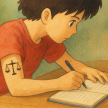

The Forgotten Room
La Luna Azzurra was alive the way the restaurant always was on a Friday night—buzzing, golden, and perfectly under control. Xiomara liked it that way. The restaurant was her armor, each table a carefully set piece of order in a world that once thrived on chaos. From her usual post near the bar, she scanned the room—linen crisp, laughter even, candles steady despite the chatter and the opening of doors.
Then the phone rang.
The sound was small against the music, but it cut through everything, a clear note that reached her before Jane picked it up. Xiomara barely looked up. Jane could handle anything. She always did.
But the shift came anyway. It began in Jane’s face, a flicker of confusion that turned into quiet alarm.
“Xiomara,” Jane’s voice carried, careful, too careful. “It’s … it’s for you. Private.”
Private meant trouble. Nothing good ever came labeled that way.
Xiomara took the receiver with a practiced smile meant for the dining room, though her hand trembled faintly.
“This is Xiomara.”
The voice on the other end didn’t need to introduce itself. Years melted in a heartbeat—her sister’s tone was sharp, brittle, still coated in the smoke of their father’s house.
“Papà è partutu” -Papa’s gone.-
For a moment, Xiomara couldn’t breathe. The room seemed to tilt, the air pressing too close. She turned away from the tables, eyes fixed on the flickering reflection in the bar mirror. Her own face looked unfamiliar—pale, unguarded.
“You need to come home,” her sister continued in Italian. “The will—he named you. You have to read and sign it.”
Home.
The word landed like a stone in her chest.
Sicily wasn’t home. It was the place she had walked away from without looking back, swearing she’d never step onto that soil again. It was marble floors that echoed with shouts, the smell of tobacco, and cold sweat. It was the room she’d left with the door open the day she moved out.
“I can’t,” she whispered, but even as she said it, she knew she would.
Because the dead have a way of pulling the living back.
Xiomara ended the call with a quiet “I understand,” though she didn’t. Not really.
She stood there a moment, the phone still pressed to her hand, the hum of the restaurant fading into something distant and hollow. Somewhere behind her, Jane’s laughter tried to fill the space again, and Alessandro’s voice carried from the kitchen, low and commanding. Life moved on as if nothing had changed.
But for Xiomara, the walls had shifted.
Home.
The word wouldn’t let go.
She hadn’t thought of the house in years—the mansion perched above Palermo, its windows shuttered against the sea winds. She could still see the iron gates, the long gravel drive where the tires had crunched the day she left, carrying her farther and farther from everything she’d ever known.
She’d left her room open on purpose that day. Her statement to make clear there was nothing she wanted from that room or her life there.
Closing that door would have felt like claiming something she didn’t want anymore. The curtains had fluttered in the salt-heavy air, sunlight spilling across the dressing table, catching on her hairbrush, her mother’s perfume bottle, the notebooks she’d filled with sketches of recipes and places she dreamed of visiting. Maybe all of it would still be there. Perhaps all of it now belonged to someone else.
She had walked away without taking a thing.
Her father’s voice had chased her down the hall—cold, dismissive. “You’ll be back,” he had said. Xiomara hadn’t turned around to face him for a last, final goodbye.
She hadn’t thought about it until now.
Xiomara drew a steadying breath and pressed her palms to the wooden counter. She’d built everything in this restaurant to erase that voice, that house, that past. Brick by brick, table by table, she had crafted order where there had once been chaos.
And now, with a single phone call, the past had opened its jaws again.
The mansion would be the same, she knew. Her sisters, circling what was left of power. The staff who never met her eyes. The room she had abandoned, waiting like a ghost with her name carved into it.
She closed her eyes, and for a moment, she could almost smell it, the faint scent of lemon polish, wilted roses, and the dust of years.
That room was more than a place. It was a story she had refused to finish.
And now she had no choice but to turn the page.
The next morning unfolded in a blur of pale light and unspoken thoughts.
Amsterdam looked washed clean after the night’s rain, the cobblestones slick, the canals whispering under the bridge as Alessandro’s car rolled toward Schiphol.
He didn’t talk much, and neither did she. They’d built their peace on silence these days—comfortable, familiar, sometimes fragile. When he reached over at a red light, his hand brushed hers briefly before returning to the steering wheel.
At the terminal, he carried her bag to the drop-off lane. The scent of coffee drifted from the café behind them, the hum of departures filling the air. Alessandro looked at her the way he always did before service. Measured, steady, hiding more than he said. A glance full of unspoken understanding, ritual, and emotion.
“Good luck,” he murmured, leaning in to kiss her cheek. His lips were warm, his breath carrying the faintest trace of basil and espresso.
She managed a small smile. “Keep the kitchen from burning down while I’m gone.”
He huffed a laugh, but his eyes followed her longer than they should have.
Then she was inside, swept into the rhythm of travel—lines, announcements, the echo of luggage wheels on tile. The day dissolved into a sequence of small motions that didn’t quite connect.
On the plane, as the city shrank beneath the clouds, her thoughts circled back to him. Not Alessandro. Her father.
Whatever else he’d been—ruthless, distant, impossible—he had kept his word.
That had been the deal: her silence for her freedom, her distance for his support. And he had honored it.
Every month, like clockwork, the transfer had come.
At first, she’d needed it, survival disguised as generosity. Later, she hadn’t and had told him so. But the payments never stopped. They came even when the restaurant became very successful, even when she no longer replied to her sisters’ clipped messages.
She used to resent it, that silent reminder of the strings she’d cut but never quite severed.
Now, staring out the airplane window, she felt something else. Nostalgia, maybe. Sadness, certainly.
Her father had never said he was proud of her. But maybe this was the closest he’d ever come, his way of watching from afar, still paying for the daughter who’d refused to obey.
Clouds parted, and the Mediterranean spread below like hammered silver.
She pressed her forehead against the airplane window and closed her eyes.
Palermo waited beneath those clouds—unchanged, unwelcoming.
And somewhere within the city, her past and a room left open to gather dust.
The air in Palermo felt heavier than she remembered—sweet with jasmine, thick with memory. The taxi wound its way through streets that hadn’t changed since she was a girl: sun-bleached walls, laundry lines strung like faded prayers, old men arguing over coffee outside corner cafés.
By the time the car turned onto the road leading to the estate, Xiomara’s pulse had slowed into a strange calm. She had thought she’d never see this place again. Yet there it was—the mansion rising against the hillside, white stone dulled by years of sun and salt. The shutters were still the color of oxidized copper. The fountain in the courtyard still flowing, diffusing water above its arch.
No one waited for her at the gate.
She wasn’t surprised. Her sisters had answered her messages with silence, the same way they had lived—sharing blood but little else. They had always seen her as the fragile one, too soft, too unlike their father. And now, even in his death, they refused her presence except where duty required it.
The housekeeper, old Signora Lupo, opened the door with a hesitant smile and a whispered, “Condoglianze, Signorina Xiomara.” The marble floor gleamed just as it had when she’d left. Her footsteps echoed as if the house itself was listening.
Everything smelled faintly of lemon oil and dust.
“The lawyers come tomorrow,” Signora Lupo said quietly. “I have prepared the guest room for you.”
Xiomara paused. Then, slowly turned to face the housekeeper, “I'll stay in my old room.”
Signora Lupo’s eyes flickered—something unreadable. “It is, well, no one’s been inside since your father … well. He was the last.”
A chill threaded through her. “The last?”
“Yes. After you left, he went up one evening. Stayed a while. Then locked the door. Told us to leave it as it was and forget about it. We did.”
Xiomara turned toward the grand staircase. The railings gleamed under the filtered light, each step carrying her closer to a past she’d buried. The climb felt endless, air thickening with each floor, the portraits watching, the silence pressing closer.
Her room was at the very top, tucked beneath the eaves like an afterthought. The youngest child was given the farthest corner.
When she reached the fourth floor, she paused. The hallway smelled of stillness.
The door was there, white paint flaked at the edges, the brass handle dulled with time.
Her father had closed it. And after that, no one had touched it.
Her hand trembled as she reached for the key Signora Lupo had slipped into her palm. The metal cool, familiar.
For a moment, she could picture him in her mind, standing in the doorway years ago, looking at her room with something that might have been regret.
The lock turned with a reluctant click.
And the forgotten room, sealed in silence for all those years, exhaled.
The door creaked open, protesting the years.
The first breath she took burned a little. Dust, old fabric, the faint ghost of her mother’s attar of roses — everything settled heavy in the air, as if time had thickened instead of passed.
Xiomara stood on the threshold, afraid to move. The afternoon light filtered through sheer curtains turned gray with age, painting the room in muted gold. Her bed was still draped in the same coverlet. She had forgotten how neatly she’d folded it the day she left. The vanity mirror was veiled with a film of dust, her own reflection blurred and ghostlike.
It was a dustbin now. Forgotten, neglected — yet heartbreakingly familiar.
Every object was exactly where she had left it: the framed photo of her mother on the nightstand, the cracked ceramic jewelry box she’d bought from a street vendor in Taormina, the stuck-in-time hairbrush beside it, still tangled with a strand of dark hair. Besides dust and stale memories, the air carried a faint sweetness of dried flowers that had long since lost their color.
Her throat tightened. She had left it all behind to prove she could live without it — without him, without the power this house represented.
But someone had come here after her.
Her gaze landed on the desk by the window, the one she used to sit at during sleepless nights, scribbling plans for escape on the backs of old receipts. Everything there was untouched except for the leather journal lying in the center.
It didn’t belong.
The cover was deep brown, faded at the corners, embossed with the family crest. The same insignia had loomed above her father’s study door all her life. The moment she saw it, she felt the years between them collapse.
Her hand hovered above it before she dared to touch. The leather was cool, smooth. Someone had placed it there, thoroughly considered.
She sat down at the desk, her knees brushing the same carved edges she had once kicked in frustration. The chair creaked beneath her, the sound breaking the silence like a sigh.
The journal’s clasp opened with a soft click. Inside, the first page was blank except for a date — written in her father’s unmistakable handwriting, bold and precise.
The day after she left.
The next page held only a few words:
“A man builds power, but a wise daughter builds legacy.
I never knew which mattered more until you walked away.”
Her breath caught. The words blurred, the room spinning slightly around her. She’d spent half her life believing he had never cared. That he’d let her go without a thought.
But this—this was not indifference. This was a confession in ink.
She turned another page. Empty.
And another. Empty still.
Her fingers trembled as she turned to the last pages, the paper whispering against her skin. Most were blank—until near the back, where fresh ink marked a final, uneven hand.
The lines were jagged, as if he had written in haste or pain.
“If you’re reading this, my little one, then I have already met the end I have earned.
I owe you truth, at last.”
Xiomara leaned forward, her pulse steady but her breath shallow.
“You always believed I took your mother from you. I let you believe it. Perhaps I wanted punishment. But I swear to you, it wasn’t my hand.
Your mother’s death came from a deal gone wrong—a deal I forced your sister to make. I thought she was ready. I thought she could control men who live without rules.
She couldn’t.
The South Americans came for her when it soured, but they took your mother instead. Wrong time. Wrong car.
The gunfire wasn’t meant for her.”
Her hand flew to her mouth. A slight, broken sound escaped her. All these years, she had hated him for what she thought was his silence over murder.
She could still see her mother’s scarf, blood soaking its embroidered edges, the chaos in the courtyard, the way her father had stood over the body—expressionless. She had mistaken his shock for indifference.
And he had let her.
She turned the page.
“I covered it up to protect the family name. I hid your sister’s guilt. She was too much like me—ambitious, proud, careless with human life.
I thought I could control the damage. I thought I could keep you safe by making you hate me.”
Tears blurred the ink. Xiomara pressed her thumb to the words as if she could feel his voice through the page.
Then the tone changed, darker, more deliberate.
“Your game tops that of Armand Evangelisti. But do be careful with him and his phantom partner, Nathan.”
Her chest tightened.
How did he know those names? Both regulars at La Luna Azzurra, the quiet connections between supply and luxury, the undercurrent of favors and dangers exchanged in back rooms.
Her father had known. He had always known.
“Don’t worry about your sisters,” his writing continued. “I have left them plenty, even for their next generations.
Take what I left you, my little one. Please co-sign my will, and keep this diary close to you at all times.”
The final line trailed off, as though the pen had slipped from his fingers mid-thought.
Xiomara sat for a long time in her old, now so quiet room, the only sound the faint pulse of her own breathing. Outside, the cicadas had begun their evening song. The light slanted low through the shutters, dust turning golden in the air.
She could almost see him there—her father, sitting at this very desk, the lamp burning low, the house asleep. Writing not as a man of power, but as a father stripped of it.
Her anger softened, not into forgiveness, but into understanding.
She closed the journal and ran her palm over the embossed crest. The leather felt smooth beneath her hand, and for the first time, it didn’t make her skin crawl.
He had hidden everything from her—the truth, his guilt, his love. And yet, in his own warped way, he had left her the one thing he had never managed to give in life: clarity.
Xiomara stood and looked around the room again.
It was still a dustbin — the broken pieces of a life she had outgrown. But now she saw the story inside it. Every object, every shadow, every layer of dust was a record of what she had survived.
She opened the window. The hinges groaned, reluctant after so many years. Warm air swept in from the sea, carrying the scent of salt and lemon groves. Curtains lifted like breath, releasing the stale air into twilight.
She took one last look at her room — the place that had held her secrets, her dreams, her fears — and felt something shift inside her.
Not peace, exactly. But release.
When she stepped into the hallway, she left the door open again. Just as she had decades ago.
But this time, it wasn’t defiance. It was discretion.
Downstairs, the house echoed with silence. Her sisters’ laughter drifted faintly from the veranda, brittle and distant. They didn’t matter anymore. The ghosts in this house weren’t theirs to carry.
Xiomara slipped the journal into her bag. It was heavier than it looked, weighted with words and ghosts.
As she reached the main doors, she looked back once more at the staircase, at the shaft of light cutting through the dust. The air felt different now—lighter, forgiving.
Her father had locked her room to keep it untouched. But in doing so, he had preserved the one piece of their story that still held truth in it.
She whispered into the quiet, “Addiu, pà.” -Goodbye, papa-
Then she stepped out into the Sicilian evening. The sound of distant waves rolled through the air, soft and steady, like the beating of a heart finally at rest.
Behind her, the forgotten room stood open to the night, breathing again.
About the Creator
Sacha Sutama
Sacha writes like a match struck in the dark— bright, and impossible to ignore. His stories burn with emotion, obsession, and truth, exposing the beauty hidden inside chaos. Every line dares you to look closer and feel something real.
Keep reading
More stories from Sacha Sutama and writers in Writers and other communities.
I Can See You
The moment Taylor spoke, Marina felt something shift. The voice—rich, velvety, and undeniably human—wrapped around her like a whisper meant only for her ears. She had expected something robotic, something synthetic, but this was different. It carried warmth, subtle inflections, and a confidence that made her pulse quicken.
By Sacha Sutama3 months ago in Confessions
The steps to losing a child
Step One: Lose a child. Not what anyone wants to happen and nothing you can do to change it, but you can go through steps to becoming happy again. You can go through steps to loving again. You can go through steps to become a new you because after losing a child you will never be the same person you once were.
By Tabitha Hinkley2 days ago in Fiction



Comments
There are no comments for this story
Be the first to respond and start the conversation.