
The ear
An abstract story about the loneliness of one ear.

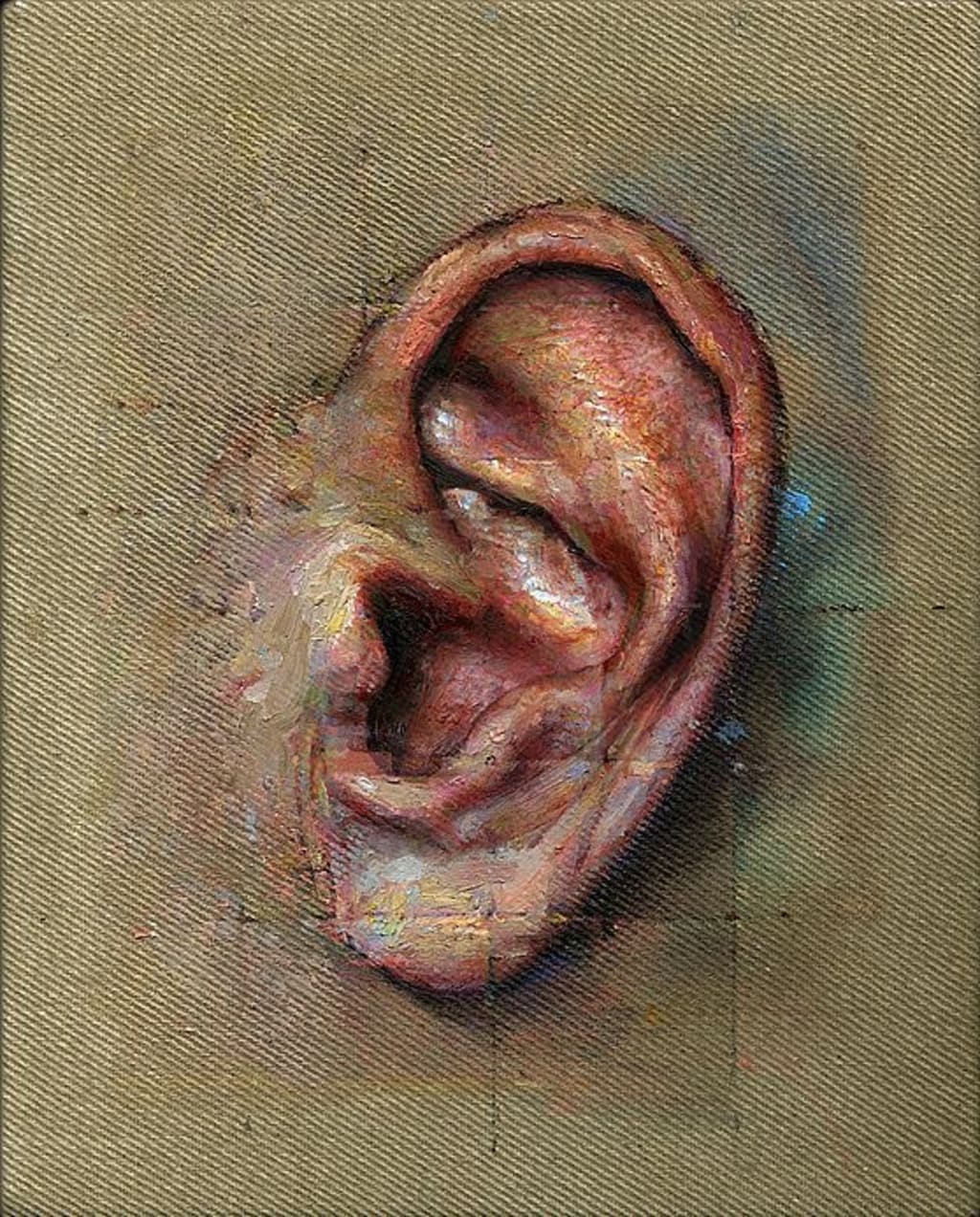
The Ear
She had been told what sounds she should and should not hear. If she heard the sounds she was not supposed to hear, after being struck hard on the head with a firm fist—so hard that she could hear the sound of her body’s cartilage breaking—she would be forever covered in something called cotton. And over time, that cotton would become her identity, and she would forget who she had been and what her abilities were. But we must not forget that hearing is just as important as not hearing, though it is less popular.
The cotton would help her ear not hear all the permitted and prohibited sounds, and she was to be afraid of the cotton.
The ear had many thoughts in its solitude. A small opening had been left open in the room near her room to allow movement. Sometimes she would hear, in the forbidden part of the house, the voices of those who heard—whispered together, guessed by mouth and chin, and seen. But she was not sure.
Sometimes she would hear their cries, and sometimes their laughter. But she had been warned not to pay attention to the cries and laughter of others. What others do is important. And to what extent they have gone too far, she must listen—without having any emotional feelings toward the other.
She would say to herself: Who is the other? Will she be like a mouth, a chin, and a nose? She has no idea of a mouth, chin, or nose—she can hardly describe them—she only knows that they are for eating, speaking, and kissing, and that the chin stimulates the mouth, and the nose is for smelling…
Then she would laugh and say: Well, what can they do to me! They are related to me, I am related to myself, sometimes I am not even related to myself—it’s related to unknown voices that tell me which sounds I should hear and which I should not.
She didn’t know what she was doing here. She had no friends. She didn’t know why she should leave this darkness, this strangeness, and not rejoice for herself out there. She was sure she was happy to some extent, but she knew that it was light outside, the air was pleasant, there were other people, and they couldn’t just do whatever they wanted or didn’t want in peace.
Outside this forbidden area, one doesn’t feel the weight of an unknown object on their head—and even if it is heavy, others help remove that object from one’s head and throw it away. She didn’t know where “outside” was. But she was sure it wasn’t like this. Out there, one is free. She didn’t know what freedom was, but without a doubt, it was a time when they didn't strike you on the head with a firm fist and tell you what you should and shouldn’t hear.
About the Creator
Tamana Mehrzad
My name is Tamana Shafayee, pen name Tamana Mehrzad.
Born in 1997. I’m a poet and writer from Herat, Afghanistan. I write ghazals and rubaiyat on love, war, women’s rights, and social issues. My first poetry book was published in 2019.
Keep reading
More stories from writers in Writers and other communities.
Maintenance Planning Guide for Used Cars
Buying a used car is only the first step. The real key to long-term reliability, safety, and value lies in smart maintenance planning. Unlike new vehicles, used cars come with wear, history, and unknowns—making a proactive maintenance plan essential.
By Bison Tonneau Covers6 days ago in Writers
The Path to Salvation
The late autumn evening air filled the monk's lungs, but it wasn't the season that chilled his bones. The heavy-handed presence of evil he had sensed upon entering the woods surrounding this mountain village had not bothered to conceal itself from him.
By Made in DNA7 days ago in Fiction




Comments
There are no comments for this story
Be the first to respond and start the conversation.