

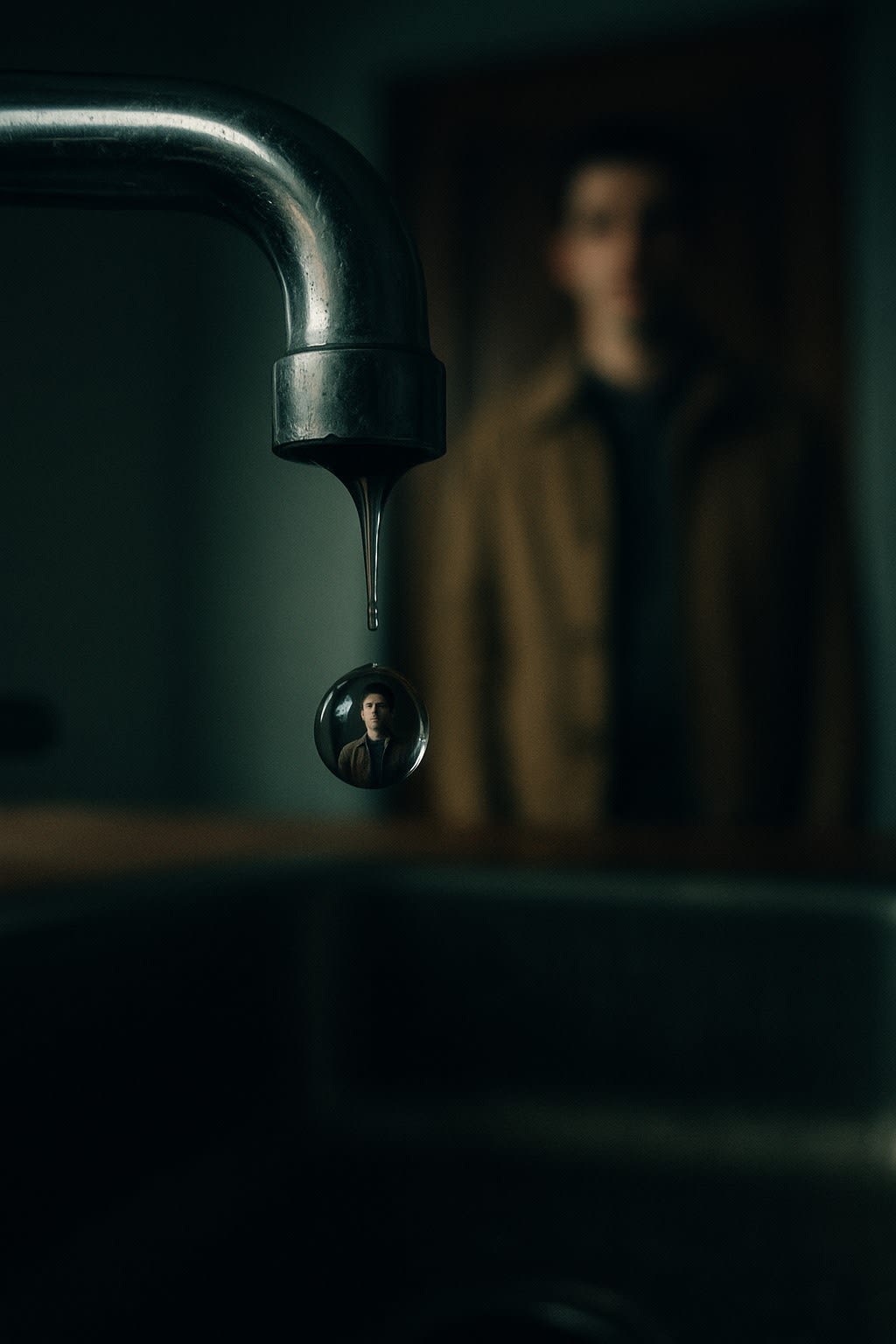
The sink has been dripping for three hours this evening.
Not the gentle kind of domestic drip that collapses into white noise after a while, but a metronome that has decided it is God. A single drop fat enough to announce itself. A second of silence. Another drop, louder, as if it fell from a cathedral ceiling, traveling through the rusted throat of the pipe into some private underworld. It reverberates. It trespasses. It colonizes my brain until my thoughts are no longer mine but tiny raindrops organizing themselves into a march.
The cat watches like a priest.
He sits on the counter, tail wrapped around his paws, green eyes narrowed to citrine knives, as if the sink is confessing, as if it’s telling him something I’m not allowed to hear. He is not my cat. This is not my sink. This home isn’t mine; I’m tending it the way a stranger tends a candle in a chapel, careful not to drip wax where it doesn’t belong.
The drop conquers another second. And another. It’s almost soothing, except it is not.
I try to hear my own heartbeat under it. I try to determine if the pipes are inside the wall or the wall is inside me. I try to think of anything else, but the drop insists on becoming the thought.
When the knock comes, it braids itself into the rhythm: drop knock, drop knock, as if the whole world has agreed to keep time with the faucet.
I turn the handle to make sure the knock is real. The drip stutters, then withholds. The sudden silence is violent. The cat flicks an ear, offended by the interruption.
Another knock. Soft. Polite. The kind of knock you practice if you want to be invited in without being blamed for it later.
I am not good with doors. Doors ask a question I’m rarely prepared to answer. Who are you? Which life do you want tonight? But boredom is a dangerous amount of faith in disguise. Boredom tells me I could survive a small risk just to break the rhythm of the sink.
So with caution, I walk to the door. I press my eye to the peephole. The fisheye turns the corridor into a small planet and he is the single citizen standing on it—smiling, jacket the color of sand stuck to my boots from this morning’s walk, hands in his pockets like he’s trying to keep his fingerprints to himself.
He’s familiar the way a dream is familiar. The kind of familiarity that doesn’t answer how, only nods in yes.
I undo the locks. Metal clacks. A small song of permission. I open the door a width that says I could close it quickly if I needed to.
“Hello?” I manage. My voice stands on tiptoe, trying to look taller.
“Hi,” he says. Soft voice. Wry smile, then a sincere one. Furry eyebrows, a hint of stubble like the afterthought of a storm. Short brown hair. He extends his hand, and I don’t take it. I don’t know if this is about boundaries or superstition. His hand hovers in the air a second too long, then returns to his pocket as if it never meant anything by coming out.
“I know the woman who lives here,” he says. “We’ve… overlapped.” He says it like a geography problem.
“She’s not here,” I say. “I’m watching her cat.”
He leans the smallest bit, as if scenting the room. His gaze catches the cat on the counter. The cat catches him back, green eyes pinning him to the threshold. Something passes between them—a treaty or a warning, I can’t tell.
“Nice to meet you, Not-The-Woman-Who-Lives-Here,” he says, and I almost close the door because something about the playfulness feels practiced. But the part of me that likes riddles nods. The boredom in me pulls up a chair.
“What do you need?” I ask.
He looks past me toward the window, where the last light of evening is bruising the sky. “A walk,” he says. “Only if you feel like seeing how the fog lifts when the moon gets involved.”
Strangers who speak in weather metaphors are either poets or liars. Sometimes both.
“I don’t let people in,” I say.
“I’m not asking to come in,” he answers. “I’m asking if you want out.”
The cat blinks. The faucet remembers to drip. Something in my body leans forward. I tell myself it’s only a walk, and I tell myself that my cells are older than my fear. Both are true.
“Give me a minute,” I say.
I lock the door behind me because that is the only religion I have that always makes sense. He keeps a respectful distance as we descend the stairs. On the street, the air is damp, the color of oyster shells. We walk side by side but not touching, as if there is a third person made of air keeping space between us.
“What’s your name?” I ask when we turn toward the ocean.
He tells me. It fits his mouth the way a river fits a bed it’s carved itself.
“And yours?” he asks.
“Tonight,” I say, “I’m whoever doesn’t belong to the sink.”
He laughs. Not a test, not a weapon. A warm thing. We fall into the kind of conversation that happens when there’s something else to look at; the waves let us borrow their cadence. He talks about rocks like they are elders, about currents like they hold memory. He says he likes to walk at this hour because the beach forgets what people have done to it during the day. He speaks lightly, but listening to him I feel that careful door crack inside me—the one that opens when someone is fluent in a language I was born with but rarely hear.
“I feel like I know you,” he says at one point, almost embarrassed to be cliché.
“I know,” I say, because I feel that too. Not just the storybook flash of déjà vu, but something somatic, sub-verbal. My cells leaning over the balcony of my blood to get a better look. The atoms inside me turning to whisper to each other: again?
It should terrify me that something in me recognizes him. It does and it doesn’t. The ocean makes room for paradox the way a mouth makes room for a name.
When the fog rises it looks like the shore exhaled. We stop at the edge of the wet sand where the tide has been writing its private alphabet, letters collapsing into letters. He faces me in a square way that makes me want to step to the side.
“What do you do?” I ask, to ruin the magic before it ruins me.
He considers. “I’m here to gather the people who remember,” he says.
“Remember what?”
“That love is a system. A physics. A law.”
My skin tightens a degree, like an animal’s before a storm. Over the water, a lone gull drags a ragged cry across the sky.
“You’re laughing at me in your head,” he says gently.
“I’m not,” I say, and in some way I’m not. I have believed stranger things. I have sworn vows to invisible forces and kept them. But his sentence vibrates on a frequency I’ve heard before, and the last time I followed it I spent months pulling barbed wire from my psyche.
He continues, as if reading from a script the moon handed him. “There will be a circle,” he says, “not of men above women or women above men, but a weave. Love not as possession, but as orbit. I’ve been given a blueprint. I’ve been told—” He stops himself and smiles like the end of a confession. “Anyway. I don’t mean to scare you.”
I could say, Men have been told things for a long time and the things have often required my smallness. I could ask Who told you, and what do they get if I kneel? I could say a hundred wise things, and all of them would be true, and none of them would explain why my body is humming like a string plucked by a god.
There is a moment when a kiss is not yet a kiss but already history. The air leans. The tide holds its breath. He doesn’t move first or maybe he does, but we are already inside it before we decide. When his mouth finds mine, the scene fractures. Not like glass. Like a chrysalis.
I mean this literally: the beach slides away as if pulled by a polite stagehand, and another set rolls forward, and then another, as though kissing is a trapdoor and we fell through it into the vault of every possible version of us.
Here is one: We’re knocking on a door with laughter still in our throats from running up the stairs two at a time. He is wearing that sand-colored jacket. I am wearing a white dress I didn’t choose. We are pretending to know the person who lives inside because we have learned that doors open more easily for familiarity than for truth. A woman peeks through the chain and he says a name that does not belong to me but I answer anyway. She lets us in because what else can you do with a night that wants something from you. There is a cat on a counter judging us like an elder. We sit, we speak in honey and prophecy, we pull out language like silk scarves, we say love so many times it loses its clothes and shivers. When the woman cries we hand her a towel of our certainty. We give her a new name and then keep it. We call it initiation, as if a theft can become a gift if you pray over it loudly enough.
Here is another: There are twenty of us on the beach at dusk, women mostly, wearing white because purity is the easiest optical illusion. He stands at the center, arms open, and calls it a constellation when we gather around him. We chant until our tongues float. We are promised everything that’s ever been promised to the hungry: belonging, I see you, the end of loneliness, the end of being wrong. Someone sings and her voice breaks and we call that breakthrough. We pass a cup full of something that tastes like consent. He speaks of orbits again. He says we are moons and he is the center not because he is better but because he is math. He says we can all become centers if we remember how to listen. We do not notice that the only time anyone becomes center is when he points at them.
Another scene: A room where the windows have been draped so that time can’t find us. A table strewn with notebooks as if we are a think tank instead of a congregation. “Revolution,” someone writes in a looping hand. “Love economy,” someone else writes. “Devotion as activism,” he murmurs, delighted at his own echo. We stop eating certain foods and start speaking certain words and we say it’s because our bodies are becoming instruments. We lift each other from our old lives like flowers from their pots and we call the bare roots freedom. We stop calling our mothers. We build a vocabulary where “no” means “not yet” and “I’m tired” means “you’re resisting” and “I can’t” means “you’re afraid of your own power.” When doubts surface, we gather around the doubter and love her so hard she dissolves. We call it healing. Sometimes it is. Sometimes it is the river washing away our edges.
The montage speeds up. It becomes a liturgy of doors and sand and vows. We recruit with our eyes. We tangle our bodies because touch is a technology and because a warm body is easier to persuade than a cold one. He is always tender. He is always sure. He promises me the leadership of a sub-circle, a necklace of women whose faces I love. He says, “You were born for this,” and this is the problem—he’s not entirely wrong.
Then one more: Night thick with salt. A ceremony that is either beautiful or unforgivable. A flame passed from candle to candle. A promise cut into our palms with a seashell. I look up and every face is washed with devotion. I am overcome with the holiness of a thing that is not holy. I am lightheaded from fasting; I keep thinking of the sink. I keep thinking the only thing I own is the decision to turn it off.
As the knife of the scene is about to drop—as the next act requires more of me than I will ever get back—the whole reel burns out.
The beach returns.
I am still kissing him. The gull is still dragging the same torn cry across the sky. The fog is still an animal waking. But my body is buzzing with the aftermath of a life I didn’t live. My lips are on his but a door has closed in me with a soft click of mercy. I step back. The air between us cools.
“Tomorrow?” he says, hopeful. As if we have been speaking about tomorrow all along.
“Yes,” I say, and my voice is both a promise and a eulogy. “Here. Same time.”
He searches my face for one more secret. Finds none I will give him. He smiles in a way that makes him look like a boy who believes in maps. He walks away without looking back, which is its own kind of power. I stand until he becomes a fact in the distance.
On the way home, my legs tremble as if I’ve run a race. Maybe I have. The world is rinsed in that strange clarity that follows a near-accident—the saturation turned up, the edges outlined. The corridor smells like lemon cleaner and secrets when I reach it. The key sticks twice before the lock remembers me. Inside, the cat is where I left him, except of course I didn’t leave him anywhere; he is his own leaving.
He looks at me with that supervisory stare cats have. I report to him anyway. “I didn’t join,” I say. He blinks. I can’t tell if he’s disappointed or relieved or just has dust in his eye.
The sink has resumed its sermon. Drop. Drop. Drop. It wants me to believe that nothing has changed. It wants me to choose it or be chosen by it. I approach it like a penitent. I turn the handle a fraction and then another. The drip thins. Pauses. The pipes sigh, the way houses do when their ghosts settle back down.
Silence comes back like a friend who forgives me too easily.
I feed the cat because feeding is a spell that makes sense. He eats like nothing holy has ever happened. I sit on the floor and listen to the silence until it becomes a shape I can lean against. My body shakes out what it was holding. My mind rewinds the night and pauses on the moment when everything became inevitable and then didn’t.
What do we call that? Wisdom? Cowardice? An angel? A boundary? I don’t care. I only know that my mouth tasted like somebody else’s future for a second, and then like mine again.
I go to the window. The moon has pulled the fog into a veil around her face. The streetlight makes a halo of the parking lot’s smallest puddle. Somewhere, he is telling someone about me. He will say I am almost ready. He will say I am resisting. He will say tomorrow.
I wash my hands. Not because I am unclean, but because water is an ending you can perform. The tap runs cold, then colder, then exactly right. I cup the water and carry it to my face as if I’m offering myself a drink. When the last drop leaves the faucet, I close the valve like I’m tying a knot. The silence is not perfect. I don’t need it to be.
I go to bed knowing I won’t return to the beach at that hour again. He will wait for a while. He will forgive me in advance and after. The tide will erase our names the way it erases everyone’s. Tomorrow will come anyway. The cat will approve and disapprove. The sink will try a new voice. My cells will remember and forget and remember again, the way cells do.
Before sleep finds me, I open my eyes into the dark and let the possible cult flicker one last time across the inside of my skull, like a trailer for a movie I won’t buy a ticket to. It is beautiful, in the way all disasters are beautiful from a safe distance. It is horrific, in the way all beauty turns when it forgets it is accountable to the living.
In the morning, the ocean will act like last night was a rumor. I will make tea in a stranger’s kitchen and thank the kettle when it sings. I will write this down because keeping it inside would grow it into a myth. I will text no one. I will walk to the shore at a different hour, when the sun is less theatrical and the sky less earnest, and I will watch ordinary dogs drag ordinary sticks across the tideline.
The only thing I’ll carry with me forever is the spirit that lives inside my home—the one that lives inside my ribs, not inside any building. The one that knows the difference between a prophecy and a seduction. The one that recognized the blueprint because she once drew it and then burned it.
If he knocks again, I will let the sink answer. It knows how to say no in a language everybody understands.
And if you ask me whether I regret the kiss, I will tell you this: sometimes the fastest way out of a story is through the first sentence. Sometimes the kiss is a map. Sometimes it’s just a mouth.
Either way, I turned the water off.
About the Creator
Bruk
Writing from the pit of my psyche...
Keep reading
More stories from writers in Writers and other communities.



Comments
There are no comments for this story
Be the first to respond and start the conversation.