
SQLite vs. Hive in Flutter
A Comprehensive Comparison with Detailed Code Examples


1. Introduction:
SQLite:
SQLite is a popular embedded SQL database engine. It is widely used in mobile application development for its simplicity, performance, and reliability. SQLite databases are serverless, self-contained, and transactions are ACID compliant.
Hive:
Hive is a NoSQL, key-value database designed specifically for Flutter and Dart. It is known for its high-performance, simplicity, and is optimized for read-heavy workloads.
2. Installation and Setup:
SQLite:
To use SQLite in Flutter, add the sqflite package to your pubspec.yaml:
dependencies:
sqflite: latest_version
Hive:
For Hive, include the hive and hive_flutter packages in your pubspec.yaml:
dependencies:
hive: latest_version
hive_flutter: latest_version
After adding these packages, you should set up and initialize the database for both SQLite and Hive.
SQLite Example:
import 'package:sqflite/sqflite.dart';
import 'package:path/path.dart';
class SQLiteHelper {
Database _database;
Future<void> openDatabase() async {
final databasePath = await getDatabasesPath();
final path = join(databasePath, 'my_database.db');
_database = await openDatabase(
path,
version: 1,
onCreate: (db, version) {
db.execute('CREATE TABLE items(id INTEGER PRIMARY KEY, name TEXT)');
},
);
}
Future<int> insertItem(Item item) async {
return await _database.insert('items', item.toMap());
}
// Implement additional CRUD and data manipulation methods
}
Hive Example:
import 'package:hive/hive.dart';
import 'package:path_provider/path_provider.dart';
class HiveHelper {
Future<void> openBox() async {
final appDocumentDirectory = await getApplicationDocumentsDirectory();
Hive.init(appDocumentDirectory.path);
await Hive.openBox<Item>('items');
}
// Implement additional CRUD and data manipulation methods
}
3. Data Modeling:
SQLite:
SQLite uses tables and rows for data modeling. You define your data structure using SQL schemas. This provides structured and typed data storage.
Hive:
Hive uses boxes and objects for data modeling. It is schemaless, allowing you to store objects without a predefined structure, making it more flexible in terms of data modeling.
4. CRUD Operations:
SQLite:
SQLite uses SQL queries for CRUD (Create, Read, Update, Delete) operations. It provides full support for SQL operations and transactions.
Hive:
Hive offers a simplified way to perform CRUD operations on objects in your database, which doesn't require writing SQL queries, making it easier for developers.
5. Query Performance:
SQLite:
SQLite is well-suited for complex queries and is optimized for handling large datasets. It excels in scenarios that require advanced SQL operations.
Hive:
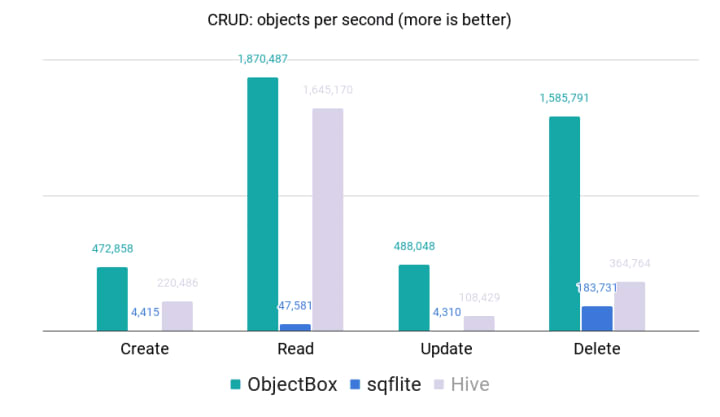
Hive is optimized for read-heavy workloads, providing fast access to specific data. It is ideal for scenarios where quick data retrieval is a priority.
6. Synchronization and Offline Usage:
SQLite:
SQLite is primarily a local database and may require additional code and libraries to handle data synchronization and offline usage.
Hive:
Hive offers built-in support for offline storage and synchronization with cloud-based databases, making it a good choice for apps that need to work both online and offline.
7. Community and Ecosystem:
SQLite:
SQLite has a well-established and mature community with extensive resources, libraries, and third-party tools available for support.
Hive:
Hive, while relatively new, has gained popularity, especially within the Flutter ecosystem, and has a growing community.
8. Use Cases and Project Scenarios:
SQLite:
SQLite is ideal for applications with complex data structures, extensive data manipulation requirements, or those that require the use of SQL queries. It is particularly suitable for applications that involve complex transactional operations.
Hive:
Hive is well-suited for projects that prioritize fast data access and simplicity. It excels in scenarios where you don't want to manage SQL schemas and need efficient data storage. It is especially suitable for read-heavy applications.
Conclusion:
In summary, your choice between SQLite and Hive in your Flutter project depends on your specific requirements and project goals. SQLite provides full SQL support and is versatile, while Hive is lightweight, schemaless, and optimized for efficient data storage and retrieval. The provided code examples illustrate the basic setup for both databases, and you can expand upon them to meet your project's unique needs.
About the Creator
kamran iqbal
Software Engineer | Mobile App Developer | Flutter Developer
Keep reading
More stories from kamran iqbal and writers in Writers and other communities.
Flutter vs. React Native
Mobile app development remains a dynamic field, and as we move further into 2023, two frameworks, Flutter and React Native, continue to dominate discussions in the development community. Choosing between these two giants requires a nuanced evaluation of their features, performance, and suitability for specific project requirements. Let's delve into a detailed comparison of Flutter and React Native in the context of 2023.
By kamran iqbal2 years ago in Writers
Team Bellevue Kandy: The YouTube Creator Who Celebrates Congolese Filmmaker Bellevue Kandy
Team Bellevue Kandy is a rising YouTube fan-page channel created in 2025, dedicated to the Congolese actress, director, producer, and screenwriter, Bellevue Kandy. Inspired by Bellevue Kandy’s screen presence, the creator designed a community space for fans to discover her new projects, revisit her most iconic moments, and pay tribute to a filmmaker who continues to shape Congolese cinema.
By Solene Writes5 days ago in Writers




Comments
There are no comments for this story
Be the first to respond and start the conversation.