
Recent Iberian Power Outage: Causes, Impacts, and Future Implications
Unraveling the Blackout That Plunged the Iberian Peninsula into Darkness.
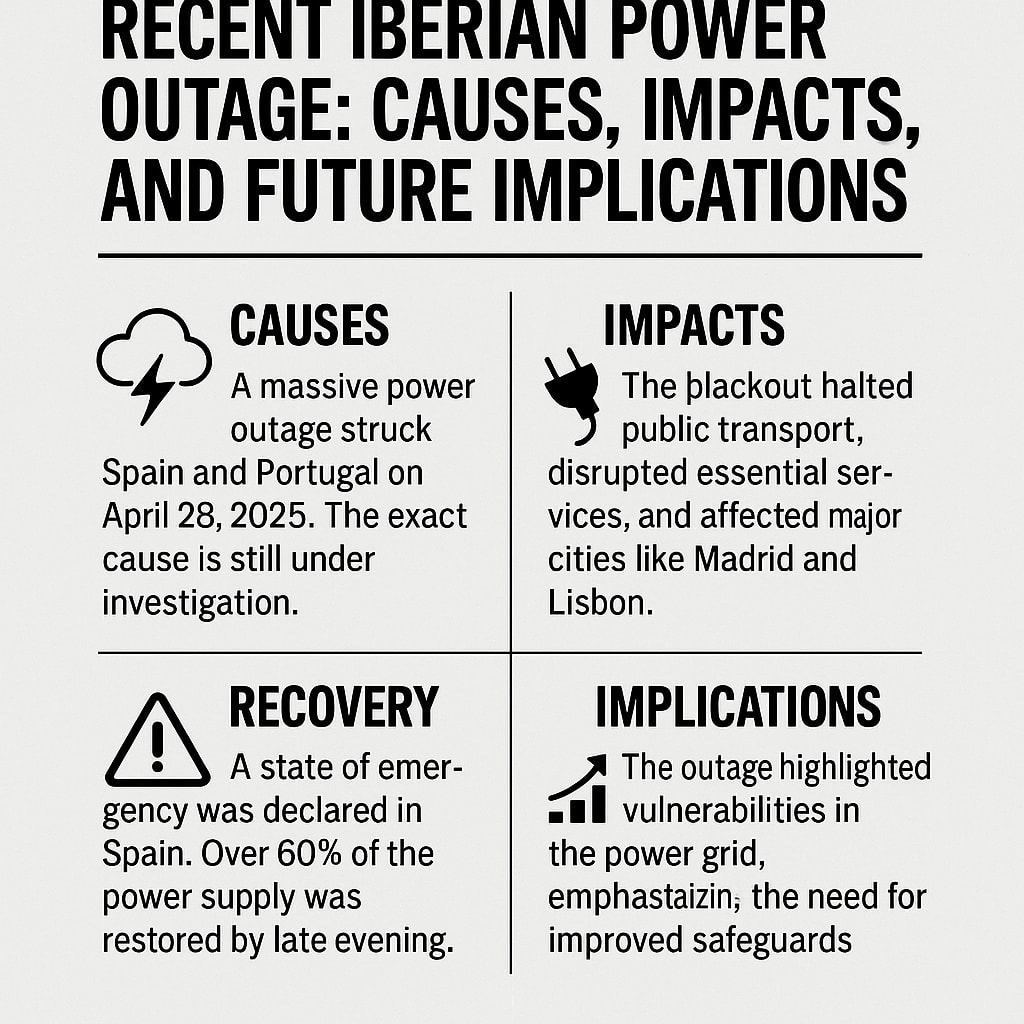
On April 28, 2023, a significant power outage swept across the Iberian Peninsula, affecting millions of residents in Spain and Portugal. This blackout, which commenced around midday, brought major cities to a standstill, disrupted daily activities, and raised concerns regarding the resilience of Europe's power infrastructure. This article aims to provide a comprehensive overview of the incident, examining potential causes, immediate impacts, and long-term implications for the region and beyond.
Incident Overview:
The sudden loss of electricity at approximately 12:30 p.m. local time affected key urban centers including Madrid, Barcelona, Lisbon, and Porto. The outage led to the suspension of subway services, paralysis of traffic systems due to non-functional traffic lights, and disruptions in mobile networks and ATMs. Businesses faced operational challenges, with many resorting to emergency generators or opting for closure. Airports experienced delays, and notable events such as the Madrid Open tennis tournament were postponed.
While the blackout predominantly impacted Spain and Portugal, regions in southern France and Andorra experienced brief disruptions but recovered swiftly. Gibraltar notably remained unaffected by the incident.
Investigating the Causes:
Authorities and investigators are actively exploring several theories to determine the root cause of this widespread outage. One hypothesis suggests an unusual atmospheric phenomenon resulting from extreme temperature fluctuations that may have induced abnormal vibrations in high-voltage power lines, disrupting grid synchronization.
Another theory points to a technical malfunction involving a sudden drop of approximately 15 gigawatts of power—equivalent to 60% of Spain's electricity demand—potentially triggering a cascade of shutdowns. Additionally, issues with a crucial transmission line connecting Spain and southern France have been reported, though French officials have refuted claims of physical faults.
Cybersecurity experts are also monitoring the situation closely. Although no evidence of hacking has been discovered thus far, the possibility of a cyberattack remains under consideration.
Response from Authorities:
In response to the crisis, the Spanish government swiftly declared a national state of emergency. Prime Minister Pedro Sánchez established a crisis team at the national electricity control center, while King Felipe VI convened an emergency meeting with top security officials.
By Monday evening, approximately 60% of Spain's power supply had been restored. Portugal's recovery has been slower, with officials cautioning that it may take several days for full services to resume, particularly in rural areas.
Economic and Infrastructure Impacts:
The economic repercussions of the blackout have been immediate and significant. Temporary shutdowns in oil refineries were reported, and internet traffic from Spain decreased by roughly 60%, affecting online businesses and communications. Retailers, logistics companies, and healthcare facilities experienced considerable disruptions. Experts anticipate that a full assessment of the financial damage will require weeks.
The incident has highlighted vulnerabilities within Europe's interconnected electricity grids. Both Spain and Portugal face mounting pressure to enhance their infrastructure to mitigate risks associated with technical failures, cyber threats, and climate-related challenges.
Future Implications:
As power restoration efforts continue in rural and industrial areas, a thorough investigation into the outage's causes is underway, expected to conclude in several weeks. The event serves as a wake-up call for the region, emphasizing the necessity for robust infrastructure upgrades and comprehensive risk management strategies.
Conclusion:
The recent power outage across the Iberian Peninsula underscores critical challenges facing Europe's energy systems. As investigations proceed and recovery efforts advance, stakeholders must prioritize infrastructure resilience to safeguard against future disruptions. This incident will likely catalyze policy discussions and investments aimed at fortifying Europe's energy security for years to come.
About the Creator
Keep reading
More stories from Mohammad shovon and writers in Writers and other communities.
Vancouver Attack
The evening of the April 26th of the tragic a tragic attack in the widows of the widowships during day of day in Vanouver, British Columbia, a Filipino's party Around 8:14 p.m. Local time, a black daily queer went to a crowd gathered to the route of the route of the Oriental and Fraser Road, causing 11 dead 4.444 victimsVictims have changed from 5 to 65. Between them was clear "kiara" gaupol of gaupol, a The 3488 years old and founder of Carnival Nerd's Nerded Marine. Some local hospitals, including the general hospital of Vancouver, reported an orange code to handle the victim's incidentsuspicious and chargesDRIRED, identified as Vancouver resident, 30, Kai-Ij Adam Lo, is captured by passers and install in police detention. Has been charged with eight duties of the eighth of seconds, additional allegations provided for as The investigation continues. The authorities said that the incident was not treated as terrorism, but he made a significant story about the important health and intritorial problems with cleanliness.response of community and policyAttack attack will be a large Philippine Community of Vancouver. The political chiefs, including the Prime Minister store, that suspends his campaign activity and chairman ken sim, express condolum and support and support. International permissions, as Philiendians Philities Sardidudid Marcos Jr. King Maria III she also offered their symamaties. The context of the age4 Lapow Fastival, called the Cape Coljymes. The Spanish collegewhift, e was officially the soft in the 2023. The festival had been attracted to 1,000 participants and performances presented, including one of the black apples of black peas. Especially, the opposite of previous festivals, event was missing Some security measures, as the slope jump used to complete the place. Europe: Wine to the Guardian, Wikipediaa supporting center has been created for victims and their families such as the city do not cry this destructive event.
By Mohammad shovon9 months ago in Writers
It's Winter
Anne Bernays and Pamela Painter — What If? Writing Exercise for Fiction Writers prompts The Exercise —Write a scene involving two characters. Have the point-of-view character presume something entirely different about the situation from what the other character's overt behavior seems to imply. For example, a landlord comes to visit, and the tenant suspects that it isn't a visit but an inspection. Make up several situations in which one character can fantasize or project or suspect or even fear what another character is thinking. The Objective - To show how your characters can use their imaginations to interpret the behavior and dialogue of other characters.
By Denise E Lindquistabout a month ago in Writers
Szakacs Films Announces Development of New International Film and Television Projects
Szakacs Films announced today the development of new international film and television projects led by actor and producer Andreas Szakacs. The announcement reflects the company’s continued focus on producing globally relevant, character-driven content for international audiences.
By Andreas Szakacs3 days ago in Writers



Comments
There are no comments for this story
Be the first to respond and start the conversation.