
Pulsars: The Cosmic Spinning Lighthouses
Pulsars are true cosmic wonders, revealing profound secrets of the universe we live in.

By Andre Wormsbecker / Quantum Dox
In the vast and mysterious universe, pulsars stand out as one of the most fascinating wonders. These highly magnetized neutron stars are known for their incredible rotation speed and the intense radiation they emit in regular pulses. Discovered for the first time in 1967, pulsars continue to captivate astronomers and scientists with their unique properties and insights into the nature of the cosmos. In this article, we will explore the fascinating world of pulsars, their origin, characteristics, and the role they play in our understanding of the universe.
Origin and Formation of Pulsars
Pulsars originate from stellar explosions known as supernovae. When a massive star reaches the end of its life, it collapses under its own gravity, resulting in the formation of an extremely dense neutron star. During this process, the neutron star inherits the angular momentum of the progenitor star, resulting in an extremely high rotation speed. This accelerated spin is one of the distinctive features of pulsars.
Properties and Behavior of Pulsars
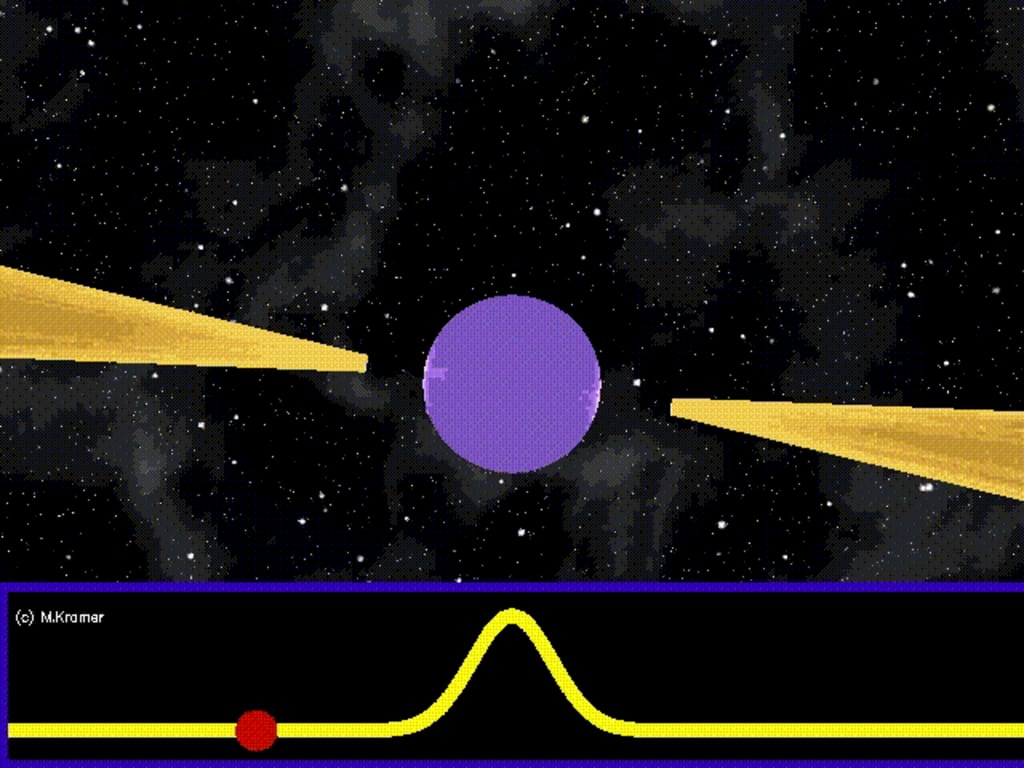
Pulsars are known for emitting intense beams of radiation in directions opposite their magnetic poles. As the neutron star rapidly spins, these beams of radiation sweep through space like cosmic lighthouses. When one of these beams passes by Earth, astronomical detectors register a series of periodic radiation pulses, hence the name “pulsar.”
Pulsars are highly precise in their regularity. Some emit pulses with periods of just a few milliseconds, while others can have periods of several seconds. This incredible regularity makes pulsars natural cosmic clocks, allowing scientists to use their emissions for precise time measurements and to study complex astrophysical phenomena.
Types of Pulsars
There are different types of pulsars, each with unique characteristics. The main types include radio pulsars, X-ray pulsars, and gamma-ray pulsars. Radio pulsars are the most common and were the first to be discovered. They emit radio radiation pulses and are typically found in association with supernova remnants.
X-ray and gamma-ray pulsars, on the other hand, emit radiation in these ranges of the electromagnetic spectrum. They are generally found in binary systems, where the neutron star is orbiting a companion star. These systems can exhibit complex behaviors, such as periodic X-ray emissions and gamma-ray bursts.
Scientific Importance of Pulsars
Pulsars have been of great importance to science and have provided valuable insights into various areas of astrophysics. They are used as natural laboratories to test fundamental theories of physics, such as Einstein's general relativity. Observations of pulsars in binary systems have also helped scientists detect gravitational waves, confirming the existence of these ripples in the fabric of spacetime.
Additionally, pulsars have aided astronomers in studying the interstellar medium, stellar evolution, the formation of neutron stars and black holes, as well as the properties of matter under extreme conditions. They can also provide clues about the nature of dark matter and the distribution of matter in the universe.
Pulsars are true cosmic wonders, revealing profound secrets of the universe we live in. Their rapid rotation and emissions of radiation in regular pulses offer a window into the study of complex astrophysical phenomena and tests of fundamental theories. With ongoing advancements in observations and detection techniques, we are sure to discover more about these cosmic lighthouses and expand our knowledge of the cosmos.
The Relationship of Pulsars in the Quantum World
Pulsars do not have a direct relationship with quantum physics. Quantum physics is the branch of physics that studies phenomena occurring at subatomic scales, while pulsars are macroscopic astrophysical objects composed of highly compact neutron stars.
However, quantum physics is a fundamental theory that describes the behavior of matter and energy at very small scales, and its laws are applicable to all subatomic particles. Although pulsars are not directly related to quantum physics, quantum principles and phenomena have an indirect influence on various areas of astrophysics, including the study of neutron stars and supernovae, which are the precursors to pulsars.
Quantum physics is also related to understanding the structure and properties of matter under extreme conditions, such as those found in pulsars. While neutron stars are primarily governed by nuclear and high-energy physics, some of their properties and phenomena can be described in terms of quantum effects, such as the Pauli exclusion principle and quantum degeneracy.
Furthermore, techniques and tools from quantum physics, such as sensitive detectors for individual photons, are often used in the observation and study of pulsars. These advanced quantum instruments enable precise detection of the radiation pulses emitted by pulsars and help astronomers investigate their properties and behavior in greater detail.
Thus, while there is no direct relationship between pulsars and quantum physics, quantum physics plays an indirect role by providing the theoretical foundation and experimental tools necessary for the study and understanding of these fascinating astrophysical objects.
- - -
Did you enjoy our topics? How about leaving a comment and sharing with others who also like to talk about this?
About the Creator
Quantum Dox
We are a study group aiming to awaken human consciousness to a new reality. Independent and non-profit, we explore research and studies to deeply understand existence and how the reality of the world and the universe operates.
Keep reading
More stories from Quantum Dox and writers in Writers and other communities.
Angels
by Andre Wormsbecker You don't need to fear the angels. You don't need to revere the angels. Just understand them and accept them within yourself. When we understand that within us pulses a vibrant energy called the divine spark, we can better comprehend the angelic figure. Beings from this angelic hierarchy are around us or are part of our spiritual hierarchy in one way or another. There is no way to be free or absent from an enlightened being nearby. Even for the less enlightened — who, in reality, are simply lacking in light. Angels are, at times, mentors, guides, friends, or beings that touch us to open our eyes in certain situations or to embrace us in a divine and unconditionally loving way.
By Quantum Doxabout a year ago in Writers
Unofficial Challenge: Black History Celebration
Forward: February 28th, 10:53 PM, EST... The final hour of Black History Month, 2026. Hello fellow writers. I've had this challenge waiting in my drafts for most of the month. But I held off on publishing it, until now.
By Sam Spinelli7 days ago in Writers
Real men drink, right?
He has a problem. He’s felt it for years now, but he refuses to face it. He doesn’t want to admit it, to himself or to the people around him. All his heroes were the same. He likes to recall the scene where James Bond sits in a dusty pub in Latin America, a glass of whiskey in hand, his gaze fixed on a scorpion crawling across the bar. When he first fell for literature, it was Post Office and Women, which he read over and over again. Without those cans of beer and bottles of cheap whiskey, Bukowski’s work wouldn’t have been so raw, so honest. Even Vaclav Havel spent most of his nights in Prague bars; without that, he wouldn’t have been who he was. Those were the real men.
By George Roastabout 10 hours ago in Writers


Comments
There are no comments for this story
Be the first to respond and start the conversation.