
Onomatopoeia
A Grammatical Oddity Illustrates the Difficulties of Translating Between the Senses and the Power of the Written Word

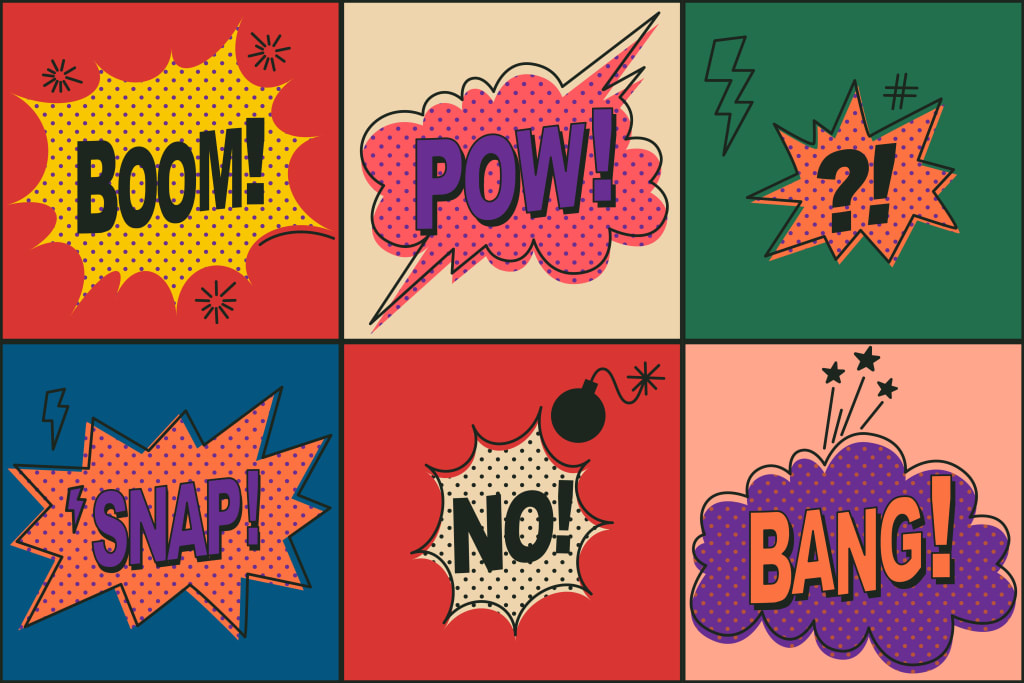
For those who never learned or perhaps have forgotten, onomatopoeia, in addition to being one of the most misspelled words in the English language, are words that are intended to convey noises or sounds. Think pow or ka-pow from the Batman comic books of old. The existence of onomatopoeia reminds us that in any exclusively visual medium such as writing, whether it be text only or illustrated like comic books or graphic novels, there are very few ways to convey the sound a thing makes. Essentially there is analogy to something else that makes a similar sound, perhaps physical/bodily reactions, and onomatopoeia. I am leaving out formalized systems of representing sounds like musical notes because they are only understood by a small subset of people and are generally only applied to specific types of sounds (i.e. musical sounds). None of those options does a very good job in my estimation and together they illustrate just how difficult it is to translate a sound into words or any other visual format in a way that truly captures the essence of it. The difficulty ultimately springs from the fact that all of those options for describing a sound, rely on a different sense, vision, to interpret. If one examines the other senses it quickly becomes clear that translation between any one of them to any other suffers from similar problems though the degree of difficulty varies with the diversity of language that has been developed to describe the particular sense in question. For example, for myself at least, it is easier, though still not easy, to describe how something tastes then how something sounds. This is primarily because many more words are available to describe the taste of a thing than the sound of a thing. That is interesting in its own right, but it becomes even more interesting when one realizes that words are also the only way to convey sight in an exclusively auditory medium. In that case the words must be spoken or written in a form that can be interpreted by another of the senses, like braille. In addition, words are the only option to convey taste in an exclusively taste based medium, if there were such a thing. The same of course goes for touch. In fact it is the case that it is not possible to describe any sense experience to another person (and maybe not even to oneself) without language and words.
This is of course a thing that has been discussed and debated ad nauseum by philosophers and everyday people throughout the ages. It is one of the things which makes writings so powerful, and just one of the many reasons why it is such a useful skill to foster and develop. Onomatopoeia also happens to be a lot of fun to say and to try and use in your writing. Using it, both the word and the technique, cleverly requires much wit and wisdom and it is an interesting thing to challenge yourself to find new and different ways it might be employed. Here is just one example from my own work. Now if I could just come up with a good onomatopoeia for the sound my hand makes when it smacks against my head in frustration each time I finish a perfectly good story only to discover I have not yet hit the magical six hundred word minimum for publication here on Vocal. I would suggest something like thwack but it seems played out and cliche. How does crichswak sound? Or, maybe I should say how does it look? Now that's a headscratcher isn't it?
About the Creator
Everyday Junglist
About me. You know how everyone says to be a successful writer you should focus in one or two areas. I continue to prove them correct.
Keep reading
More stories from Everyday Junglist and writers in Writers and other communities.
Great Works of Literature - Vocal Style
In addition to my endless complaining about the absurd word count minimum for story publication on Vocal I also take issue with the nonsensical subtitle requirement. No matter how much I think about it, and it is actually way too much, I cannot for the life of me imagine what potential justification there could be to require every article or story published here to have one. This includes the poets community by the way. A poem with a subtitle is not a thing I even thought existed until I started publishing here. A story without a subtitle cannot even be submitted for screening by the censorship board (sorry I mean submitted for review to the moderators) without one. Can you imagine what the world would have been/be like if this were an ironclad rule of writing and literature, and had been since the beginning of the written word? Luckily, you don't have to as I have imagined it for you below. Normally I would have ended this introductory section right there. Right at the period after the word below. However when I had completed the piece and checked the word count I noted it was nowhere near 600 words. So, after a round of curses, head slaps, and sighs I had to think of a way to stuff more words into this crap fest of an story and the following was the best I could come up with. What you are now reading are the thoughts currently emanating from my brain. In other words you are reading the words coming out of my head currently, totally unfiltered, exactly as I experience them in my head, at this very moment. Or, I guess, actually for you the reader, it will be at some later moment but hopefully you take my meaning. Now, can you imagine having to live with this person 24/7 365 days a year. Ouch, right. Welcome to my world. Do you think I have hit 600 words yet? I am gonna say no, probably another one hundred or so to go. See how I typed out the word one hundred instead of using the numerals one and zero and zero. Smart right? And then I did it again in the sentence right after the first one. I could have typed out the numerals as numerals each time but that would not have padded my word count in the same fashion as fully typing out the words that the numerals stand for, or is it the numerals that stand for the words? Hmmm. That's a weird thing to think about isn't it. Which stands for which? Six hundred and ten. Nice.
By Everyday Junglist2 years ago in Writers




Comments (1)
these communities don't require 600 words (and fiction can be short if you select the subcategory microfiction): Art BookClub Chapters Critique Fiction Poets Pride Writers