
My Journey Into Buddhism
How Buddhism Helped Me Become a Better Wife and Mother

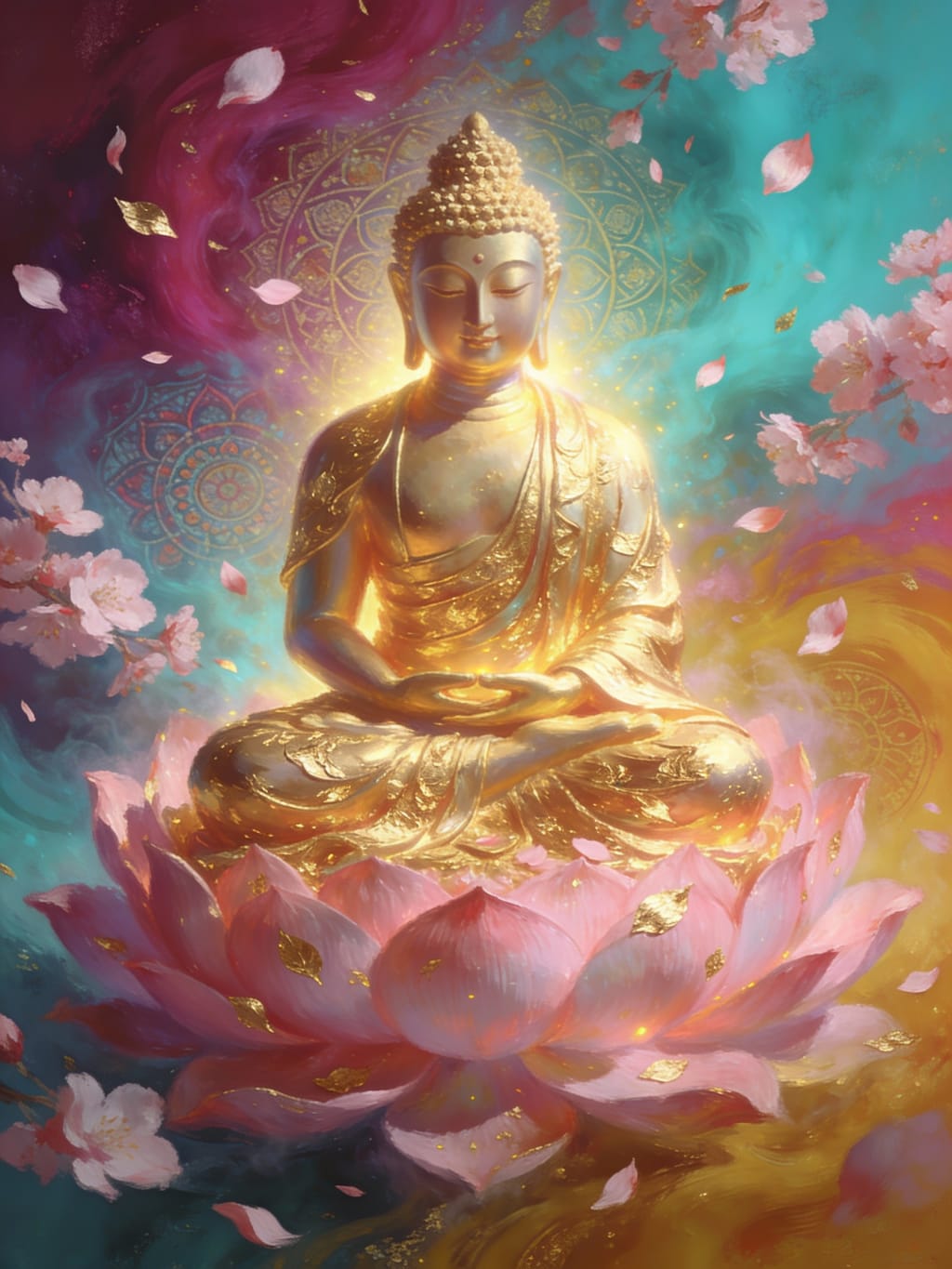
I didn’t find Buddhism because I was searching for enlightenment. I found it because I was exhausted, angry, and trying not to fall apart.
By the time I turned 30, I had already lived long enough to know that life didn’t magically settle down just because you survived the hard parts (they never stop). I’d survived depression, abuse, several miscarriages, and more than one stretch of time when I honestly didn’t think I would be here much longer. I had survived the kind of sadness that makes your body feel heavy, like gravity has doubled, and no one else noticed. I had survived the guilt of staying alive when some days it felt like disappearing would be easier for everyone.
I’ve tried to believe in things before. I tried one religion after another, hoping that one would fit, yet knowing deep down that it wouldn’t. I wanted something solid, something that could hold me when my own dark thoughts were so loud I couldn’t hear anything else. But every belief system I encountered felt like it wanted certainty, obedience, or faith that didn’t ask questions. I had too many questions. I had too much history to try and make myself believe in something just because someone told me I should.
So I stopped trying.
Life, however, didn’t stop. It kept piling on. I became a mother. Then a mother of two. Then a homeschool mom of two kids with ADHD; two beautiful, creative, exhausting little humans whose brains never seem to slow down at the same time. I love them fiercely, but love doesn’t erase stress, and love doesn’t magically teach you patience when you’re running on 4 hours of sleep and your kid is having a melt down over math for the third time that morning.
My husband works long hours for the Department of Corrections and his job has a tendency to follow him home in unseen ways: tension in his shoulders, exhaustion in his eyes, a silence that means he’s already spent the day’s energy dealing with other people’s bullshit. I don’t want him to come home and have to deal with mine. We were both tired, and tired people don’t always treat each other gently.
I yelled a lot.
I hated that about myself. I hated how fast my voice rose, how sharp it could get before I even realized I was doing it. I hated seeing my kids’ shoulders tense when I snapped. And I hated apologizing afterwards and promising to do better without knowing how. I wasn’t a monster. I was overwhelmed. But knowing that didn’t stop the guilt from setting in and weighing heavy on my heart at night.
The thing is, I wasn’t failing because I didn’t care; I was failing because I didn’t know how to cope.
I found the dramas by accident.
It was late and I was scrolling through videos on Youtube looking for something different to watch. The series was short-episodes put together in one 2 to 3 hour long video. Something about it drew me in. It was emotional and dramatic and funny. Woven through each one were moments of Buddhism, not heavy-handed sermons, just characters sitting in silence, talking about suffering like it was a shared human condition, instead of a personal failure.
There was a scene in the drama where a character said something simple, “Suffering exists, but it doesn’t mean you are broken.”
I paused the show.
No one had ever told me that before. Not like that. It resonated deep within me.
I kept watching. Then I found another series. And another. I noticed several patterns: the way characters acknowledged pain without drowning in it, the way they talked about Anitya (impermanence), about the idea that feelings come and go like weather. No one promised happiness. No one threatened punishment. No one demanded belief. It was just…practical.
That caught my attention.
I started looking things up, not because I planned to become anything, I was just curious. What was Buddhism exactly? Was it a religion? Or a philosophy? A lifestyle? The internet, of course, was full of answers, but what stood out to me was how often Buddhism talked about the mind- not as something to conquer, but something to understand.
I read about the Four Noble Truths, and for the first time in a very long time, a spiritual framework didn’t feel like it was judging me or trying to change me. Life includes suffering. But there is a way out. There is a way to reduce suffering. That way involves awareness, compassion, and effort.
That was it. No guilt, no shame, no demand that I be perfect. Just honesty.
Don’t worry, I didn’t suddenly become calm, there is more to the story. I didn’t stop yelling overnight either. Buddhism didn’t turn me into a serene, candle-lit version of myself that floated through each day whispering gentle wisdoms. Real life doesn’t work that way.
What changed was smaller and deeper.
I started noticing how my breathing slowly began to change. When one of the kids was talking over the other or the dog was barking and my brain started buzzing, I noticed that my chest would tighten and my breathing would become shallow. Sometimes I caught myself in time and sometimes I didn’t. But even noticing it felt like progress.
I learned about the idea of the pause- the between a feeling and a reaction. Before, my anger felt immediate and justified. Buddhism didn’t tell me anger was bad, but that anger was only temporary. It showed up, stayed for a bit, and eventually left.
The first time I managed not to yell my son was frustrated with an assignment and started having his usual meltdown. I felt that familiar heat rise in my chest. My mouth opened… and then I stopped.
That felt like a miracle.
I still yell sometimes. Buddhism didn’t erase my past, or my trauma, or my nervous system’s tendency to always be on high alert. Instead, it brought me a greater sense of self-awareness and compassion.
I started practicing compassion towards my kids- not just when they were calm and agreeable, but when they were loud, difficult, and overwhelmed. Then, slowly, I started turning that compassion towards myself.
That was harder.
I had spent years believing that being hard on myself was ok. Buddhism changed this way of thinking. If suffering is universal then maybe my struggles weren’t proof of failure, but proof of simply being human.
I stopped trying to control everything. Not because I stopped caring, but because I realized trying to control everything all the time was unhealthy. My kids were going to have bad days, my husband was going to come home exhausted, and I was going to mess up. None of that meant it was ruined unless I decided it was.
Some nights, after the kids go to bed, I like to sit quietly. No chanting or incense, just me, breathing, noticing how my body feels. Other nights, I sit and cry feeling the weight of the world. And then there are those few and far between nights when I feel nothing at all. Buddhism doesn’t demand that every moment be meaningful. It allows emptiness to simply be emptiness.
That mattered more than I expected.
I didn’t become religious like people usually do. I didn’t convert. I didn’t join a temple. I didn’t announce anything to my family. Buddhism became something quieter- a lens I looked through, a reminder taped gently to the inside of my mind.
When I yell now, I notice it faster, and when I apologize it feels more honest. When the kids struggle, I don’t see it as a personal failure anymore, and when my husband is distant I don’t automatically assume the worst. Impermanence works both ways: bad moments passed, but so did the good ones, and that made me want to be there for them while they lasted.
The biggest change, however, wasn’t peace.
It was space.
Space between thought and action. Space between guilt and worth. Space… to breathe.
I am still a mom of two kids with ADHD. I still homeschool and my husband still works long hours at a job that takes a lot out of him. I still get overwhelmed and lose my patience. Buddhism didn’t give me a new life. It helped me live the one I already had with a little more awareness and a little less self-hatred.
I didn’t find Buddhism because I was searching for meaning.
I found it because, for the first time in my life, something looked at my pain and said, “You are not alone. And you are not broken.”
About the Creator
Keep reading
More stories from Carolyn Patton and writers in Writers and other communities.
The Dead Princess's Mercy
General Wei stared at the pool of black water beneath his feet. In its reflection, he didn’t see his own battle scared face, but the faces of the three thousand men he had burned alive at the Siege of Yan. Their skin was translucent and their mouths were stitched shut with what looked like rusted wire.
By Carolyn Patton2 months ago in Fiction
How Supply Chain Disruptions Affect Aircraft Parts Availability
Aircraft operations depend on the steady supply of replacement parts, components and maintenance materials. Airlines, maintenance providers and aviation service companies depend on a steady supply of aircraft parts to keep fleets operating safely and efficiently. However, global supply chains are complex networks involving manufacturers, distributors, logistics providers, and regulatory authorities. When disruptions occur within this system, the availability of aircraft parts can quickly become limited.
By Beckett Dowhan4 days ago in Writers




Comments
There are no comments for this story
Be the first to respond and start the conversation.