
Is Laparoscopic Myomectomy Safer Than Open Surgery? A Detailed Comparison
A Detailed Comparison of Safety, Recovery, and Outcomes to Help You Make an Informed Choice

Fibroids are a common concern for many women, often causing discomfort and health complications. In fact, a study says that around 70% of women will develop fibroids during their reproductive years. When surgery is necessary, myomectomy offers a way to remove fibroids while preserving fertility. However, with advancements in surgical techniques, the decision between laparoscopic surgery for myomectomy and traditional open surgery can be overwhelming.
Let's compare these two procedures head-to-head, focusing on safety, recovery, and outcomes to help you decide the best path forward.
What Is Myomectomy and Why Is It Done?
A myomectomy is a specialised surgical procedure designed to remove uterine fibroids and noncancerous growths that can disrupt your quality of life. Unlike a hysterectomy, which removes the entire uterus, a myomectomy preserves the uterus, making it an ideal option for women who want to maintain their fertility.
Many women opt for this procedure when fibroids cause symptoms like heavy menstrual bleeding, persistent pelvic pain, bloating, or pressure on the bladder or bowel. By targeting and removing only the fibroids, a myomectomy offers relief from discomfort while keeping future pregnancy possibilities open. For women seeking to manage their symptoms without sacrificing reproductive health, this surgery provides a vital balance between treatment and preservation.
What Is Laparoscopy Myomectomy?
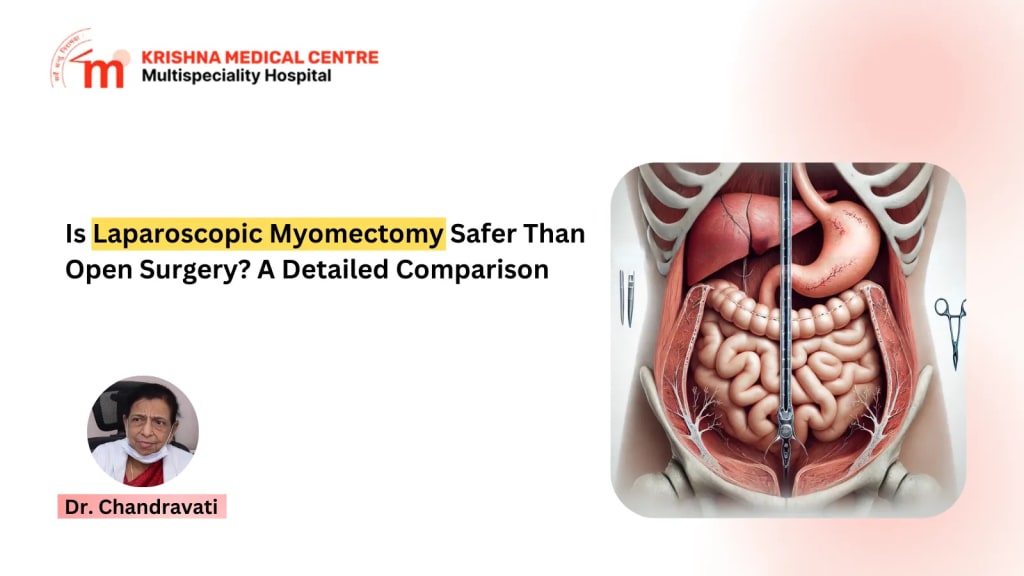
Laparoscopic myomectomy, also called minimally invasive myomectomy, is a surgical technique that removes uterine fibroids through small incisions in the abdomen. Surgeons use a laparoscope, a thin tube with a camera, to view the uterus and guide specialised instruments to remove the fibroids.
Compared to open surgery, this method results in:
- Smaller incisions
- Less blood loss
- Shorter recovery time
- Lower risk of infection
Laparoscopic myomectomy is especially suitable for women with smaller fibroids who prefer a faster and less invasive recovery.
What Is Open Myomectomy?
Open myomectomy, or abdominal myomectomy, is a conventional surgical method that requires a larger abdominal incision to remove fibroids. This method is typically recommended for women with larger or numerous fibroids that may not be accessible through minimally invasive techniques.
Key characteristics of open myomectomy include:
- Larger incision (typically 5 to 7 inches)
- Higher risk of blood loss due to the size of the incision
- Longer recovery time (up to 6-8 weeks)
- Potential for more scarring
While open surgery remains a viable option, it is generally reserved for more complex cases where laparoscopic surgery is not possible.
Laparoscopic vs. Open Myomectomy: A Safety Comparison
When comparing the safety of laparoscopic vs. open myomectomy, laparoscopic surgery is generally considered the safer option for many women. Here’s why:
- Lower Risk of Infection: Because laparoscopic surgery involves smaller incisions, there is less exposure to external contaminants, reducing the likelihood of infection.
- Less Blood Loss: The smaller incisions in laparoscopic surgery also mean less bleeding during the procedure.
- Fewer Complications: Laparoscopic myomectomy is associated with a lower risk of complications such as adhesions (scar tissue) and injury to surrounding organs.
However, open myomectomy is sometimes necessary for large fibroids, complex cases, or when the fibroids are deeply embedded. In these cases, the surgeon may opt for open surgery to ensure complete removal of the fibroids.
Recovery Time: How Does Laparoscopic Myomectomy Compare?
Laparoscopic myomectomy offers a much faster and more comfortable recovery experience compared to open surgery. Here's how they differ:
- Most women recover from laparoscopic myomectomy in about 2 to 4 weeks.
- Recovery from an open myomectomy usually takes 6 to 8 weeks.
- Smaller incisions result in less tissue damage and quicker healing.
- Post-operative pain is generally milder with laparoscopic surgery.
- Patients often need fewer pain medications after a laparoscopic procedure.
- Faster return to daily activities and work.
This shorter recovery time is one of the reasons many women prefer laparoscopic fibroid removal when eligible.
Which Procedure Is Right for You?
The decision between laparoscopic and open myomectomy depends on several factors, including:
- Fibroid Size: Larger fibroids or multiple fibroids may require an open procedure for better access.
- Health Condition: Pre-existing health conditions, such as obesity or uterine abnormalities, may influence the choice of procedure.
- Surgeon’s Recommendation: A skilled surgeon will evaluate the fibroid location, your overall health, and other factors to determine the most appropriate surgical approach.
Ultimately, the best option is your unique situation and should be discussed with your healthcare provider.
Key Takeaway
Laparoscopic myomectomy is generally considered safer and offers several benefits, including faster recovery and fewer complications, compared to open myomectomy. Various factors, including the fibroids' size, location, and overall health, determine the choice between laparoscopic and open surgery. Consult with your doctor to determine the best surgical approach for your needs.
About the Creator
Krishna Medical Center
Krishna Medical Centre, a distinguished healthcare institution with a rich legacy, located at 1 Rana Pratap Marg, Near Moti Mahal Lawns, Hazratganj. Established in 1985 by the renowned Gynaecologist, Dr. Chandrawati.
Keep reading
More stories from Krishna Medical Center and writers in Writers and other communities.
Hysterectomy for Endometriosis: Is It the Best Solution for Pain Relief?
Endometriosis is a painful condition that affects millions of women worldwide, causing severe pelvic pain, irregular bleeding, and, in many cases, infertility. For some women, conventional treatments don’t provide enough relief. In these cases, a hysterectomy may be considered as a treatment option for managing endometriosis-related pain. This blog explores whether a hysterectomy for endometriosis is the best solution for pain relief and when this surgical option might be appropriate.
By Krishna Medical Center9 months ago in Writers
It's Winter
Anne Bernays and Pamela Painter — What If? Writing Exercise for Fiction Writers prompts The Exercise —Write a scene involving two characters. Have the point-of-view character presume something entirely different about the situation from what the other character's overt behavior seems to imply. For example, a landlord comes to visit, and the tenant suspects that it isn't a visit but an inspection. Make up several situations in which one character can fantasize or project or suspect or even fear what another character is thinking. The Objective - To show how your characters can use their imaginations to interpret the behavior and dialogue of other characters.
By Denise E Lindquist20 days ago in Writers
How AI Is Transforming Small Business Operations
Introduction In the present time of modern technologies, Artificial intelligence is no longer just suitable and profitable for larger enterprises or high tech-industries. Significantly, it became a more convenient, budget-friendly, practical and impactful tool for medium to small size businesses for navigating tighter margins, fulfilling the expectations of customers and rapidly increasing competition in the market. From routine basis automation tasks to deep insights unlocking AI is enhancing how SMEs execute, decide and grow.
By Abbasi Publisherabout 2 hours ago in Writers


Comments
There are no comments for this story
Be the first to respond and start the conversation.