
If this is not a crime thriller plot
I don’t know what is


Sometimes, I use elements of true crime stories for my fictional mystery and thriller writing. Why invent a dastardly crime when so many are committed every day? If, as I do, you like to ensure that your fictional writing has the authenticity of a true story, then where better to go than the current news feeds?
This recent story of the conviction of American Aimee Betro for a bungled attempt at a revenge killing in the UK is one such example. It has all the hallmarks of a true story, not least because it is, well... a true story. If I were going to write a story about a contract shooting, or other such murderous conspiracy, this would be a candidate for much of the authentic detail. Anyone who thinks that they can come up with this sort of thing by exercising their imagination alone, must have a more productive and intricately detailed dreamscape than this humble mortal.
One of the things that irritates me about a lot of murder mysteries I read or see on screen is that they bear little or no relation to real murder. That is because all of the detail is made up, invented on the spot, as being the quickest and least-effort approach. Yet, to do enough real-crime research to get nitty gritty on what it is like to be a murderer or would-be murderer, is so easy.
One of the things far from the truth is that murderers, when depicted in fiction, are so often shown to be a race apart. They are mindless killers, who have superhuman powers, it seems, to kill without being detected. That is until the super-superhuman powers of the fiction detective are pitched against them. Then, the detective comes up with lots of theories about who did it, rather than collect and sift evidence, which is the job of real-life detectives. This is absolute nonsense and the reality of homicidal crime is that it is very human, seldom carried out efficiently, and the perpetrators are often less than the masterly criminals portrayed in fiction.
Fiction in any form has always intended to be realistic," Raymond Chandler, The Simple Art of Murder
Take the example of the perpetrator in this attempted murder, this conspiracy to assassinate a member of a family in a bitter feud with the co-conspirators of the would-be murderer.
Was she a professional assassin, a career criminal, steeped in a murderous past? No! It seems she had hardly a trace of past criminal connections or career trajectory.
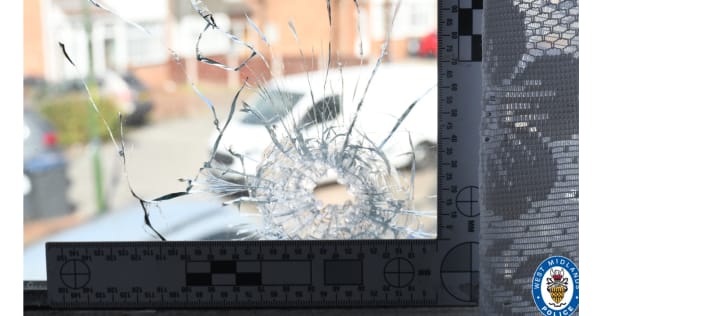
Aimee Betro tried to shoot her target from just feet away outside his home in a cul-de-sac in South Yardley, but her gun jammed. CCTV footage showed how the victim had just returned home and was getting out of his car, but sped away as she approached him with the gun, smashing the open door from Betro’s car. But a few hours later, she returned and fired three bullets through bedroom windows of the family home. West Midlands Police Aug 12, 2025.
Reading stories like this, we can see where the motivation to plot a murder comes from in one example. We can find out some of the ways that 'assassins' or hired killers are recruited. We can learn how they might try to cover their tracks or fail to do so. We can also understand how the criminals might underestimate the ability or the tenacity of law enforcement agencies to collect and analyse evidence that can lead to the identity of the perpetrator. Later this evidence will help to convict them.
Do the good guys always win? No, of course not. Some murders remain unsolved, some are attributed to innocent parties, resulting in miscarriages of justice. Sometimes the ability to find a killer and bring them to justice may depend on the resources available to the law enforcement agencies where the murder was committed.
What are the killers themselves like? Most murderers and those who commit lesser crimes of homicide or attempted murder are pretty ordinary. Some killers are people of questionable emotional or mental capacity whose rage steps in to take the place of simple reasoning, problems solving and negotiation. The killer may well be a violent person who resorts to violence rather than deploy other means to resolve problems. Sometimes the killing is unintended or unpremeditated and just the result of a violent outburst. Sometimes the killing is planned, prepared for, the victim set up.
In such cases the killer, or the person offering to pay another for a killing, will aim to fool the authorities, to get away with murder. Have they thought of everything? Have they covered the risk of a particularly tenacious investigative team being assigned to the case?
It is of course the flaws in the planning or execution of such a dastardly plan that are the stuff of murder mystery writing. As in so many other areas of fictional story creation, presenting a convincing and authentic case can often depend on research, research, and more research.
If you do want to use true crime stories in your fiction writing, be sure not to copy anything from the real events. If you look at individual details and use these to help you to invent fictional events that are authenticated by the same level of detail, you are less likely to attract legal scrutiny.
Happy crime writing.
About the Creator
Raymond G. Taylor
Author living in Kent, England. Writer of short stories and poems in a wide range of genres, forms and styles. A non-fiction writer for 40+ years. Subjects include art, history, science, business, law, and the human condition.
Keep reading
More stories from Raymond G. Taylor and writers in Writers and other communities.
A Glimmer in the Gaslight
This is a writing exercise and was entirely inspired by a recent Top Story from the wonderful Vocal creator Lana Lynx. Lana's story stemmed from her wondering what it would be like if dead authors, particularly dead Russian authors, posted their story ideas and WIPs on Facebook. Please check out the truly amazing and amusing results.
By Raymond G. Taylor7 months ago in Writers
Unofficial Challenge: Black History Celebration
Forward: February 28th, 10:53 PM, EST... The final hour of Black History Month, 2026. Hello fellow writers. I've had this challenge waiting in my drafts for most of the month. But I held off on publishing it, until now.
By Sam Spinelli6 days ago in Writers
The Complete Guide to Crawl Space Encapsulation in Odessa
Understanding Crawl Space Encapsulation in Odessa Homes A home’s crawl space plays a quiet but critical role in overall structural health. In Odessa, environmental conditions such as moisture fluctuations and soil characteristics can influence how crawl spaces perform over time. As a result, many homeowners explore crawl space encapsulation Odessa solutions as a preventive measure rather than a cosmetic upgrade.
By Abbasi Publisher5 days ago in Writers
Bomb Scare
It was 2027, and the world never thought it would happen. A missle hit the United States, but it wasn't where they had anticipated. A little town in the northeast was hit by a missile strike, they didn't know why, and they didn't know exactly where it hit, but they did know it was a coastal community, somewhere between Maine and Delaware.
By Gregory Paytona day ago in Fiction




Comments (6)
This is fascinating! I love how you break down the reality behind true crime and show how it can inspire authentic, believable fiction. Your approach makes the writing feel so much more grounded.
This article would make a great lecture in a true crime and/or mystery creative writing course. Great research and work.
⚪️ Your commentary on what Aimee Betro did ~ whether we can exercise our imagination, realistically, to meet all the details of this case. Was an eye opener. ~ I can see how doing our research would make our fictional stories shine. Especially with all the nitty gritty stuff. ⚪️ showing/ including some of the collecting and sifting evidence, is much better than their super human powers. I agree. ~ thank you for all the wonderful advice: the emphasis on research and more research — not to copy anything from real events. But rather, individual details to help us invent fictional events. ♥️♥️ informative and well presented, thank you again Raymond♥️♥️ 🤗
"They are mindless killers, who have superhuman powers, it seems, to kill without being detected. That is until the super-superhuman powers of the fiction detective are pitched against them." I guess they do it this way to spice things up because nobody would wanna read something that seems realistic. Else it would be nonfiction, instead of fiction. That's just my assumption though
Extremely interesting article with a lot to think about.
I'm always intrigued by true crime. And agree with your assessment for the possible motives. Writing a fictional murder mystery is complicated and takes time to get right. Interesting article, Ray.