
I Stopped Chasing Tactics and Finally Connected With My Readers
Sell the Transformation, Not the Features

Official Statement: The storyteller is not the author themselves, but a highly respected new media expert in the industry. The content of this post was compiled and organized based on the author’s interview with them.
For five years, I was a marketing junkie.
My credit card statement proved it: a graveyard of $2,000 "masterminds," $497 "funnel-hacking" courses, and endless $27 "ultimate cheat sheets."
I was fluent in acronyms. CAC, LTV, CTR, ROAS. I could define them all. I had complex social media content calendars and automated email sequences that looked like NASA flowcharts. I ran Facebook ads and A/B tested my button colors. (Orange barely beat green, in case you were wondering.)
I thought I was executing the playbook. I was doing all the "marketing" things.
And in five years of "doing marketing," I had a grand total of 183 email subscribers. I’m pretty sure 40 of them were my family.
I'd spend $500 on an ad campaign to sell a $40 e-book and make... one sale. I wasn't just failing. I was paying to fail.
I was convinced I was just one "hack" away. One "secret" funnel. One "magic" keyword. I was busy, I was optimizing, and I was completely, utterly broke. I was staring at a negative bank balance, a ghost town of a blog, and a stack of useless certificates.
I thought I was a terrible marketer. The truth was, I wasn't really learning marketing. I was just memorizing a list of tactics.
We Are Addicted to “Tactics” and Allergic to “Humans”

We're often obsessed with the channel (Instagram, Google, TikTok) and forget about the only thing that matters.
The person on the other side of the screen.
The Root Cause: We’re Selling the “Drill” to People Who Don’t Want a “Hole”

This is the fundamental reason my "marketing" failed.
I sat in my office, guessing. I assumed I knew what people wanted.
"They must want our new AI-powered, cloud-based, synergistic-analytics dashboard!"
So I’d create a landing page that shouted this at them:
"OUR DASHBOARD IS AI-POWERED! IT IS EFFICIENT! IT HAS 15 NEW FEATURES!"
And the customer—tired, overwhelmed, stressed, and scrolling on their phone while a kid screams in the background—could not care less.
We're selling the features. We're selling the specs. We're selling the drill.
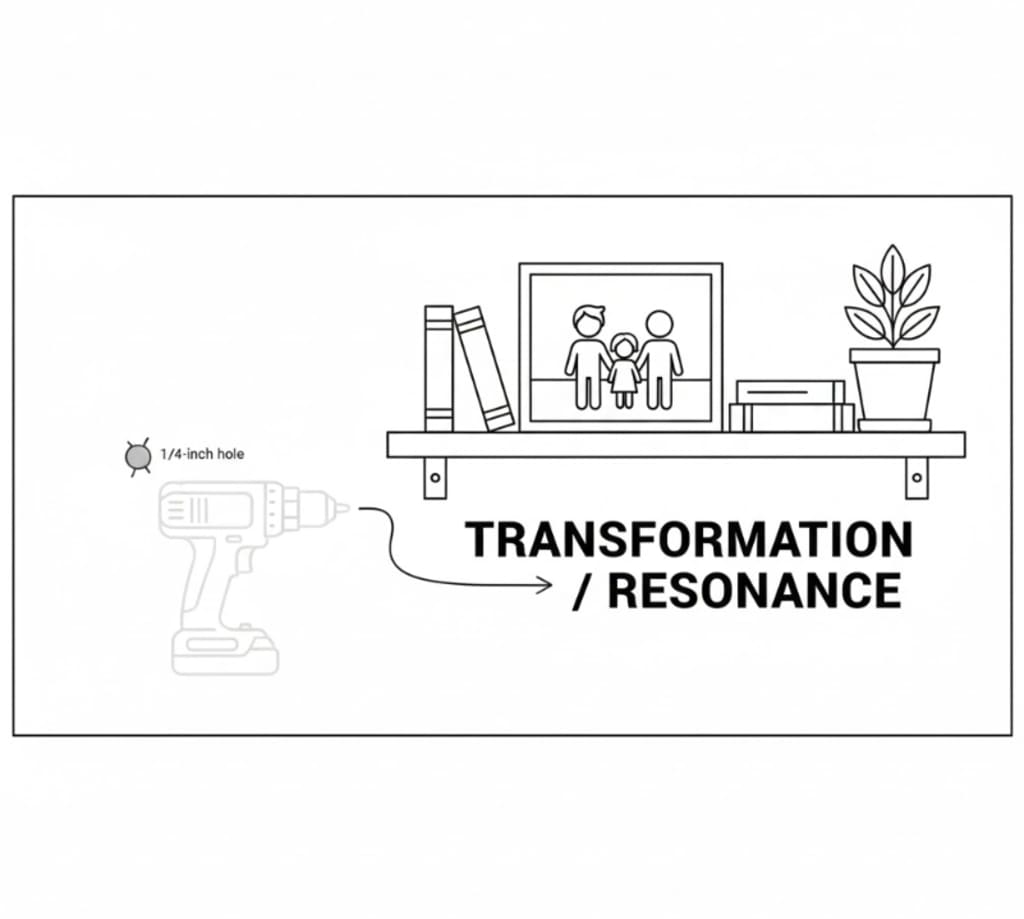
As the old saying goes, "People don't want a quarter-inch drill. They want a quarter-inch hole."
This is "Marketing 101." But I think it's wrong. It doesn't go deep enough.
Nobody wants a hole.
They want the beautifully hung family photo. They want the shelf that finally gets the clutter off the floor. They want the feeling of pride when their neighbor compliments their living room.
They want the feeling the hole enables. Status. Peace. Security. Connection.
My marketing was failing because I was selling dashboards to people who just wanted to look smart in their Monday meeting and leave work at 5 PM. I was selling diet plans to people who just wanted to feel confident walking into a party.
I was selling tactics. They wanted transformation.
The “Aha” Moment: To Learn Marketing, You Must Stop Learning “Marketing”
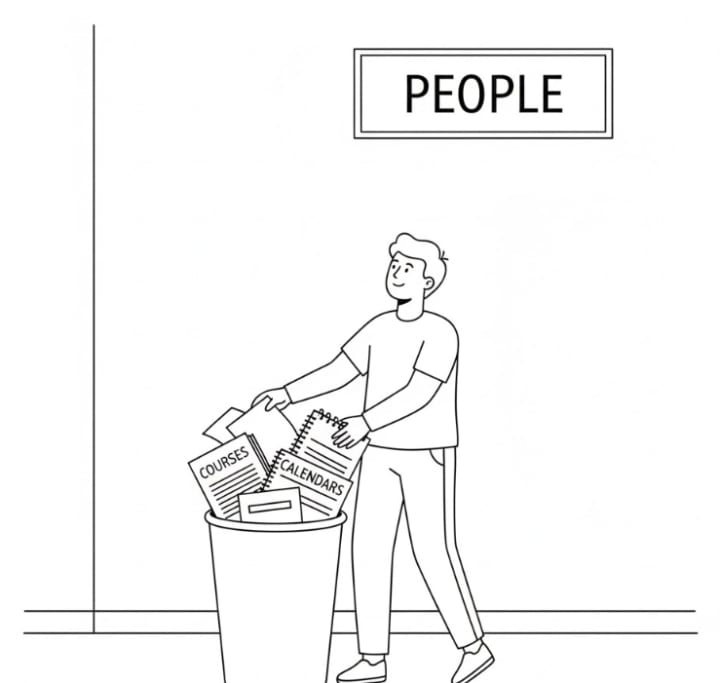
I was at rock bottom, ready to get a "real job."
I closed all my courses. I unsubscribed from all the "gurus." I deleted my content calendars.
I decided, as a last-ditch effort, to stop doing marketing for 30 days. Instead, I would only learn about people.
This is the counter-intuitive conclusion I came to: All the "marketing" blogs and hacks are useless if you don't understand why people do things. It's like trying to become a great novelist by only memorizing the dictionary. You have all the words (the tactics), but you have no idea how to craft a story (the strategy).
I needed to stop being a "marketer." I needed to become a student of human nature.
I stopped asking: "What's the best time to post on Instagram?" I started asking: "What is my customer secretly afraid of at 9 PM when they're scrolling Instagram, and how can I make them feel seen?"
This single shift changed everything. My entire focus moved from my tools to their truth.
My New Framework: A 3-Step Listening Process

I threw out the 50-step funnels and replaced them with this simple loop.
Step 1: Understand the "Why" (Learning Basic Human Psychology)
Instead of learning about ad platforms, I started learning about basic human psychology. These are the "source code" for decision-making.
I became obsessed. I read Robert Cialdini's book, Influence, and it was like a lightbulb went off.
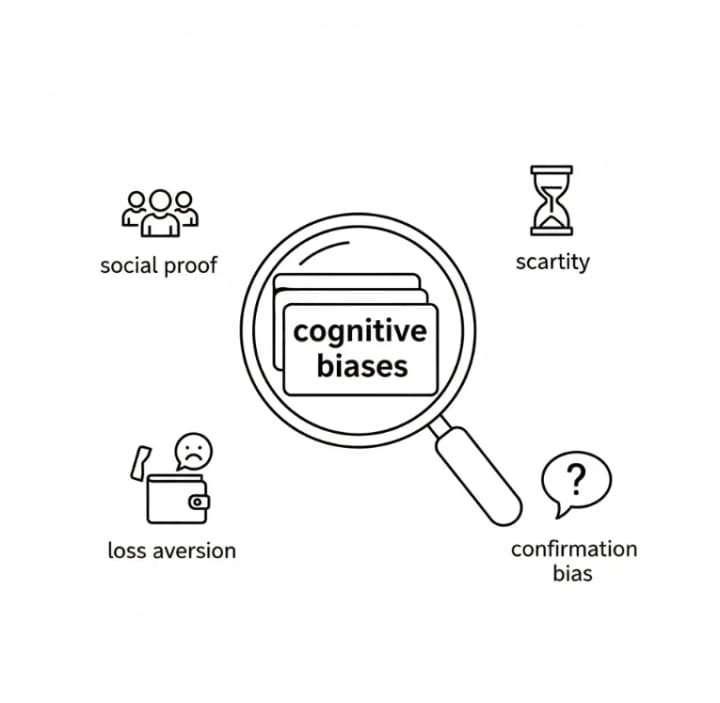
I started seeing these principles everywhere. I finally understood why a "24-hour timer" (Scarcity) short-circuits our rational brain, or why a "free PDF" (Reciprocity) makes us feel indebted. I saw how "Social Proof" (reviews, testimonials) builds trust far better than a brand's own promise.
My Actionable Step (How I Did It): Go read a book like Cialdini's. Then, spend one hour on the internet actively hunting for examples. This hour of active "hunting" was 100x more valuable than any $2,000 marketing course. I was finally learning the why behind the what.
Step 2: Stop Guessing and Start Listening
This was my biggest and most arrogant mistake: I assumed I was my customer. I'm not. You are not your customer.
I had to shut my mouth and stop inventing their problems. I had to find their actual problems, in their actual words.
Where do they hang out before they know you exist? They're on Reddit. They're on Quora. They're in niche Facebook Groups. They're in the Amazon review sections for your competitors' books.

I used to write blog posts like, "The 10 Best Productivity Tips." That was me, guessing. Then I went to the r/productivity subreddit. I never posted; I only read. I sorted by "Top - Past Month."
And I saw the real language. They didn't say, "I need to optimize my workflow for better synergy." They said: "I have 3 projects due, 2 screaming kids, and I cannot stop staring at the wall. I feel like a complete failure." "Does anyone else feel like a fraud? I just got promoted and I'm terrified I'll be found out." "I am drowning in my to-do list. It's 10 PM and I haven't done anything."
That is the pain. That is the language. "Staring at the wall." "Complete failure." "Fraud." "Drowning." These are emotional, visceral words. That was my new marketing swipe file.
My Actionable Step (How I Did It): Find one online community where your ideal customer lives. Read the "Top 10" posts. Open a blank document and write down only the exact emotional words they use to describe their pain. Your next blog post title must use these words.
Stop inventing your marketing copy. Start (ethically) copying it from the people you want to help.
Step 3: Build a Bridge with a Story
Okay. Step 1: I understood their internal psychology. Step 2: I understood their external pain (their words). Now, I needed to connect their pain to my solution.
This connection is not a feature list. It's a story.
This was the final piece. Bad marketing shouts features. Great marketing tells a story. And in that story, you are not the hero. This is the second-biggest mistake we make.
The customer must be the hero. You are the guide. I learned this from Donald Miller's Building a StoryBrand. Think about it: in Star Wars, Yoda isn't the hero. Luke is. Yoda just gives him the plan. We, as brands, need to be Yoda.

My Actionable Step (How I Did It): I took my "About Me" page. My Old Headline (Me as Hero): "I'm a productivity expert here to give you the best productivity tips and tricks." My New Headline (Customer as Hero): "You're tired of being busy and overwhelmed. I give you simple systems to get your real work done, so you can finally close your laptop at 5 PM and feel proud of your day."
See the difference? The first is about me. The second is about you.
From "Ghost Town" to Growing Audience
I did this. I threw out all the tactic sheets. I focused only on this 3-step loop: Psychology. Empathy. Story.
My next blog post wasn't "10 Tips to Be More Productive." It was "I Felt Like a Fraud for 5 Years. Here's How I Finally Started to Feel Capable."
I used the exact language from Reddit (Step 2). I structured it as a story where I was the one in pain, making the reader feel seen (Step 3). It was vulnerable and built a connection (Step 1).
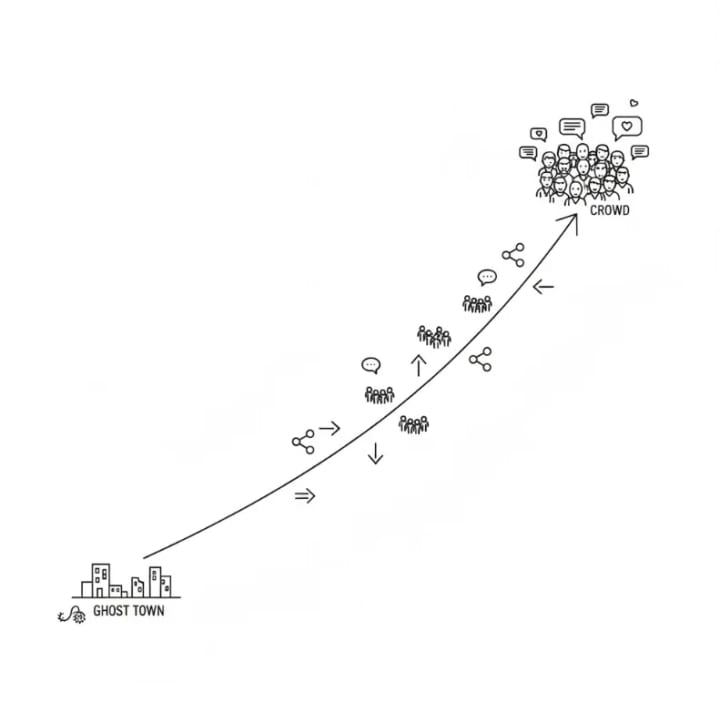
That one post got more traffic in three days than my entire blog had in the previous five months. It finally connected with people. Why? Not because of SEO or a funnel. It resonated because one person read it and had a powerful reaction: "This person is inside my head. They understand me." And that person shared it.
That is marketing. Marketing is not convincing. Marketing is resonating.
I repeated the loop. Find a pain. Listen to the language. Tell a story that serves them. Over and over. That's how I finally built an audience.
I stopped selling and started serving. I stopped shouting and started listening. I stopped learning marketing and started learning people.
Your Tools Don’t Matter If Your Message Is Wrong

I stopped staring at my analytics. I stopped obsessing over my email "open rate." I stopped A/B testing my button colors.
You can have the most expensive email software and the most complex ad funnel. But if your message does not connect with a real, human, deep-seated pain, you have nothing. You are just shouting into the void.
Your message comes from empathy. Your clarity comes from psychology. Your connection comes from storytelling.
Stop learning tools. Start learning people. That is the only "marketing hack" that has ever, and will ever, work.
About the Creator
Cher Che
New media writer with 10 years in advertising, exploring how we see and make sense of the world. What we look at matters, but how we look matters more.
Boundless
A geographical map could take you there. To the places I've been, to the sights I've seen, to the landscapes I've climbed. But no compass could point you in the direction of my memories. To the experiences I've lived, to the happiness I've felt, to the wonder I've held so close to my heart.
By Alyssa Musso6 days ago in Writers
Best URL Shorteners
Long URLs filled with tracking codes and parameters can look messy and difficult to share. URL shorteners help transform these lengthy, cluttered links into shorter, cleaner versions that are easier to manage and share. Not only do they make URLs more user-friendly, but they also come with additional features like custom branding, tracking, and performance analytics.
By Backlinks Cart3 days ago in Writers
It's 2026. Songs Turning 10 This Year
In 2016, we saw the rise of short form videos and what would lead to the birth of TikTok. We cannot forget the Snapchat filters no matter how cringe worthy some of them might have been. It was also the year in which the hit series Stranger Things debuted.
By Jasmine Aguilar6 days ago in Beat




Comments
There are no comments for this story
Be the first to respond and start the conversation.