
How To Recover From The Google March 2024 Core Update (Relaxed and Easy)
Google's March 2024 was a severe hit, for many websites. Here are 4 strategies to deal with the Google March 2024 Core Update!

Google's March 2024 was a severe hit, for many websites. A few sites got a boost, but so many more sites got slapped down really hard. Some even disappeared from the search results completely. They got deindexed, destroying the year-long, hard work of the website owners overnight.
If you're one of those websites that got hit really hard, you are surely asking yourself how to recover from the Google March 2024 core update.
Well, since I'm a website owner myself (I'm running an artist website along with an art blog), I've been dealing a lot with search engine optimization (SEO) strategies. Because, without applying any SEO tactics, you won't be able to get your website seen. So much is for sure.
In this post, I'll be sharing my best tips on how to recover from the Google March 2024 core update - relaxed and easy, without sleepless nights. Because, even if your website got hit by the new search algorithm changes, there are still ways to get exposure.
And one thing's for sure: SEO is still working and if you apply it the right way, you'll be able to drive organic traffic to your website - Google update or not!
But before we get into it, let's start at the beginning: what's that Google 2024 core update actually all about?
What Is The Google March 2024 Core Update?
Well, the March 2024 update is Google's new way of "tackling spammy, low-quality content on Search."
The company announced that they made key changes to their algorithms with the aim of improving the quality and helpfulness of the search results. This includes "algorithmic enhancements" to the core ranking systems to make sure that the search results only show the most helpful information on the web and little to no "unoriginal content."
Additionally, Google's new spam policies aim at keeping websites out of the search that are "unhelpful, have a poor user experience or feel like they were created for search engines instead of people."
In particular, Google's new spam policies focus on three practices: expired domain abuse, site reputation abuse, and scaled content abuse.
- Expired domain abuse happens when someone purchases an expired domain (preferably with a high domain authority) and repurposes it to host low-quality content, hoping to rank well in the search by using the past reputation of the domain name.
- Site reputation abuse is when third-party pages are published with little or no first-party oversight or involvement, where the purpose is to manipulate search rankings by taking advantage of the first-party site's ranking signals. Such third-party pages may include sponsored, advertising, partner, or other third-party pages that provide little to no value to users.
- The scaled content abuse policy aims at cutting down on unoriginal content that provides little to no value to users and has been generated for the primary purpose of manipulating search rankings.
Does that mean that Google punishes AI-generated content now?
Well, according to this policy, content is considered spam, if it was created with the primary purpose of manipulating search engine result rankings.
This may include automatically-generated content. But also "man-made" content or a combination of the two may be categorized as spam, if Google thinks it was created to manipulate its algorithm.
In its Search's guidance about AI-generated content, Google explicitly points out that "it's important to recognize that not all use of automation, including AI generation, is spam."
Well, so far so good.
It all sounds pretty good, doesn't it? I think we've all come across those unnerving websites that are filled with AI-generated gibberish, well-optimized for search engines but absolutely unhelpful, right?
An improved search experience without spammy website results would be just great.
So, what's all the uproar about? Shouldn't everyone just be happy with the Google March 2024 core update?
Well, that's the way it should have been, but something must have gone wrong…
What's The Impact Of Google's March 2024 Core Update?
Google probably implemented their latest update with the best of intentions, but something must have gone wrong. It cannot be otherwise - in my opinion and according to what SEOs are saying.
Google's latest core update started on March 5, 2024 and completed 45 days later on April 19, 2024. So, as I'm writing this article at the beginning of July, we're already three and a half months in. Technological changes can be rocky at the beginning, but after more than a quarter of a year, things should have been smoothed out.
However, that's not so much the case for Google's new ranking criteria.
But, after all, the March 2024 core update is one of the most complex updates Google has ever implemented, so far. It involves multiple of their core ranking systems, not only one or two… and this is probably where things are going wrong.
Who Are The Big Winners Of The Google March 2024 Core Update?
Sites that experienced a boost in their search engine rankings following the Google March 2024 core update are
- forum sites like Reddit and Quora,
- social sites like YouTube, Instagram, Facebook, Twitter, and Pinterest, as well as
- e-commerce sites like Amazon, Ebay, Walmart, and Etsy (if you're about showcasing and selling art, Etsy surely rings a bell).
Who Are The Big Losers Of The Google March 2024 Core Update?
Interestingly, the biggest losers of Google's latest core update are huge informational sites with user-generated content, including wikipedia.org, nytimes.com, linkedin.com and medium.com.
That's only for the huge sites on the web.
There are many more smaller sites that are the really big losers. For those sites, it will be much harder to recover from the Google March 2024 core update, because they don't have the same brand awareness as those well-known sites.
The websites that have taken a big - and most likely unjustified - hit from the core update are small websites, blogs, and new websites.
All you need to do is run a quick search on the web, typing in something like "march 2024 core update reddit," and you'll find so many website owners that are clueless why their sites were hit by the update and what to do about it.
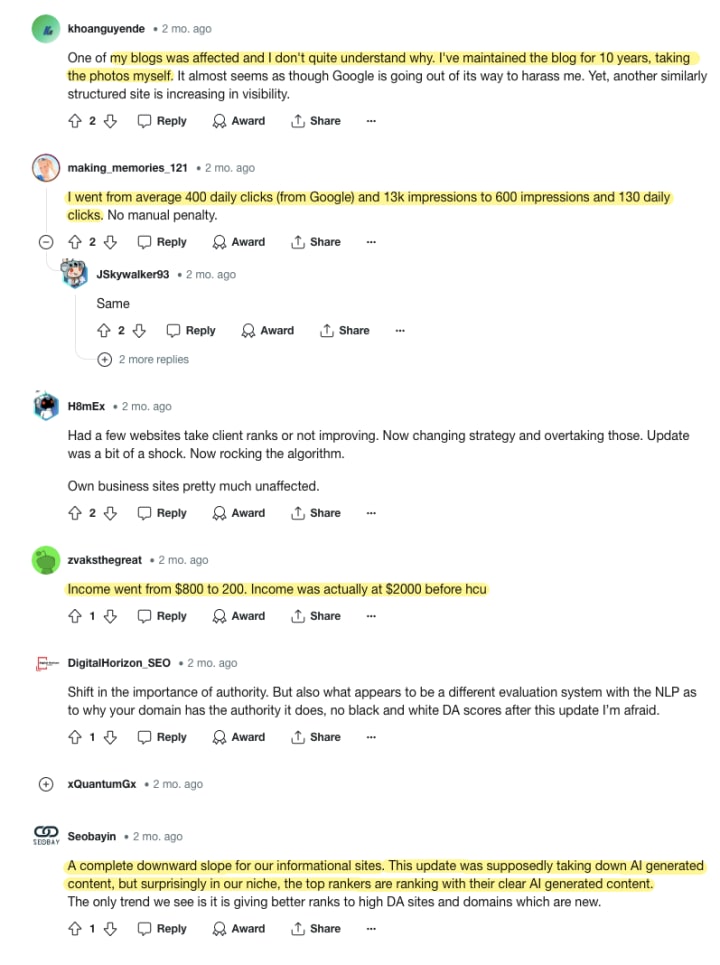
Some website owners even report that they've received a "manual action," meaning a real human person from Google took a look at their site and determined that it's spam.
But even if no manual action has taken place, so many bloggers find that their websites have simply disappeared from the search - even though they don't contain any mass-produced, AI-generated content.
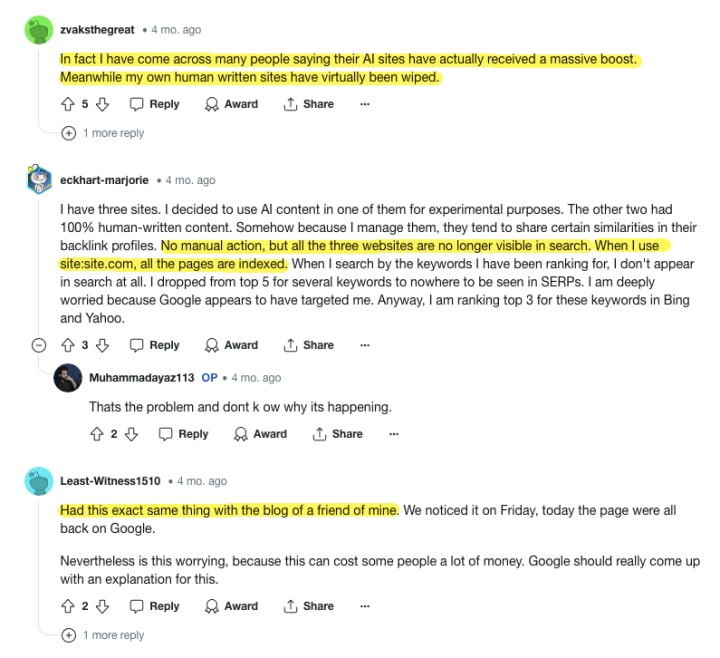
Mind you, those sites haven't been deindexed - they simply don't show up in the SERPs anymore and no one knows why.
On the other hand, sites that feature a huge amount of AI-generated articles have experienced a massive boost after Google's March 2024 core update.
To find out whether your site has been deindexed by Google, just type in "site:yourdomain.com" into the search bar. When pages of your site appear in the search, you're not affected. However, if your website or any of its pages don't appear, then you may have been deindexed.
I've run a quick test for my artist website… and found that it's indexed:
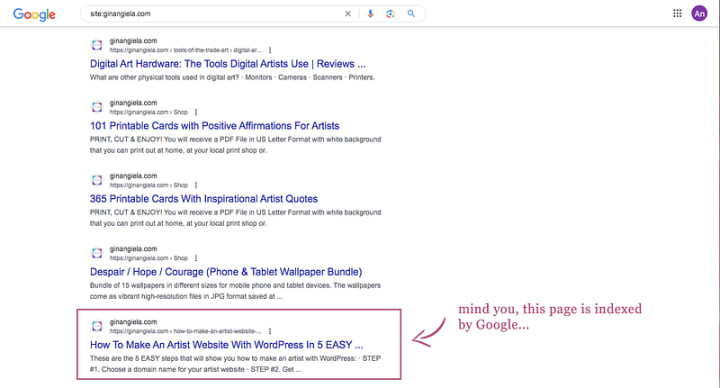
Please note the last page that shows up as indexed in Google's results. I'll come back to that page in just a minute, because this is exactly where I believe that things are going wrong with the Google March 2024 core update.
Does Google's March 2024 Core Update Rank Websites Fairly?
As I already mentioned above, I have my own website and I've been consistently optimizing my art blog for SEO. That's why, from time to time, I tend to check how my posts are performing - in different search engines.
One blog post that I checked recently is a tutorial on how to make an artist website with WordPress. And this is where things get really interesting…
When I check the performance of that site in Yandex, Bing, and Ecosia, I find that it's the first organic search result when I type in "make an artist website with WordPress ginangiela." On Yandex, it's even among the top search results without adding my domain name (ginangiela). See for yourself:
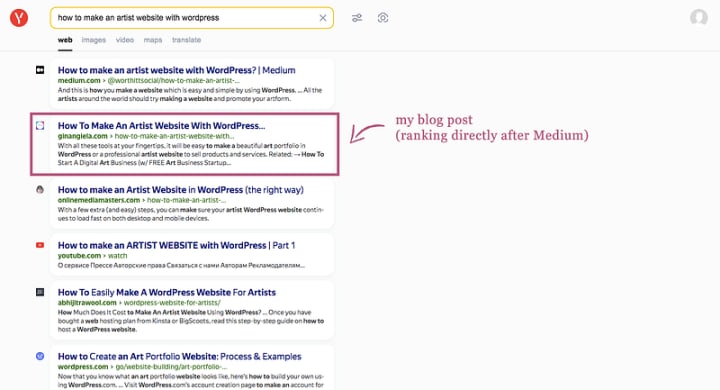
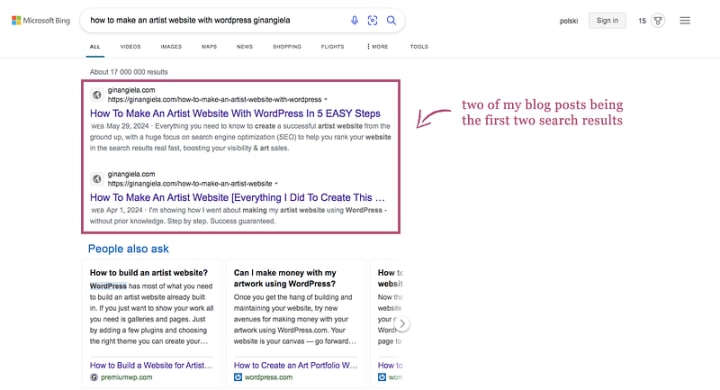
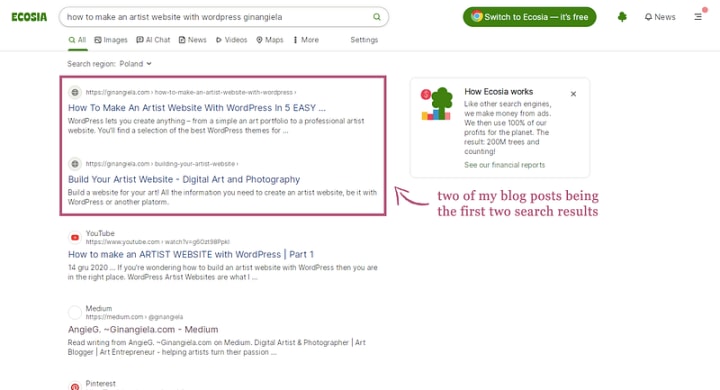
That's what you would expect in the search engine results pages in response to that query, right?
Well, not so on Google:
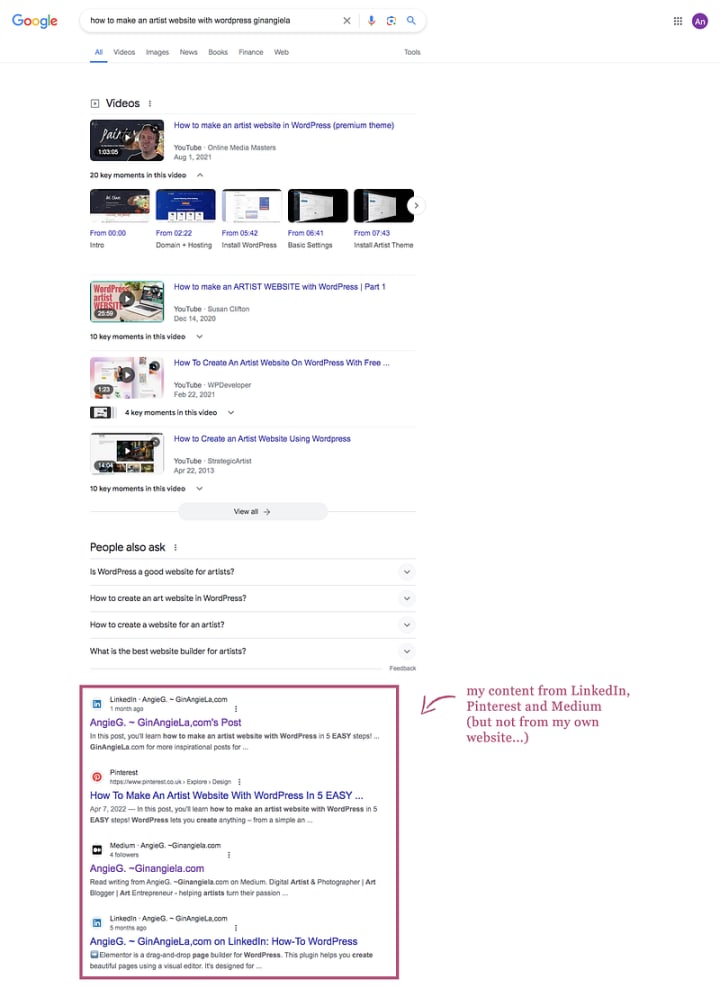
Even though I typed in pretty much the exact title of my blog post along with my domain name, the page doesn't appear in the search - at all!
All you get is a couple of YouTube videos plus some links to other platforms that I use, i.e. LinkedIn, Pinterest, and Medium.
As I showed you in the screenshot above, my post on How To Make An Artist Website In 5 EASY Steps is indexed, my entire website as such is indexed -- however, you don't see a trace of it in the SERPs!
Let me say that again: I'm searching for a very specific post on Google, I'm typing in the exact title along with the domain name, and despite the page being indexed - I don't find the desired page in Google's search results.
Now, you can tell me: how well is Google's search actually working?
You find the page in every other search engine, only the market leader that prides itself on having improved its search results so much with its recent core update doesn't show the most relevant search result to a given query.
How do you rate the quality of those search results on a scale from 1 to 10?
In my opinion, it's zero.
Now, here comes the one-million-dollar question:
If you believe that you've created really helpful quality content and it doesn't show up in Google's search anymore, how much helpful quality content will Google return when you're searching the web to solve a problem?
You see. Probably not so much either.
Something's definitely going wrong here.
This shouldn't happen. Especially not with the world-leading search engine - that wants to stay the world leader in the search engine market.
That being said, it's not only a sign of low quality. But it's also a severe violation of good practices, the way I see it, because, as the market-leading search engine, Google holds an immense responsibility. How many website owners have been losing half or maybe even all of their income from one day to the other because their website doesn't show up in the search anymore - for no obvious reason?
But things are getting even more weird.
While Google's Text Search doesn't list any of my pages when I'm looking to make an artist website with WordPress, you find even more of my articles in the Image Search - both from my own website as well as from LinkedIn and Medium.
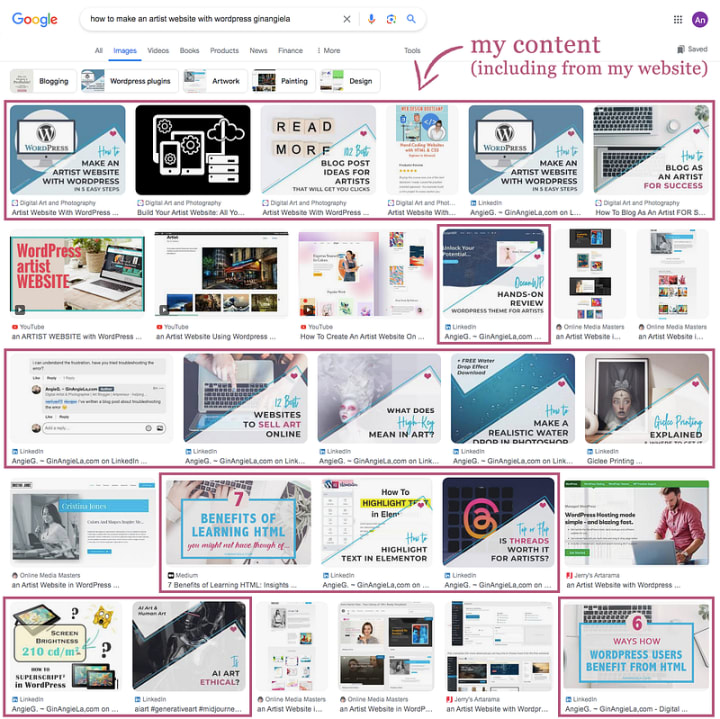
Mmh…
Does anyone still want to make me believe that everything's working well with Google's March 2024 core update?
In my view, things have never been as bad - not after the Google's August 2022 helpful content update, not after Google's revised E-E-A-T quality guidelines… NEVER.
Well, so it is and there's nothing much we, as website owners, can do about it. The most important thing to take home thus far is that Google Search doesn't work as well anymore as it used to.
But I'm here to help, and the main purpose of this article is to give you hands-on strategies on how to deal with the Google March 2024 core update. No need to stress out. There are still so many things you can do to get your website going.
So, let's get into it!
4 Strategies To Deal With The Google March 2024 Core Update - Relaxed & Easy 😉
1. Change the search engine.
Google has established itself as the market-leading search engine and is the default search engine of the Chrome browser and many other browsers.
We're all used to seeing the red-green-blue-yellow G in the address bar when we're trying to find answers on the web.
However, since Google's search results have gotten so poor that you can be sure to not get the most helpful and relevant information in return to a given query, it may be time to change your default search engine.
In a recent Medium article, I already mentioned that the search results of other search engines are often more precise than Google's.
But you also have to look at it this way: if you're a website owner and you've been working really hard to create the most helpful content for your readers for the past ten years and now Google has simply banned your pages from its Search for no reason - why would you continue to support that search engine?
Instead, do support the search engines that support you.
I, for example, have set my default search engine to Yandex.com.
Google has long held the status of "too big to fail." However, the more people are realizing that they don't get the same quality results as they used to, the more users will turn to other search engines. And rightly so.
2. Use other platforms to drive organic traffic to your website.
It's never a good idea to rely on just one source to drive traffic to your website.
Google updates are nothing new, and we're likely to see more algorithmic changes in the future. Since the latest update turned out to be so bad, we have to expect the worst for future updates.
But even if Google's search should get better again, we cannot just rely on search engines to get visitors to our website.
That's why I recommend to actively use social media and sites like Medium to send readers over to your own website.
You can promote your site on Instagram, Facebook, Twitter, Pinterest, and LinkedIn - depending on what works best for your niche.
I have a couple of posts on my site on how to leverage social media for creatives, if you're interested:
- 15 Must-Know Tips For Artists Using Pinterest To Promote Their Artwork
- 7 DOs To Post Your Art On Facebook & Grow Your Artist FB Page
- 10 DOs & DON'Ts For Artists Posting Art On Instagram
- How To Upload Digital Art To Instagram & Make It Look Good
You can also find more tips here in my Medium article on how to get traffic to a new blog.
3. Focus your SEO efforts not only on Google, but also on other search engines.
Google is (still) the biggest search engine in the market, but it's definitely not the only one.
I know that most, if not all, SEO optimization tools (and experts) mostly focus on Google rankings.
However, you should keep in mind that Google is not the only search engine that can drive organic traffic to your website.
Whenever I check my analytics, I'm astonished to see how much traffic I'm getting from Bing, DuckDuckGo, Yahoo, Ecosia, Yandex, AOL, and others.
Plus, I also discover search engines that I've never heard of before. Oceanhero.today, for example, is one of those search engines that I had no idea it exists. They appear to have a similar approach as Ecosia.org.
Instead of using its profit to support the planting of trees, like Ecosia does (which is also the most privacy-friendly search engine), Oceanhero fights against ocean pollution.
Those would be great choices for default search engine as well, right?
4. Create people-first content and use SEO the right way.
No, SEO is not dead. SEO is still a thing to rank your website in the search- - even in 2024.
Creating people-first content and using SEO the right way is also the best strategy to recover from the Google March 2024 core update.
Creating visibility for your website is simply not possible without applying any search engine optimization strategies. No search engine will be able to pick up your content, if you don't include any relevant keywords.
Not even Google will be able to, even though they like to emphasize that they prioritize content that is not primarily created with search engines in mind.
And that's exactly what you should be doing: write content for people, not for search engines. But use SEO in a reasonable and effective way.
Basically speaking, SEO consists of three pillars:
- Technical SEO
- Site Structure SEO (Architecture)
- On-Page SEO (Content)
If you manage to implement those three types of optimization in your blog/website, you have amazing chances of ranking your website in the search results - even in 2024.
If you need some help in getting your website on point, I have a great guide that explains everything in detail, from setting up a website, starting a blog, optimizing your blog for all three types of SEO, attracting organic traffic, monetizing your site, and much much more!

Alternatively, you can also book my One-On-One Website Consulting For Creatives, which is still free at the moment. So, if you got hit by the Google March 2024 core update or if you just want to know what you can do to optimize your site for ranking in the search, apply here and maybe we'll see very soon. I'll be happy to help.

What are your experiences with the Google March 2024 core update? Did it impact your website? Let me know in the comments. I'd love to hear from you! ♥
If you'd like to stay up-to-date with new blog posts of mine, feel free to sign up for my newsletter here.
See you on the next post!
Cheers, Angie
About the Creator
GinAngieLa
Digital Artist & Photographer | Art Blogger | Art Entrepreneur - helping artists turn their passion into profit & find their authentic voice.
Keep reading
More stories from writers in Writers and other communities.
The Path to Salvation
The late autumn evening air filled the monk's lungs, but it wasn't the season that chilled his bones. The heavy-handed presence of evil he had sensed upon entering the woods surrounding this mountain village had not bothered to conceal itself from him.
By Made in DNA7 days ago in Fiction




Comments
There are no comments for this story
Be the first to respond and start the conversation.