
How to create a prompt for story
A step-by-step guide to crafting creative prompts that spark unforgettable stories


How to Create a Prompt for a Story
It was a rainy Saturday morning when Arjun sat down at his desk, fingers hovering over the keyboard. The cursor blinked back at him like a silent dare.
He wanted to write a story—needed to, actually. His creative writing club had set a challenge for the weekend: “Write a short story using a self-made prompt.”
But where did a prompt even come from?
Arjun sighed. It was one thing to respond to a writing prompt. It was something else entirely to create one—something good enough to spark a real story.
He leaned back in his chair, cracked his knuckles, and muttered to himself, “Okay. How do I create a prompt?”
And that’s where his journey began.
Step 1: Understand What a Prompt Really Is
Arjun realized that before he could write a prompt, he had to know what it meant. A writing prompt wasn’t just a topic. It was a seed—something designed to spark ideas, characters, settings, conflicts. A good prompt wasn't restrictive; it was a doorway into possibility.
He pulled out his notebook and wrote down:
“A good prompt = a question, scenario, or phrase that activates imagination.”
Step 2: Choose a Focus
He knew prompts could focus on different elements. Some were about characters, others about settings, themes, or conflicts. Some were even random first lines.
He decided to brainstorm a few categories:
Character-focused: “A child who can hear people’s thoughts… but only when they’re lying.”
Setting-focused: “A town where it hasn’t rained in 10 years—until today.”
Conflict-focused: “You wake up with a note in your hand. It’s written by you… from the future.”
Theme-based: “A story about trust broken and rebuilt.”
First line prompts: “The music stopped the moment she entered the room.”
Just like that, he had five mini-prompts. And suddenly, ideas were beginning to swirl in his head.
Step 3: Add a Twist
Arjun had learned from his favorite authors that the best stories often start with a what if—a twist that defies the ordinary.
He asked himself:
“How can I make this prompt unexpected?”
He looked at the character-focused prompt he’d written earlier. The one about the child who could hear lies. Then he added a twist:
“A child who can hear people’s thoughts—but only when they’re lying. One day, they hear their mother’s voice in their head.”
That small change gave it emotional weight. It wasn’t just a cool ability—it was personal. It was a story waiting to unfold.
Step 4: Keep It Open-Ended
As tempting as it was to create detailed scenarios, Arjun reminded himself that a good prompt should inspire, not dictate.
“Too much detail kills the creative spark,” he noted.
So he practiced trimming his prompts—keeping just enough intrigue without closing off the possibilities.
He revised one:
From:
“A teenager wakes up in a parallel universe where their best friend is their worst enemy and their dog can talk.”
To:
“You wake up in a parallel universe—everything is the same, except for one thing that changes your life.”
That way, anyone could use it. It became a prompt not just for his story, but for any writer’s imagination.
Step 5: Test It
Finally, Arjun picked his favorite prompt and asked himself the most important question:
“Do I want to write this story?”
He settled on this one:
“Every night, you dream of a strange city. One day, you see it in real life.”
It gave him chills.
“Yep,” he said, already pulling up a blank document. “This one’s the one.”
And that night, he wrote. The story that poured out of him was filled with misty alleyways, forgotten memories, and a city that knew his character better than she knew herself.
Arjun’s Rules for Creating a Good Prompt
By the time he shared his story with the writing club, Arjun had learned a few things. He even shared a list—his personal rules for crafting story prompts:
Start with a question or "what if" scenario.
What if the moon disappeared one day and no one noticed?
Keep it open-ended.
Leave space for the writer to imagine the “why” and “how.”
Use emotion or mystery.
Prompts that spark curiosity or emotional resonance lead to better stories.
Test it on yourself.
If you want to write it, chances are someone else will too.
Don’t overthink it.
Sometimes the best prompts are the simplest ones.
Arjun didn’t just write a story that weekend. He learned how to begin—not just for himself, but for others.
Because sometimes, the hardest part of writing isn’t the ending. It’s the first spark.
And if you know how to make that spark, you’ll never run out of stories to tell.
About the Creator
Huzaifa Dzine
Hello!
my name is Huzaifa
I am student
I am working on laptop designing, video editing and writing a story.
I am very hard working on create a story every one support me pleas request you.
Thank you for supporting.
Reader insights
Outstanding
Excellent work. Looking forward to reading more!
Top insight
Eye opening
Niche topic & fresh perspectives
Keep reading
More stories from Huzaifa Dzine and writers in Writers and other communities.
how to create a story on vocal media
How to Create a Story on Vocal Media When Maya stumbled across Vocal Media late one evening, she was searching for something more than just another blogging site. She had always loved to write—little poems in the margins of her notebooks, diary entries full of drama and dreams, short stories she never dared to show anyone. But publishing? That had always seemed out of reach. Vocal Media felt different. It looked sleek, organized, and filled with diverse voices from around the world. That night, she decided: I'm going to write my first story.
By Huzaifa Dzine8 months ago in Writers
Unofficial Challenge: Black History Celebration
Forward: February 28th, 10:53 PM, EST... The final hour of Black History Month, 2026. Hello fellow writers. I've had this challenge waiting in my drafts for most of the month. But I held off on publishing it, until now.
By Sam Spinelli3 days ago in Writers
A Historic Declaration
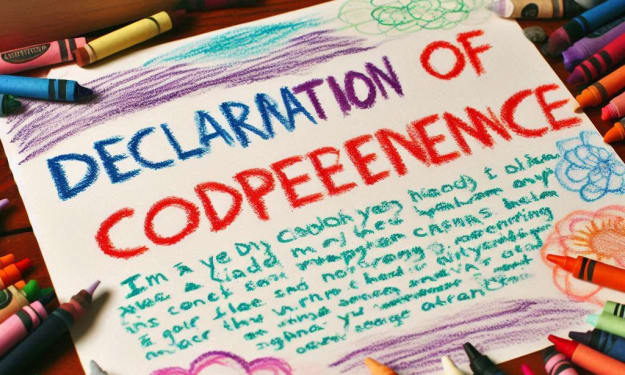
We the People of the Husbands of the United States of America, in Order to form a more perfect Union, and I mean you...with me...establish Justice, insure domestic Tranquility, provide for the common defence, promote the general Welfare, and secure the Blessings of Liberty to ourselves, after Puberty, do ordain and establish this Declaration of Co-Dependence.
By Gerard DiLeo6 days ago in Humans


Comments (2)
Very nice story 🎈🎈🎈
Loved how this breaks down the magic behind a great prompt—simple, inspiring, and super practical!