
How Product Intelligence and AI Are Transforming eCommerce Data Analytics in 2026
Learn how product intelligence, AI web scraping, and eCommerce data analytics help brands analyze markets, train AI models, and drive smarter decisions in 2026.


eCommerce leaders are no longer competing on price alone.
They’re competing on who understands the market faster, deeper, and more accurately.
In 2026, winning brands rely on product intelligence, eCommerce data analytics, and AI-powered web scraping to uncover insights that were invisible just a few years ago. Static reports, delayed dashboards, and intuition-based decisions simply can’t keep up with real-time competition.
This blog explains how AI-driven data collection and analytics are reshaping eCommerce strategy—and how businesses are turning raw product data into revenue-driving intelligence.
Why Traditional eCommerce Analytics Is No Longer Enough
Most eCommerce businesses already track sales, traffic, and conversions. Yet many still struggle with:
- Sudden price undercutting by competitors
- Stockouts despite strong demand signals
- Poor product positioning in crowded marketplaces
- Delayed reactions to market changes
The reason? Traditional analytics only shows what happened inside your store—not what’s happening across the market.
To compete effectively, businesses need external visibility, not just internal metrics.
Product Intelligence: The Foundation of Competitive Advantage
Product intelligence goes beyond basic SKU tracking. It provides a holistic view of how products perform across competitors, marketplaces, and regions.
With strong product intelligence, businesses can analyze:
- Competitor pricing and discount strategies
- Product availability and assortment gaps
- Feature and specification differences
- Marketplace positioning and ranking signals
- Demand and seasonality trends
By leveraging product intelligence, decision-makers gain clarity on why products win or lose—not just how they perform.
This insight enables smarter pricing, better assortment planning, and faster go-to-market decisions.
Turning Product Signals Into eCommerce Data Analytics
Data becomes valuable only when it’s analyzed, connected, and contextualized.
That’s where eCommerce data analytics plays a critical role. Instead of isolated reports, analytics platforms combine product intelligence with sales, inventory, and marketing data to reveal actionable patterns.
With advanced eCommerce data analytics, businesses can:
- Identify high-margin products and loss leaders
- Understand price elasticity across categories
- Optimize inventory based on demand signals
- Measure the impact of competitor actions
- Improve forecasting accuracy
The result is a unified view of the eCommerce ecosystem—connecting market behavior directly to revenue outcomes.
Why Artificial Intelligence Web Scraping Powers Modern Analytics
Manual data collection can’t scale in today’s dynamic eCommerce environment. Prices change daily. Listings update hourly. Competitors move fast.
This is where artificial intelligence web scraping becomes essential.
AI-driven scraping systems can:
- Adapt to dynamic websites and marketplaces
- Extract structured data from complex layouts
- Detect anomalies and data inconsistencies
- Scale across thousands of products and sources
- Deliver clean, analytics-ready datasets
By using artificial intelligence web scraping, businesses move from delayed snapshots to real-time market intelligence—without manual intervention.
This automation ensures analytics teams always work with fresh, reliable data.
AI Training Datasets: Fueling Smarter Models and Predictions
Analytics is evolving rapidly—from descriptive dashboards to predictive and prescriptive intelligence. At the core of this evolution are AI training datasets.
High-quality AI training datasets allow models to:
- Predict pricing trends
- Forecast demand fluctuations
- Identify winning product attributes
- Detect early signs of market disruption
- Optimize decision-making at scale
When built from real-world, scraped market data, AI training datasets ensure AI models learn from actual customer and competitor behavior, not assumptions.
This dramatically improves accuracy, relevance, and business impact.
How These Capabilities Work Together in Practice
The real power emerges when these elements operate as a unified system:
- Artificial intelligence web scraping collects live product and market data
- Product intelligence transforms raw data into competitive insights
- eCommerce data analytics connects insights to performance and revenue
- AI training datasets enable predictive and automated decision-making
Together, they create a feedback loop that continuously improves strategy, execution, and outcomes.
This is how data-driven eCommerce leaders stay ahead—while others react too late.
Business Outcomes That Matter to Leadership
For CXOs and decision-makers, the value is clear:
- Faster response to competitor pricing moves
- Improved margin control and profitability
- Reduced inventory risk and stockouts
- Better product launches and assortment planning
- Scalable intelligence without operational overhead
Instead of relying on fragmented tools, businesses gain a single source of truth for market and product intelligence.
Final Thoughts: From Data Collection to Market Leadership
In 2026, eCommerce success is defined by who understands the market first—and acts fastest.
By combining product intelligence, eCommerce data analytics, AI-powered web scraping, and AI training datasets, businesses transform raw data into a strategic asset that drives growth, resilience, and competitive dominance.
If your analytics still looks backward, it’s time to build a system that sees the market as it moves.
About the Creator
Keep reading
More stories from Retail Gators and writers in Writers and other communities.
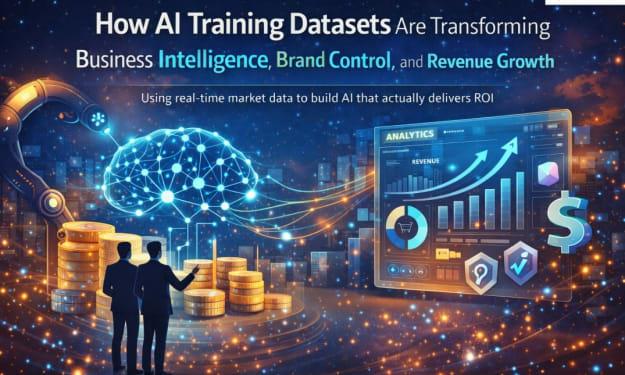
How AI Training Datasets Are Transforming Business Intelligence, Brand Control, and Revenue Growth
Artificial intelligence is no longer a differentiator—it’s a baseline. What separates high-growth companies from average performers in 2026 is how well their AI is trained.
By Retail Gatorsa day ago in Writers
Uneasy
The flickering lights seemed to bounce my legs up and down. I was feeling uneasy in this room full of old magazines and a wall that seemed to have seen generations of people. There was no smell that was distinct but the queazy feeling went up to my nose and for some reason queasiness smells like the icy cold air in the morning. Everyone around me was on their phones but my mind was too busy to be looking at mine. I wore a formal outfit and I thought this kind of outfit would make me feel more confident but instead, it made me feel less than. I tried to enlarge myself in my head but it felt like trying to stretch out a rock - it was impossible. I tried deep breathing but I felt like for every anxiety I breathed out, the more anxiety I breathed in. Then someone walked in and called my name. It was now time for my job interview.
By Marianne Leeabout 11 hours ago in Writers
🅼🅸🅳🅽🅸🅶🅷🆃 🆂🅽🅰🅲🅺🆂
"It's 10 in Tuscon! We all know what that means... It's Time for Midnight Snacks with your man, Gerald Gee! Ready to spend the night together? Me too! I'm full of snacks and can't wait to regurgitate them all back into your hungry ears. Crack a brew! Pop some corn! Anything to get ready for one hell of a show where the talk maybe cheap but the words cut deep...
By Lamar Wiggins7 days ago in Fiction



Comments
There are no comments for this story
Be the first to respond and start the conversation.