
How Haskell and Elm Enhance Software Reliability Through Functional Programming
Boost Software Reliability with Haskell and Elm Functional Programming


Software reliability is a top priority for businesses in today's fast-paced digital era. One bug or system crash can lead to financial losses, security breaches, or damaged customer confidence. That is why companies are increasingly searching for such technologies that provide consistent performance, less error, and long-term maintainability.
Functional programming is gaining ground as an effective methodology for developing robust software. Functional programming differs from conventional programming methodologies because it removes typical causes of software malfunction, including volatile state transformations and runtime bugs. Two of the most widely used functional programming languages, Haskell and Elm, can be game-changers for companies wanting to develop stable, high-quality software.
Understanding Functional Programming
Functional programming is a programming paradigm that tries to generate deterministic, bug-free code by computing expressions as mathematical functions. Unlike the usual imperative programming model based on mutation of state and mutable state, functional programming revolves around immutability and pure functions. The paradigm avoids most common software bugs and makes programs more reliable, scalable, and maintainable.
Most leading organizations use functional programming because it reduces unexpected behavior, security loopholes, and time spent on maintenance. Haskell and Elm are among the most widely used languages in functional programming, and they have strong tools for backend and frontend development. Organizations prioritizing software stability and performance increasingly use functional programming to create high-quality applications with less downtime and long-lasting effectiveness. Partnering with a software development company in the USA specializing in functional programming can help organizations leverage these technologies to build durable, high-quality applications.
Why Businesses Need Software Reliability
Buggy software doesn't pay. Research indicates that software failures cost businesses as much as $1.7 trillion a year in downtime, lost productivity, and security risk. Crashes, security vulnerabilities, and maintenance hell are the result of badly written or volatile code. All of these can slow down business growth and raise operational costs.
A sound investment in dependable and fault-free solutions is imperative for companies that rely on software to process transactions, automate operations, or engage customers. This is where functional programming, and more importantly, Haskell and Elm, come into the picture.
How Haskell Provides Solid Backends
Haskell is extensively employed in sectors where reliability is not an option, including finance, healthcare, and cybersecurity. Facebook, Standard Chartered, and GitHub are some of the companies that employ Haskell to develop software that needs to operate flawlessly under heavy usage.
Here's why companies rely on Haskell:
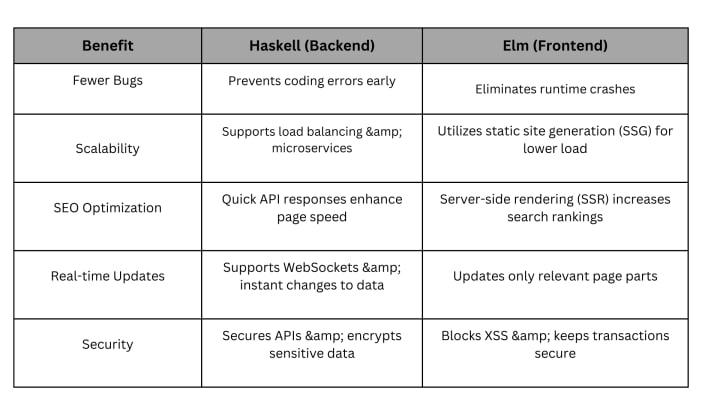
- Less Bugs & Errors: Haskell's architecture avoids typical coding errors, limiting the number of bugs that reach production.
- Predictable Performance: The data handling of Haskell guarantees stability and predictability, even at high scales and in the complexities of systems.
- Lower Maintenance Costs: Since many bugs are caught by Haskell even before the software runs, companies are saved from debugging and maintenance costs in the long run.
- Scalability & Efficiency: Haskell is built for big workloads without any performance bottlenecks, making it a great choice for expanding businesses.
How Elm Improves Frontend Reliability
Elm is created for crafting web applications that are error-free and perform well, and so it is an excellent option for web-based software companies. Organizations that implement Elm have a zero runtime error rate, which translates into fewer crashes, more seamless user experiences, and less bug-fix time.
Why companies adopt Elm for frontend development:
- No Crashes or Unhandled Errors: Elm's framework ensures that the software does not crash as a result of unforeseen problems and that user interactions remain smooth.
- Consistent User Experience: A consistent front end guarantees users a seamless, frustration-free experience, increasing customer satisfaction.
- Faster Development & Updates: Elm's design simplifies adding new features without breaking existing functionality.
- Reduced Downtime: Web apps developed with Elm have fewer problems, i.e., less lost revenue due to downtime.
The Business Benefits of Haskell and Elm
Why Companies Should Consider Functional Programming
If your company is based on software that must be secure, scalable, and reliable, functional programming languages such as Haskell and Elm can provide you with a sustainable business advantage. Companies that switch to functional programming typically experience the following:
- Faster time-to-market due to fewer bugs that interrupt development.
- Enhanced security because weaknesses are identified sooner in the process.
- Improved customer loyalty through a simpler and more predictable user experience.
- Lowered operating expenses since the software needs less repair and maintenance.
Conclusion
For businesses wanting to create stable, efficient, and scalable software, Haskell and Elm are great options. Haskell offers a strong backend that avoids catastrophic errors, and Elm provides a smooth frontend experience without crashes. Both are a strong combination that minimizes software failures, saves money, and earns customer trust.
If your business needs an future-proof, stable software solution, then today is the time to look at Haskell and Elm with functional programming. Spending money on superior technology today equates to fewer headaches and more success in the future.
About the Creator
Kiran Moda
Passionate Techwriter: I love to empower business leaders with technological innovations. Let's explore the technical world, from software development to AI.
Keep reading
More stories from Kiran Moda and writers in Writers and other communities.
How to Measure the Success of Your Software Development Projects in 2025
With companies depending more and more on their software to grow and compete, measuring the success of software development projects is more crucial than ever before. The output of such projects-whether a mobile app, a custom business solution, or a cloud platform has a tremendous impact on the company's productivity, customer satisfaction, and ultimate success. Not by 2025, but simply whether a project was on time and to budget is no longer good enough; we need far more holistic measures of success that embrace this full spectrum of factors that affect the long-term outcomes of a business.
By Kiran Modaabout a year ago in Education
Unofficial Challenge: Black History Celebration
Forward: February 28th, 10:53 PM, EST... The final hour of Black History Month, 2026. Hello fellow writers. I've had this challenge waiting in my drafts for most of the month. But I held off on publishing it, until now.
By Sam Spinelli5 days ago in Writers
Mark Twain: The Man Who Lived, Laughed, and Witnessed America’s Transformations
Have you ever wondered what it was like to grow up along the Mississippi River during a time when America was transforming faster than anyone could imagine? Meet Samuel Clemens, better known as Mark Twain—a boy from a small Missouri town who rose from modest beginnings to become one of the greatest storytellers the world has ever known. Twain didn’t just write stories; he captured the soul of a nation, observing both its humor and its heartbreak with a sharp, unforgettable voice.
By Haroon Pasha7 days ago in Writers




Comments
There are no comments for this story
Be the first to respond and start the conversation.