
"Faith written in Sumaiya's blood"
“সুমাইয়ার রক্তে লেখা ঈমান”

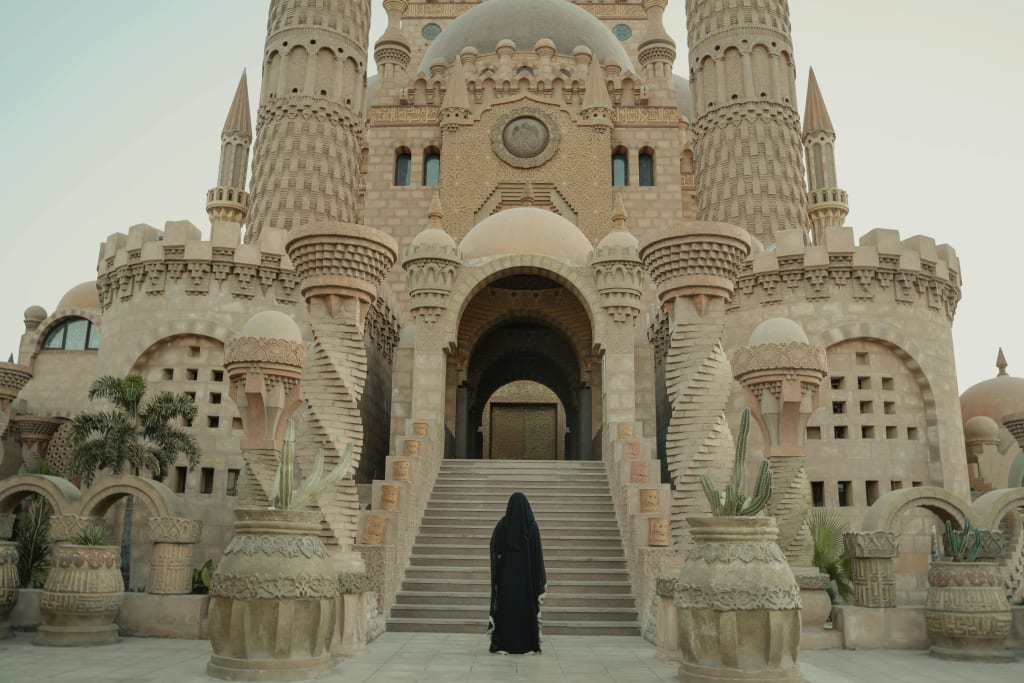
The evening light had faded in the streets of Mecca. There was dust and silence in the air. But an elderly woman was standing huddled against the wall of a house—something greater than fear in her eyes—indignation, protest, and the glow of faith. Her name was Sumaiya bint Khayyat, the first female martyr in the history of Islam.
Sumaiya was not a poetic name, nor a member of a ruling family, nor the wife of a rich man. She was a slave. Her husband, Yasir, was also a marginal Meccan, a migrant from another tribe. Their home was lit by a son—Ammar. The three of them lived together in a corner of Mecca, quietly, silently.
But everything changed when this family touched the light of Islam.
When Muhammad ibn Abdullah, the Messenger of Allah, stood up with the declaration of monotheism, the sky of Mecca seemed to be torn apart by lightning. The powerful Quraysh were furious. But the light of Islam did not go out. Rather, it spread to one house after another. Even the slaves began to taste the faith.
Sumayyah was one of them.
She, her husband Yasir, and their son Ammar secretly embraced Islam. For them, it was a silent victory. They would pray at night, memorize verses from the Quran. When the Messenger of Allah would tell them, “Be patient, O family of Yasir, Paradise is your destination,” their eyes would light up with tears and hope.
But that light would become the greatest test for them.
One day, the Quraysh leaders, led by Abu Jahl, brought this family to the courtyard of the Kaaba. They wanted to uproot this seed of faith. Abu Jahl said, “Abandon the religion of Muhammad. Say, Al-Lat, Al-Uzza is our mother.”
They remained silent. They did not turn their faces once.
Then the brutality began.
They were left on hot sand, beaten with iron rods, and stones were pressed against their chests. Yasir fell ill. But she never uttered a single word—"I have abandoned my faith."
Sumaiya was about seventy at the time. Physically weak, but unwavering in her spiritual strength. One day, Abu Jahl stood in front of her and shouted again—"Old woman, tell me, Muhammad is a liar!"
Sumaiya looked at her and said, "You are a liar. Muhammad is the Messenger of Allah. I believe that Allah is one and has no partner."
Abu Jahl went mad at these words. He picked up his spear and pierced Sumaiya's body. She lay in the midst of flowing blood, but her lips trembled—"La ilaha illallah."
She was the first female martyr of Islam.
A woman, a slave, but her position was at the pinnacle of history. Her blood did not just mix with the sand, it mixed with the poetry of faith. His sacrifice made Muhammad (peace be upon him) weep.
When the Messenger of Allah (peace be upon him) heard the news of this murder, his eyes filled with tears. He said, “O family of Yasir, be patient. Paradise awaits you.”
Ammar, their son, once said with his mouth, “I am not the Messenger of Allah.” His heart was weeping, but his tongue was under the pressure of the enemy. Then he came before the Messenger of Allah and broke down. “O Messenger of Allah! I have disbelieved with my mouth, but in my heart I believe in you!”
The Messenger of Allah embraced him and said, “If your heart is full of faith, then even if you say it with your mouth, Allah will forgive you.” This verse was revealed at that time:
“Whoever disbelieves after his faith... but whoever disbelieves under compulsion, while his heart is full of faith, there is no blame on him.”
(Surah An-Nahl, verse 106)
Sumaiya’s death may have been the first woman’s statement of monotheism against injustice. She was not a leader of a nation, a commander, or an intellectual. But she was the soul whose radiance never goes out.
She has proven that true sacrifice in the path of Allah does not require lineage, wealth, or title—only faith.
About the Creator
Keep reading
More stories from Abdul Barik and writers in Writers and other communities.
It is almost impossible for any human creation to say.
A verse from Surah At-Tariq that carries an exceptional scientific hint at the mystery of human creation. In verses 5 to 7 of Surah At-Tariq, Allah says: “Let man consider what he is created from. He is created from a flowing water, which comes forth from between the back and the front.” The key words used in Arabic are “ماءٍ دافقٍ” (flowing water) and “الصُّّْبِ وَالتََّائِبِ” (from between the loins and the sternum). A scientific analysis of this verse takes us to an astonishing level of human reproductive biology that is almost impossible for any human writing from 1400 years ago.
By Abdul Barik8 months ago in Writers
Where Dreams Loved Me Back
chapter 1 Chapter One: The Quiet I Learned to Carry Matthew’s perspective, I don’t remember when life started feeling heavy. It wasn’t sudden — it was gradual, like carrying a bag that someone kept adding weight to until one day I realized I couldn’t put it down anymore.
By Anshu Giri3 days ago in Writers



Comments
There are no comments for this story
Be the first to respond and start the conversation.