
Facebook: from social platform to digital gulag
The farce of censorship and total control over authentic voices

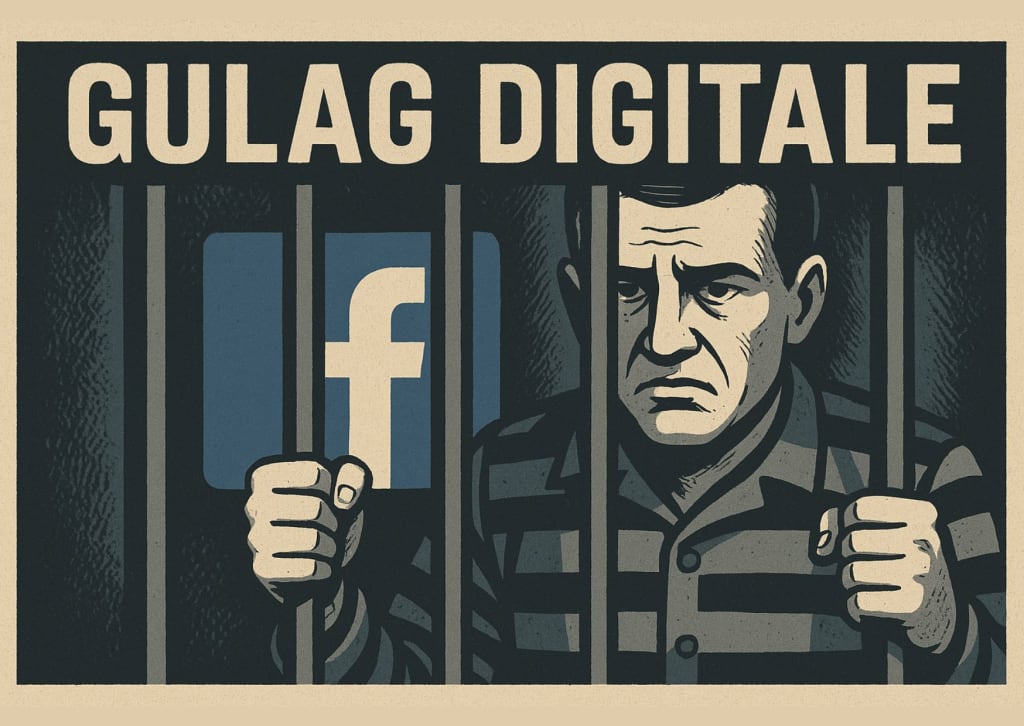
When Facebook was launched, its mission was clear: to allow people to connect, share thoughts, and stay in touch with friends and family. What started as a simple tool to build a social network among acquaintances is now something completely different. The platform that once promoted freedom of expression and personal connection has become, for many, a kind of "digital gulag", where every move can be a potential mistake with devastating consequences.
Censorship and inconsistent rules: user protection is only apparent
Over the years, Facebook has implemented numerous censorship policies, many of which have been confusing and inconsistent. In the past, users could be reported for anything, and the content would be immediately blocked "for investigation", but it was rarely restored, with no adequate explanations provided. The feeling was that any mistake, even an unintentional one, was enough to penalize users, while transparency and fairness were decidedly lacking.
Another significant change was the introduction of the name verification. Facebook required that the name be "real" and prohibited the use of fictional names or professional names, like "Gaia Deejay," even threatening to delete the account. However, today this rule has been removed, and users can now call themselves whatever they want, even impersonating famous people. For example, there are more than 100 fake accounts of Woo Do Hwan, a South Korean actor, created by users who pretend to be him to ask for donations on his behalf, exploiting his fame. The most incredible part? Facebook has removed the ability to report these fake accounts, leaving users vulnerable and allowing this type of deception to flourish unchecked.
In this context, Facebook's censorship seems more like a protection of corporate interests than a real measure to safeguard users. While genuine voices continue to be suppressed, the platform is either incapable or uninterested in stopping fraudulent behaviors, creating a situation of inequality and injustice.
The digital gulag: a system of control
What was once a place for sharing among friends and family has transformed into a system of control. The rules seem almost arbitrary, with sanctions and blocks that don’t always have a clear justification. Users find themselves navigating an environment where every move could be the "wrong step" that risks their entire profile, with no possibility of appeal.
In this system, freedom of expression is constantly under threat, and corrective actions are neither timely nor sufficiently clear. Any mistake seems to have serious consequences, and it doesn’t matter how much effort has been put into building an authentic presence: everything can be swept away with a simple click by an anonymous moderator.
Inconsistent support: an endless maze
To make matters worse, Facebook’s support system has become notoriously ineffective. Every attempt to resolve a problem often ends up in a maze of links that lead to more links, with no real solution in sight. No matter how much you try to resolve an issue, users are faced with an impenetrable wall. Problems remain unresolved, and responsibility is always placed on Facebook, with no opportunity for appeal. It’s as though, when something goes wrong, users are completely powerless, forced to accept the platform’s decisions without being able to change them.
Exploring more free alternatives
As the landscape changes and more people are looking for alternatives to Facebook, platforms have emerged that offer greater freedom of expression and a more equitable management of online communications. Platforms like Mastodon, Substack, Instagram, Medium, and vocal.media offer users more space to express themselves without the burden of excessive censorship, and without the risk of losing everything in a single blow. Here’s an overview of what makes each of these alternatives unique:
Mastodon: A decentralized platform that allows users to create their own instances (communities) on specific topics, reducing centralized control. Ideal for those looking for a platform with less censorship and a high degree of customization.
Substack: Great for those interested in writing and building a newsletter, with the opportunity to monetize exclusive content. Substack allows you to cultivate a loyal readership without worrying about the algorithms affecting visibility.
Instagram: While owned by Facebook, Instagram offers a visual space where illustrations, photos, and short videos can reach a large audience, with a more dynamic and creative atmosphere compared to the parent platform.
Medium: A blogging platform that allows you to write and share quality articles, with a community that values well-written content. Ideal for those focused on writing and reaching readers interested in in-depth reflections, without worrying too much about algorithmic filters.
Vocal.media: Similar to Medium, but with a greater emphasis on creating original content and the opportunity to earn money through the traffic generated by your articles. Great for those looking for a monetization opportunity without the limitations of Facebook.
These alternatives allow you to build an authentic online presence, free from the concerns of arbitrary censorship or being "banned" without explanation, as often happens on Facebook.
Conclusion: reclaiming digital freedom
In an age where digital connection is essential, it is crucial not to lose sight of the importance of freedom of expression. Facebook, while having a significant impact on our digital lives, has now lost its original essence, becoming a "digital gulag" where every move can be fatal. It’s time to explore more free alternatives where our work and ideas can be respected and protected, without the risk of being censored or losing everything in an instant.
Reclaiming digital freedom also means taking control of your online destiny, consciously choosing where and how to share your content, and rebuilding a network based on authentic connection.
#FacebookCensorship #DigitalFreedom #SocialMediaControl #OnlineCensorship #DigitalRights #FreedomOfExpression #AlternativePlatforms #SocialMediaReform #PrivacyMatters #DigitalGulag #OnlineJustice #CensorshipDebate #DigitalEquality #SocialMediaAccountability #FreedomOnline
About the Creator
Halina Piekarska (UltraBeauty Blog)
Blogger, writer, and illustrator, I share stories, reflections, and practical tips on psychology, well-being, and natural beauty. I believe that learning never stops, and I strive to enrich readers’ lives with knowledge and inspiration.
Keep reading
More stories from Halina Piekarska (UltraBeauty Blog) and writers in Writers and other communities.
The cost of procrastination
Procrastination: the habit that limits us Procrastination is more than just a habit; it’s a trap that keeps us anchored to the present without allowing us to make the leap toward our dreams. We all put things off: some wait for the right time to make a career change, some delay that long-desired trip, and some never take the time for themselves. But every time we procrastinate, we put aside our ambitions, our dreams, and in the end, we are left with the regret of never having acted.
By Halina Piekarska (UltraBeauty Blog)10 months ago in Motivation
Average Cost of 2D Animation Outsourcing Projects
Outsourcing 2D animation allows businesses to create explainer videos, ads, onboarding content, and product demos without building an in-house team. In the US market, pricing varies based on animation style, complexity, and production scope.
By Leo Johnson6 days ago in Writers


Comments (1)
This is why I don’t like Facebook! They have to much control! Great work!