
Ebony Quill & Parchment
Simply a Pen and Paper

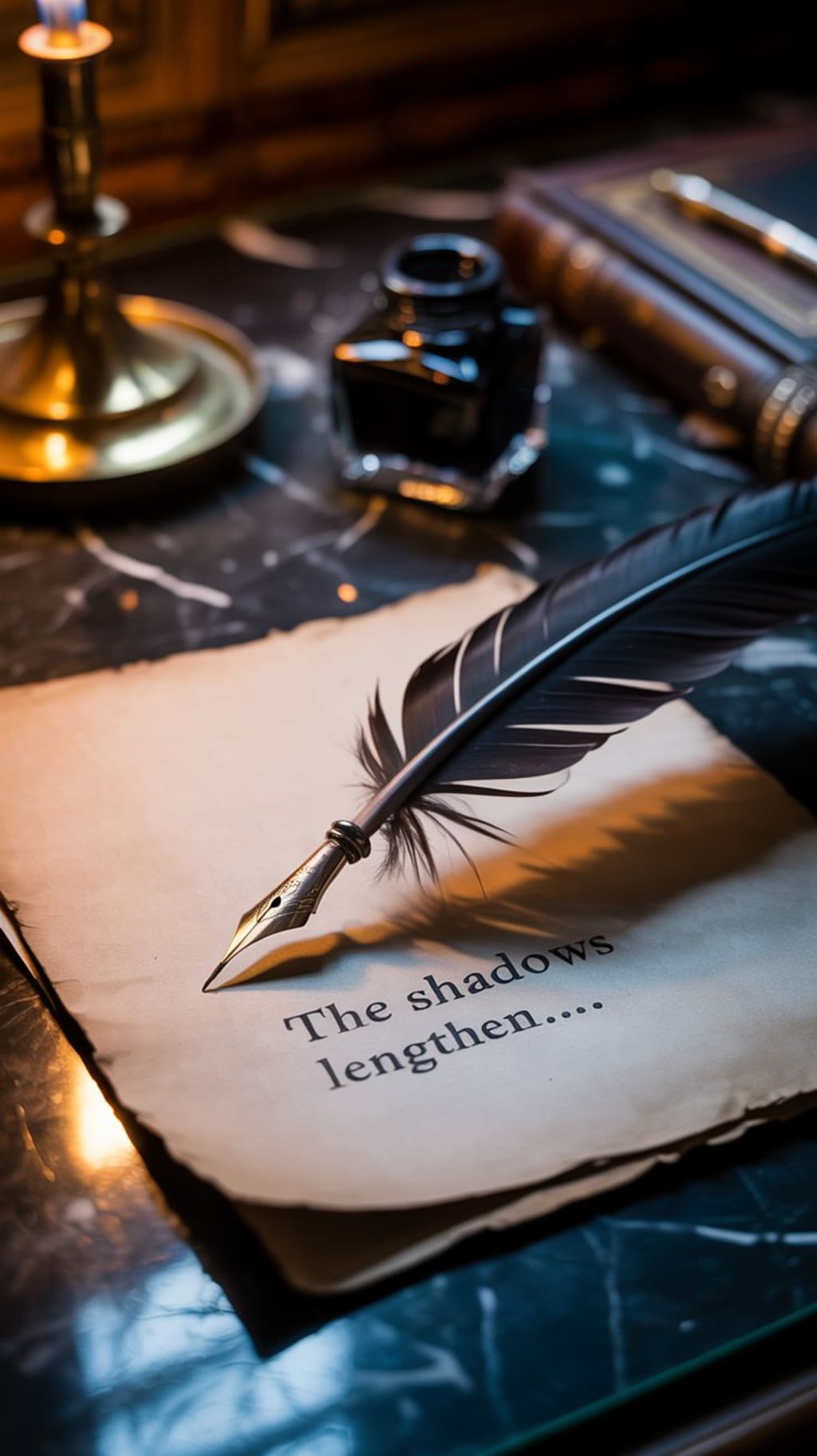
In an age of glowing screens, blinking cursors, and cloud-based documents, the simplicity of a pen touching paper feels almost revolutionary. Stripped of digital distractions, alerts, and auto-correct, the humble pairing of a writing instrument and a blank sheet stands quietly as one of the most profound tools for thought and transformation.
“Ebony Quill & Parchment” is more than just an image or phrase. It is an invitation. A return to the elemental. A celebration of the idea that everything — from love letters to revolutions — has begun with the simple act of ink meeting fiber.
The Power of the Primitive
What is it about the act of writing with a pen that feels so grounding? Unlike typing, which can feel mechanical, writing by hand is an intimate dance between mind and body. Every stroke is deliberate. Every pause has meaning. You feel the drag of the nib, the slight resistance of the paper, the pulse of thought as it travels from neuron to nerve, from muscle to page.
The ebony quill, whether imagined as a raven-feathered antique or simply a sleek black pen, represents intentionality. It is a tool without shortcuts. No delete key. No infinite undo. Writing with a quill (or any analog pen) demands presence.
Parchment, aged or new, carries the vulnerability of being marked. Once the ink soaks in, it becomes part of the page’s identity. Mistakes aren’t erased; they are acknowledged. They become footnotes in a larger story.
This is writing not for efficiency, but for meaning.
The Blank Page as a Mirror
There is a quiet power in the blank page. It doesn’t judge. It doesn’t rush. It simply waits.
A pristine sheet of parchment is both invitation and challenge. It reflects your state of mind — your fears, your desires, your hesitations. It is at once liberating and terrifying. For many, the blank page is not empty; it is too full — full of potential, of pressure, of questions about whether what we write will be good enough, honest enough, or worth remembering.
And yet, once that first line is drawn, the page becomes a companion. With every word, the paper transforms. It listens. It absorbs. It forgives. It holds space for dreams, fragments, doodles, and declarations.
Writing as Ritual
Using a pen and paper can be more than an act of creation. It can be a ritual — a sacred pause in the noise of modern life.
Think of the moments where paper holds significance: handwritten vows, the first page of a journal, a letter from someone long gone. These are moments when digital cannot compete with the tactile. The smell of paper. The smear of fresh ink. The crinkle of a folded note.
To sit with a black pen in hand, hovering above parchment, is to make a quiet promise: to speak truthfully, to explore without fear, to connect with yourself and perhaps someone else through the unspoken.
Even the most ordinary things become sacred when approached with intention. A grocery list, a note to self, a child's scribbled drawing — all of these, through the lens of pen and paper, become pieces of a life being lived and recorded.
Creative Constraints, Infinite Possibility
Paradoxically, limiting yourself to just a pen and paper can be liberating. There are no fonts to choose, no colors to tweak, no distractions from apps or browser tabs. The limitations narrow your focus and free your voice.
It’s easy to underestimate the creative clarity that emerges from such simplicity. With fewer tools, we become more inventive. Without backspace, we become more thoughtful. The physical act of writing slows us down just enough to let deeper ideas rise to the surface.
Artists often speak of the "happy accident" — the mistake that leads to something better. Writing by hand is full of those: a misspelling that becomes poetic, a crossed-out line that adds gravity, a margin doodle that sparks a new idea.
Timelessness in a Disposable Age
In a world that values speed, novelty, and digital permanence, pen and paper are defiantly slow, ephemeral, and analog. And maybe that’s the point.
Think of the letters that survived wars. The journals discovered in attics. The handwritten recipes passed down generations. These aren’t just pieces of paper — they are artifacts of presence. Proof that someone lived, loved, struggled, thought, dreamed.
Digital files can be deleted, corrupted, or forgotten in a cloud account. But ink, especially when written with care, has a strange way of surviving — of lingering in drawers, in books, in memory.
“Ebony Quill & Parchment” is, then, a nod to the timelessness of this craft. A reminder that not everything must be optimized or uploaded. Some things are better left imperfect, handmade, and human.
A Practice of Return
To write with a pen on paper is to return — to slowness, to self, to something older and wiser than the current moment. It is a rebellion against constant motion, and a return to something we all know but often forget: that the tools we need to think, to create, and to understand ourselves are already in our hands.
You don’t need a $200 productivity app to be productive. You don’t need a perfect interface to express something true. You just need what you already have — an ebony quill and a blank page.
The Last Word
This article is not a rejection of technology. It’s not nostalgia for its own sake. Rather, it’s an invitation — to rediscover the beauty in what’s simple, tactile, and enduring. To remember that great ideas don’t require flashy tools, just space, silence, and courage.
So the next time you're overwhelmed, or creatively stuck, or yearning for something real — put the phone down. Close the laptop.
Pick up your pen.
Unfold the paper.
Begin again.
About the Creator
Keep reading
More stories from Habibullah khan and writers in Writers and other communities.
What the Quiet Taught Me
There are teachers who speak in front of classrooms, with chalk and authority and raised voices that echo against the walls. And then, there are the quieter ones—those who never set out to teach but leave behind wisdom like footprints in the dust. I learned the most not from lectures or instructions, but from silent moments. From presence. From watching people live their truth without saying a word.
By Habibullah khan 10 months ago in Writers
The Future of Fixation: Exploring Advanced Maxillofacial Implants
Maxillofacial surgery has changed significantly over the last two decades. Earlier, fracture management and reconstructive procedures were more invasive, recovery was longer, and implant options were limited. Today, surgeons have access to advanced maxillofacial implants that are more precise, lighter, and biologically friendly. These developments are shaping the future of fixation in facial trauma and reconstructive surgery.
By Siora Surgicals 6 days ago in Writers




Comments
There are no comments for this story
Be the first to respond and start the conversation.