
Discovery of a Prehistoric Giant's Head the Size of a Car
Scientists have finally glimpsed the face


Solving the Evolutionary Mystery: Discovery of a Prehistoric Giant's Head the Size of a Car
Scientists have finally glimpsed the face of the largest known arthropod to ever inhabit our planet, a colossal creature resembling a millipede, thanks to the discovery of two exceptionally well-preserved fossils. This creature, known as Arthropleura, thrived during the late Paleozoic era, approximately 346 to 290 million years ago, in equatorial forests where the atmosphere was rich in oxygen. These conditions allowed these animals to grow to impressive sizes, reaching lengths of up to 2.6 meters (8.5 feet) and weighing over 45 kilograms (100 pounds).
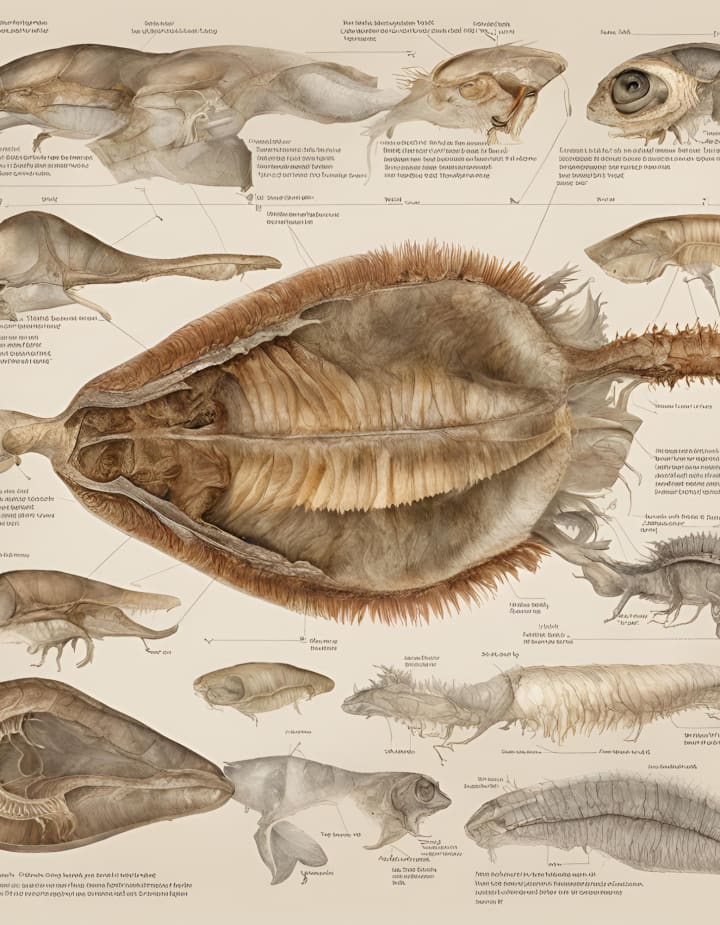
The Head Discovery: A Major Step Toward Unraveling the Mystery
According to paleontologist Mikaël Leriier, the lead author of the recent study, scientists had been unable to find a complete head of Arthropleura since its identification in the 18th century. The absence of a complete head hindered researchers' understanding of the relationship between this massive creature and contemporary arthropods such as millipedes and centipedes. However, the discovery of a complete head has finally allowed for the examination of its jaws and eyes, marking a significant advance in unraveling the mysteries surrounding this remarkable organism.
Unique Features that Make Arthropleura an Evolutionary Puzzle
CT scans of the fossils, discovered at the Montceau-les-Mines Lagerstätte site in France, revealed small jaws resembling those of modern millipedes, curved antennae, and prominent eyes on the sides of its head. This unique combination of features creates a puzzling mix of characteristics similar to both millipedes and centipedes, further complicating the evolutionary narrative of Arthropleura.
James Lamsdell, a paleontologist at West Virginia University who was not involved in the study, noted that the chimera-like nature of Arthropleura provides crucial evidence that could help answer fundamental questions about the evolution of these giant species. Despite their visual similarities, current evidence suggests that these lineages diverged around 440 million years ago, long before the appearance of Arthropleura.
A Semi-Aquatic Life? A New Hypothesis on Arthropleura’s Behavior
Historically, Arthropleura has been considered a terrestrial creature, but some recently discovered anatomical features may indicate that it could have been semi-aquatic or partially living in water, similar to certain aquatic organisms. Scientists speculate that the prominent, rounded eyes could be adaptations related to a semi-aquatic lifestyle, opening new avenues for understanding the environment in which this creature thrived.
Significance of the Discovery for Arthropod Evolution

The discovery of a complete head for Arthropleura represents a crucial advancement in resolving the evolutionary puzzle surrounding these giant arthropods. This new data allows scientists to reassess the evolutionary relationships between the massive creatures that dominated ancient ecosystems and the smaller arthropods that exist today. It reflects ongoing efforts to comprehend ancient biodiversity and the environmental changes that shaped the organisms we see today.
As research continues on this unique species, it provides fresh insights into how life evolved on Earth, contributing to our broader understanding of natural history and the development of living organisms.
About the Creator
Ali Sadeek Ahmed
Engineer-writer,( content creator, and poet )-Blogger-Youtuber
Keep reading
More stories from Ali Sadeek Ahmed and writers in Writers and other communities.
The Bag That Almost Took Everything: A True Airport Nightmare
Title: The Bag That Almost Took Everything: A True Airport Nightmare A business trip turned emotional rollercoaster when a forgotten handbag threatened to ruin a family’s long-awaited flight home. This true story reminds us how small moments—and honest people—can change everything. Joy. Tension. Panic. Relief. All in one day. All in one ride to the airport. I had been living abroad for work—far from home and family. Due to the importance of my role, I couldn’t return frequently, so the company allowed me to bring my wife and children to live with me. We built a life together in a foreign land. Once a year, we’d fly home to see our extended family. It was our ritual, our joy—until the final year. That year, the company informed me it was time to relocate to another country after our annual vacation. Everything went smoothly at first. Our belongings were shipped the day before our flight. On the morning of departure, two cars arrived at our home: – A Land Cruiser for the luggage – A Toyota sedan for my family and me. I took the front seat of the Toyota, placing my handbag under the seat—a bag that held everything: passports, money, tickets, phone. I always kept it close, especially when I wasn’t driving. At the airport, chaos took over—kids, suitcases, last-minute hugs. In a moment of distraction, I left the handbag where it was, intending to grab it after checking the luggage. But when I turned around... the Toyota was gone. No warning. No goodbye. The driver had assumed his job was over. And with him went our documents, our money—our entire ability to travel. Panic set in. My phone was in the bag, so I couldn’t call. The driver’s phone? Off. Unreachable. My heart sank. The airline would start boarding soon. The children’s excitement faded into confusion. My wife’s face tightened with anxiety. This was supposed to be a happy day—now it felt like a disaster. We called everyone we could. The company. The admin team. No one could reach him. Our time was running out. And then... like a scene from a film... The car returned. The driver stepped out, holding the handbag. “I found it when I checked the car before heading back,” he said. “I knew it had to be important.” In that instant, the fear lifted. We rushed through check-in, made it through security, and finally boarded. We flew home—shaken, grateful, changed. It’s a story we’ll never forget. Because sometimes, everything you hold dear can be left under a seat. And sometimes, the right person finds it—just in time.
By Ali Sadeek Ahmed9 months ago in Writers
The Comeback Generation: Why Starting Over After 30, 40, or 50 Is Becoming the New Path to Success
For decades, society told a simple story about success: figure out your life early, build your career fast, and lock in your future before you get “too old.” The message was subtle but powerful — if you didn’t make it in your twenties, you were somehow behind. Today, that story is breaking apart. Across the world, people in their thirties, forties, and fifties are walking away from careers, routines, and identities that no longer fit. They are starting businesses, learning new skills, moving to new cities, and chasing dreams they once believed were no longer allowed. This shift is being driven by more than just dissatisfaction. It’s being driven by clarity. With age often comes a deeper understanding of what truly matters. Many people spend their younger years chasing external approval — money, titles, or social status. But after years of experience, they begin to ask different questions. Do I enjoy my daily life? Does my work reflect my values? Am I proud of how I spend my time? For some, the answers lead to a powerful realization: staying the same feels riskier than starting over. Technology has made this kind of reinvention more possible than ever. Online courses allow people to learn new careers from their living rooms. Remote work opens doors to opportunities that were once limited by geography. Social platforms give individuals the ability to build personal brands, launch creative projects, or start businesses without massive upfront costs. What once required permission from companies, investors, or institutions can now begin with a laptop and an internet connection. But the comeback generation isn’t just about opportunity. It’s about mindset. One of the biggest barriers to starting over is fear — fear of failure, judgment, and wasted time. Many people worry that changing direction means admitting they made a mistake. But a growing number of voices are reframing that idea. They see their past not as a failure, but as training. Every job, relationship, and challenge becomes part of a skillset. Communication, resilience, problem-solving, and emotional intelligence don’t disappear when someone switches careers or goals. They carry forward, often making older beginners stronger than younger ones. There is also a quiet confidence that comes with experience. Younger people often feel pressure to prove themselves. Older beginners tend to care less about appearances and more about meaning. This shift in focus can lead to deeper commitment and greater satisfaction. Of course, starting over is not easy. It can involve financial uncertainty, uncomfortable learning curves, and moments of self-doubt. Watching younger people succeed in the same space can trigger insecurity. The question “Am I too late?” can echo loudly in the mind. But many in the comeback generation are discovering a powerful truth: there is no universal timeline for a meaningful life. Some of the most successful entrepreneurs, artists, and leaders didn’t find their true path until later years. What they often share is not youthful speed, but persistence. They kept moving forward, even when progress was slow and the outcome uncertain. There is also a cultural shift happening. Communities are becoming more supportive of non-linear life paths. Changing careers, taking breaks, and exploring new identities are becoming more accepted. The idea of having “one job for life” is being replaced by the idea of having many chapters. In this new story, life is not a straight road — it’s a landscape. Sometimes you climb. Sometimes you wander. Sometimes you stop and choose a completely new direction. And that choice, made at any age, can be an act of courage. The comeback generation isn’t trying to turn back time. They are using it — using what they’ve learned, what they’ve survived, and what they now understand about themselves. Because success is no longer being defined by how early you start. It’s being defined by how boldly you choose to continue.
By Hazrat Usman Usmana day ago in Writers




Comments (2)
Is it for real
thank you so much