
Deadliest jobs in the world
Survival of the fittest


The sulfur industry is a massive $13 billion market! But here’s the catch: the brave workers extracting it from an active volcano earn just $17 a day. Why? Because there’s a big demand for this ingredient in our sugar. In this area, that’s actually a decent wage! Look at other booming industries, and you'll spot the same trend. Whether it's collecting açaí for our smoothie bowls or harvesting table salt, people take serious risks for a paycheck in these billion-dollar sectors!

Now let’s venture to East Java, Indonesia! Hundreds of miners brave deadly smoke to dig for sulfur, also known as "devil's gold." This stuff is everywhere! It’s in matches, fireworks, detergent, paper, and batteries. Most importantly, it's what makes our sugar white! But it's no picnic inside Ijen volcano. The conditions are so extreme that many miners don’t live past 50!
Mistar, a seasoned miner. He’s been doing this for 30 years! To get to work, he rides his bike as far as it can go—then it's a tough 2-mile hike up to the crater. With only a basket and a crowbar, Mistar ventures into the 1,000-foot-deep crater. It’s blistering hot, often exceeding 100 degrees Fahrenheit, and he works near one of the world's most toxic volcanic lakes!

There’s the smoke, too. Miners are freelance contractors, so they must buy their own gear. Many can’t even afford gas masks! Instead, they make do with handkerchiefs or towels soaked in water to shield themselves from the sulfur powder.

Here’s how it works: superhot smoke meets cooler air outside, condensing into liquid that drips off pipes. As it cools and solidifies, it turns into yellow blocks of sulfur. This dual-color transformation is what earns it the name "devil's gold." Once Mistar fills his basket, he loads it onto his shoulder for the trek back. That’s roughly 154 pounds he’s carrying! Mistar himself weighs just 132 pounds!
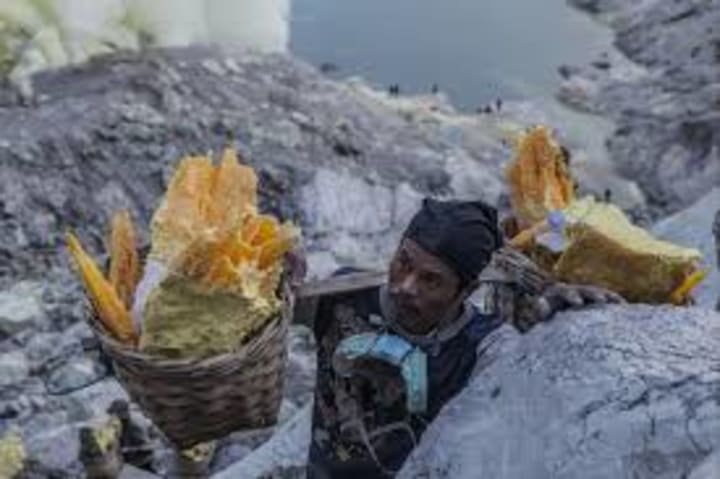
Once he reaches the crater’s edge, he transfers the sulfur to his trolley and starts the 2-mile journey back. The mining company pays miners based on weight, about 9 cents per kilo. With two loads a day, Mistar makes $17. He heads home to share dinner with his family, a mix of pride and heavy burdens on his shoulders.
Next, let’s hop over to India, one of the largest salt producers! A third of the country’s salt comes from a harsh desert, where families have been farming salt by hand for generations. The Agariyas! They arrive at the dry land of Little Rann of Kutch each October. Patadiya Ghughabhai and his wife lug whatever they need for six months: supplies for huts, clothes, tools, and all their food and water.
First, they dig 30 feet into the ground to find salty brine water. Next, they set up government-subsidized solar panels to power pumps that bring that brine to the surface. After that, they build salt pans, working hard to create expansive salt flats!
They rely on rollers to flatten the earth, making 10 to 20 pans by hand. It’s backbreaking work! Then they release the salty brine from their wells into the pans. By the last pan, the water reaches the right salinity for forming big salt crystals. As the water evaporates over months, those crystals form!
Every morning, they rake the salt before it gets too hot. But it’s tough out here. Farmers usually live to around 60. The extreme heat, acidic brine, and harsh conditions take their toll. Many Agariyas even face vision loss from years in the bright sun! Accessing medical care is often too costly because they’re far from villages.

Still, they labor until spring when the salt is ready. They harvest three times, with the first yield being the highest quality. By April, they leave with over 1,000 tons of salt! Most farmers earn around $2,000 for months of strenuous effort, well below the poverty line.
Now, let's zoom in on the Amazon rainforest! The bulk of the world’s açaí comes from here. People climb 50-foot palm trees to harvest these super berries. They’re hugely popular in the U.S., with bowls costing up to $15!

Lucas’ farm is about 70 miles from Belem, the capital of Para, where 90% of Brazil’s açaí is produced. He and his family use a simple rope to climb the trees. Today, Lucas’ son, Luis Fernando, is heading up. The trunks are thin, so lightweight climbers are a must! At the top, they swing between multiple bunches. Coming down is risky, especially with a knife in one hand!
About the Creator
Tafara Sibotshiwe
A versatile authentic writer and passionate storyteller. With a background in, Journalism, Engineering, History, Health & finance, they combine profound insight with creative flair to explore the complexities of the human experience.
Keep reading
More stories from Tafara Sibotshiwe and writers in Writers and other communities.
THE TRUTH ABOUT LONELINESS
Loneliness has serious health consequences. It can increase your risk of heart disease by 29% and stroke by 32%. This is significant and should not be overlooked. Loneliness is complex. When you lack meaningful social connections, your body recognizes your isolation. This awareness triggers your stress response.
By Tafara Sibotshiweabout a year ago in Writers
Unofficial Challenge: Black History Celebration
Forward: February 28th, 10:53 PM, EST... The final hour of Black History Month, 2026. Hello fellow writers. I've had this challenge waiting in my drafts for most of the month. But I held off on publishing it, until now.
By Sam Spinelli7 days ago in Writers
"Scream 7" (2026): Running out of Fresh Screams
This is the seventh time we’ve had a Ghostface crisis. Scream 7 is the latest edition of the Scream franchise. Sydney Prescott and her family are under attack by another anonymous killer dressed in a Ghostface costume. While having issues with her daughter, Tatum, they run from the bloody murders, trying to determine who is behind it all.
By Marielle Sabbag6 days ago in Horror




Comments
There are no comments for this story
Be the first to respond and start the conversation.